

On this page
In about 1702, a Paris experimenter who had lost most of his hearing as a teenager was working on a problem every physicist of his time shared: how do you build two thermometers that agree? Guillaume Amontons answered it with trapped air and a tube of mercury. Along the way he found the rule you now learn as the pressure law, and he hinted that cold has a floor, decades before Jacques Charles's gas experiments.
Who was Guillaume Amontons?
Amontons was born in Paris on 31 August 1663 and died there on 11 October 1705, according to his Complete Dictionary of Scientific Biography entry on Encyclopedia.com. The same entry says he became almost deaf in adolescence and turned to mechanics. You may know his name from the laws of friction he published in 1699 (Wikipedia summary).
How did Amontons discover that pressure rises with temperature?
Galileo-style thermometers let warm air expand and push liquid along a tube. Amontons turned the idea around: he kept a mass of air in a large bulb, where its volume changed little, and measured how much mercury it could hold up. An account in Evolution of the Thermometer describes the instrument as a narrow glass tube four feet long, open at the top and joined through a U-bend to a large bulb of trapped air.
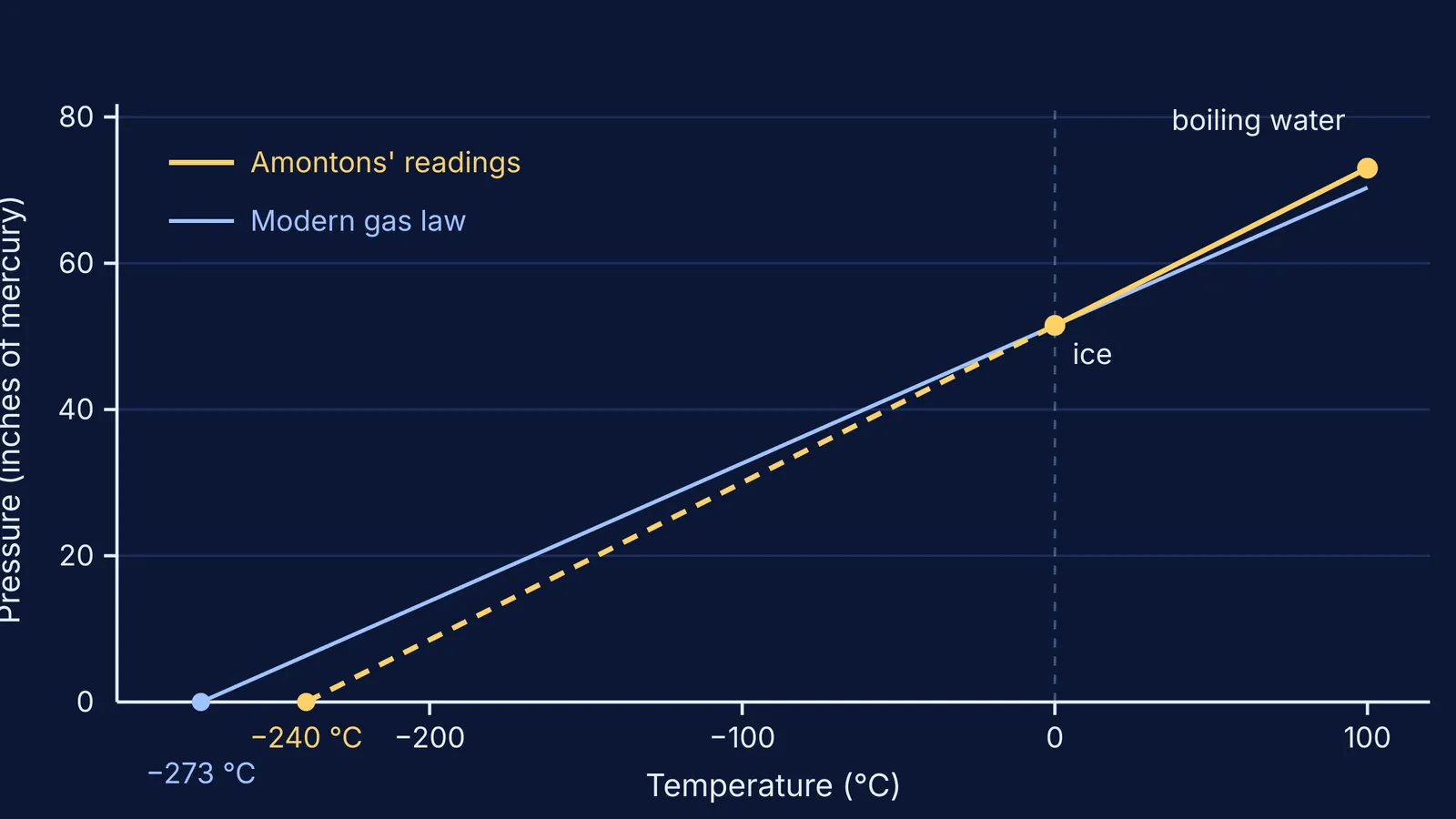
When the bulb sat in boiling water and the barometer read 28 inches, the mercury stood 45 inches above the level in the bulb, so the heated air was pushing with 73 inches of mercury (Evolution of the Thermometer). In other words, he read temperature as pressure.
He set out the idea of measuring temperature by air pressure in a memoir in the Paris Académie's volume for 1702, "Discours sur quelques proprietez de l'air, & le moyen d'en connoître la temperature dans tous les climats de la terre", pages 155 to 174 (bibliographic record, Antikvariat Lynge). His key observation, as summarised in the Dictionary of Scientific Biography, was that for an equal rise in temperature, the pressure of a gas rises in the same proportion, whatever pressure it started at.
How close did Amontons get to absolute zero?
On his scale, boiling water read 73 and melting ice read 51½ (Absolute zero, Wikipedia history section). If pressure falls steadily as air cools, there must be a temperature where the air's "spring" falls to nothing. That same source puts the zero of Amontons' scale at about −240 °C, a limit he believed unreachable. The Dictionary of Scientific Biography is more cautious: it says he only "barely implies" the idea, in his memoir of 1703.
The modern value is −273.15 °C, the zero of the kelvin scale, and in 1779 Johann Heinrich Lambert suggested −270 °C as absolute cold (Absolute zero, Wikipedia).
How can you find Amontons' zero yourself?
Use his two readings: 51.5 inches of mercury at 0 °C and 73 at 100 °C (Evolution of the Thermometer).
Pressure gained per degree: (73 − 51.5) ÷ 100 = 0.215 inches of mercury per °C.
Degrees of cooling needed to lose all 51.5 inches below the ice point: 51.5 ÷ 0.215 ≈ 239.5.
So the zero sits near −240 °C, as he implied.
Modern check: pressure is proportional to (t + 273.15), so boiling over ice should give 373.15 ÷ 273.15 ≈ 1.366. His ratio is 73 ÷ 51.5 ≈ 1.417.
A reading only about 2.6 inches too high at boiling (73 instead of about 70.4) shifts the zero by roughly 34 degrees, because you are stretching a 100-degree measurement 240 degrees beyond the data.
The lesson for numericals: a long extrapolation magnifies small errors.
If the extrapolation is hard to picture, the Fermi Simulation Lab has interactive simulations for the ideas that are easier to see than to read.
Why do textbooks credit Charles and Gay-Lussac instead?
Partly because their work was broader. Gay-Lussac published his study of how gas volume changes with temperature in 1802, crediting unpublished data Jacques Charles had gathered in 1787; Amontons could work only with air, while Gay-Lussac tested oxygen, nitrogen and hydrogen (Gay-Lussac's law, Wikipedia). Read the balloon side in our piece on Jacques Charles and the volume of a gas, and the pressure-volume half in Robert Boyle's air pump and gas law.
The physicist Pierre Duhem, in an 1898 article, gives the other reason: Amontons' instrument was large and awkward and had to be corrected for changes in air pressure, so the Florence spirit thermometer was still preferred. Yet Duhem says Amontons' rule, a fixed volume of air at varying pressure, is the one Carnot, Clausius and Kelvin proposed as the measure of absolute temperature. Our post on Lord Kelvin's two absolute temperature scales picks up the story from there.
How to use this when you study gas laws
Ask what is held constant: temperature for Boyle, pressure for Charles, volume for Amontons.
Convert to kelvin before any ratio calculation.
When a gas-law numerical goes wrong and you cannot see where, the Fermi Problem Library has a step-by-step solver that explains the reasoning rather than printing an answer.


