

On this page
When you dip a laboratory thermometer into a hot beaker during a Class 11 physics practical, you expect the liquid column to respond quickly. Yet the bulb holding that liquid is made of glass, which is fundamentally a poor thermal conductor. According to the NCERT Class 11 Physics curriculum, common glass has a thermal conductivity of only 0.8 W/(m·K), compared to 385 W/(m·K) for copper. Because glass acts as an insulator, the bulb must have an exceptionally thin wall so heat can reach the liquid without delay.
Under Fourier's law of heat conduction, the rate of heat transfer dQ/dt through any barrier depends on thermal conductivity k, surface area A, temperature difference ΔT, and wall thickness L:
dQ/dt = (k × A × ΔT) / L
Because thickness L sits in the denominator, reducing it directly increases heat flow. According to standard specifications compiled in NBS Monograph 150, laboratory thermometers typically use bulb walls between 0.3 mm and 0.6 mm thick. As explored in discussions of heat conduction along a temperature gradient, shortening the conductive pathway maximizes heat transfer for any temperature difference.
How does wall thickness determine the thermal time constant?
A thermometer does not register temperature changes instantaneously. In metrology, this delay is governed by the thermal time constant (τ). Research published by D. R. Harper 3d at the National Bureau of Standards in Thermometric Lag (1912) showed that a thermometer's temperature T(t) approaches surrounding temperature T_s exponentially:
T(t) = T_s − (T_s − T_initial) × e^(−t / τ)
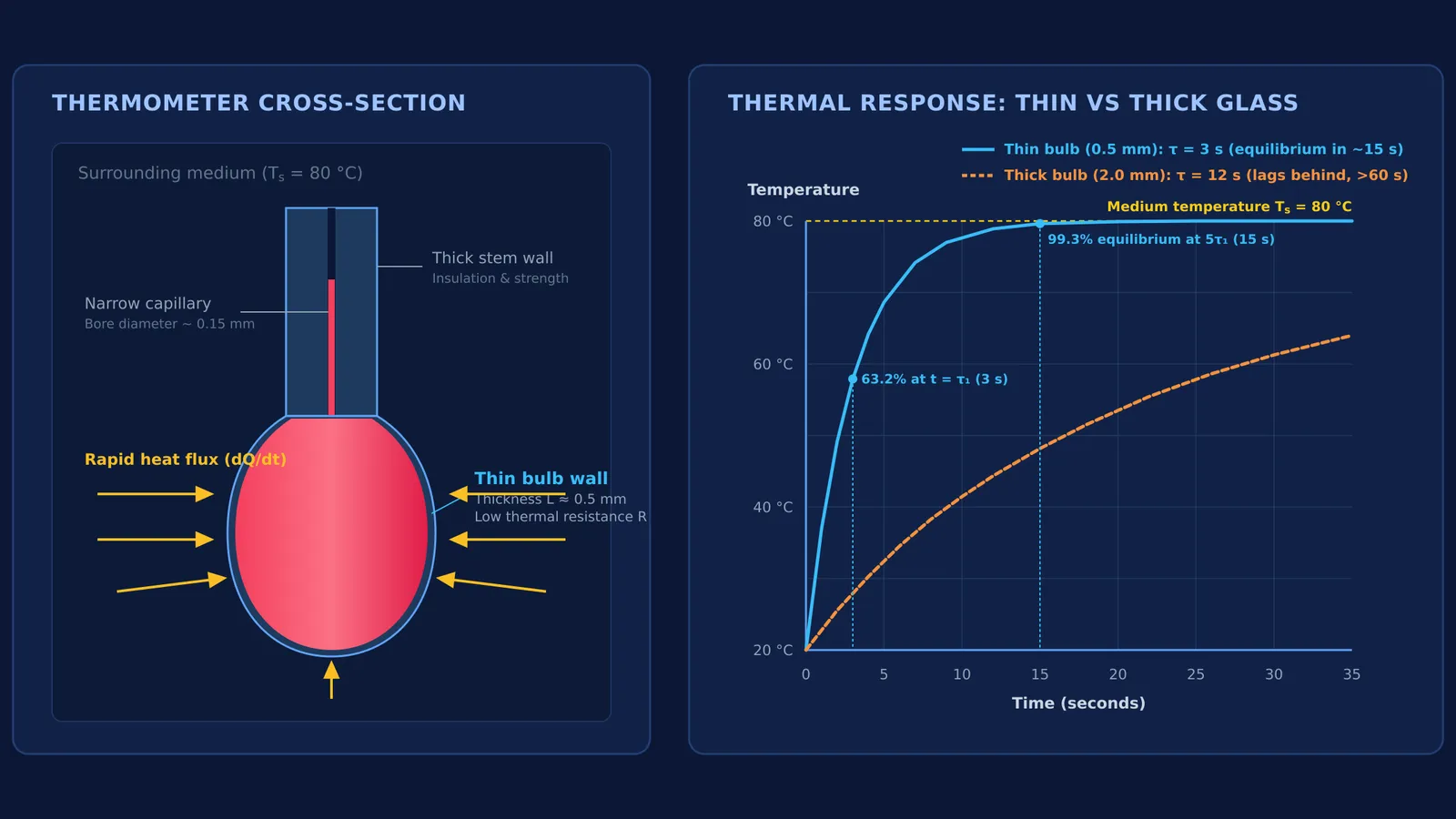
After one time constant (t = τ), the instrument completes 63.2% of the temperature change. Reaching 99.3% requires roughly 5τ.
The time constant equals thermal resistance R multiplied by heat capacity C:
τ = R × C = [L / (k × A)] × (m × c)
Here, m is the liquid mass and c is its specific heat capacity. As outlined in the NBS monograph on Liquid-in-Glass Thermometry, a thinner wall L reduces R, lowering τ to a few seconds. If the wall were four times thicker, thermal resistance would quadruple, forcing you to wait four times longer. This mirrors the behavior of thermal resistance of materials in series, where thinner boundaries minimize opposition to heat flow.
How much faster does a thin bulb conduct heat?
Consider two glass bulbs immersed in water at 80 °C from room temperature at 20 °C (ΔT = 60 °C). Both have surface area A = 5.0 cm² (5.0 × 10⁻⁴ m²) and use glass with k = 0.8 W/(m·K), as listed in NCERT Physics tables:
Thin wall (L = 0.5 mm = 5.0 × 10⁻⁴ m):
Thermal resistance R₁ = (5.0 × 10⁻⁴ m) / [0.8 W/(m·K) × 5.0 × 10⁻⁴ m²] = 1.25 K/W. Initial heat flow: dQ/dt = 60 K / 1.25 K/W = 48 W.
Thick wall (L = 2.0 mm = 2.0 × 10⁻³ m):
Thermal resistance R₂ = (2.0 × 10⁻³ m) / [0.8 W/(m·K) × 5.0 × 10⁻⁴ m²] = 5.0 K/W. Initial heat flow: dQ/dt = 60 K / 5.0 K/W = 12 W.
The thin bulb conducts heat four times faster. In practice, it reaches equilibrium in roughly 15 seconds, while the thick bulb requires over a minute, consistent with response models in NBS Monograph 150. When solving heat transfer problems that link conduction with capacity, students often struggle to connect rate equations with dynamic changes. In the Fermi Problem Library, worked problems with a step-by-step solver explain the underlying reasoning rather than just printing an answer.
Why is the thermometer stem made of thick glass instead?
While the bulb is thin, the stem above it has thick glass enclosing a capillary bore. Specifications in NBS Monograph 150 note that capillary bores measure only 0.1 mm to 0.2 mm across, while the outer diameter of the stem measures 5 mm to 7 mm. This design provides three benefits:
Mechanical strength: Thick glass protects the fragile capillary during handling and cleaning.
Thermal isolation: Glass's low conductivity of 0.8 W/(m·K), verified by NCERT, shields the rising liquid from ambient air temperatures.
Optical magnification: The curved, thick stem acts as a cylindrical lens, magnifying the 0.1 mm thread so it is easy to read.
What happens if the bulb glass is made too thick?
A bulb with thick walls introduces two severe measurement errors:
Sluggish response: In fluctuating temperatures, thick walls cause substantial lag. As D. R. Harper 3d (1912) demonstrated, a slow thermometer lags behind a changing medium by an error proportional to its time constant.
Thermal loading: Thick glass has large thermal capacity. In small liquid samples, the heavy glass absorbs noticeable heat from the fluid, altering the very temperature you are trying to measure.
This balance highlights the essential distinction between heat and temperature: an accurate thermometer must measure temperature while exchanging minimal energy. To see how thermal resistance and heat capacity apply across physics, explore the Fermi Concept Library, which covers every concept in physics, chemistry, biology, mathematics and computing, each with its own lesson and its place in the map.


