On this page
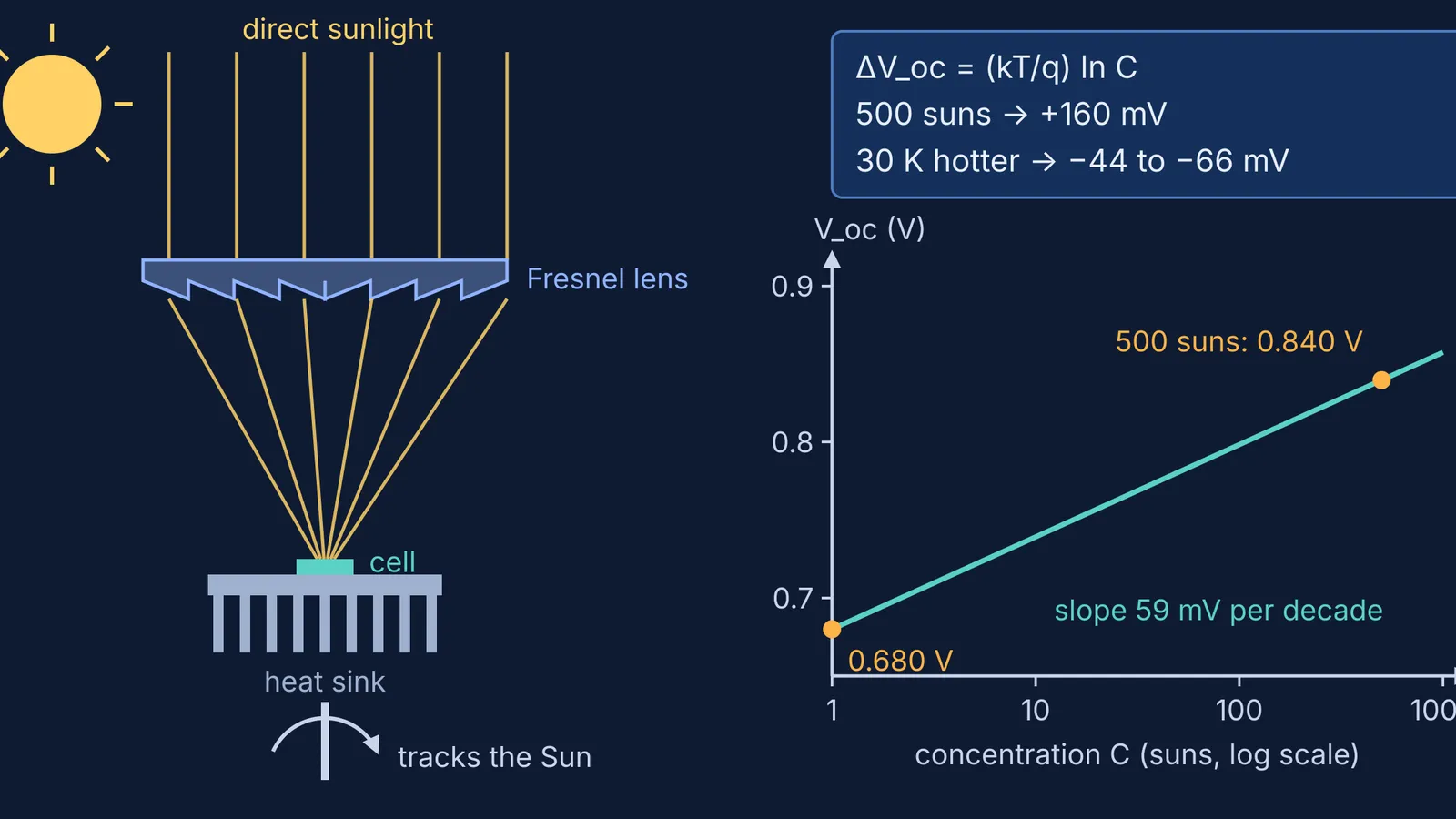
A lens the size of a dinner plate can focus sunlight onto a solar cell the size of a fingernail. The cell then sees hundreds of times the normal light, and it turns that light into electricity slightly more efficiently than it would in ordinary sunlight. These are concentrator solar cells. The extra efficiency comes from the voltage, it grows only logarithmically, and it disappears quickly if the cell gets hot. This post works out all three with a silicon cell.
What is a concentrator solar cell?
A lens or mirror collects sunlight over a large area and focuses it onto a small cell. The concentration C, counted in "suns", is how many times the light intensity on the cell exceeds ordinary sunlight. At C = 500, a 1 cm² cell receives the light that would fall on 500 cm².
The idea is economic as well as physical. Lenses and mirrors are cheap; high-efficiency cells are expensive. Concentrating the light lets a small area of an expensive cell do the work of a large one. Most concentrator systems use multi-junction cells made of III–V semiconductors, which are covered in tandem solar cells: why a top cell on silicon must match currents. Here we use a plain silicon cell, because the voltage physics is the same and easier to follow.
Why does concentrated light raise the voltage?
A solar cell's photocurrent I_L is proportional to the number of photons arriving, so it rises C times. That alone gives no efficiency gain: C times the light and C times the current is the same ratio.
The gain is in the open-circuit voltage. For an ideal diode cell,
V_oc = (kT/q) ln(I_L/I₀ + 1)
where I₀ is the dark saturation current, which depends on the material and temperature but not on the light. I_L is always vastly bigger than I₀, so the "+1" can be dropped. Multiply I_L by C and
V_oc(C) = V_oc(1 sun) + (kT/q) ln C
So more light means more voltage, but only as the logarithm of the concentration. Power is roughly current times voltage, so the power rises a little faster than the light does, and that small extra is the efficiency gain. If V_oc and I_sc are new to you, they are defined with a hands-on measurement in solar science project ideas: build it, measure it, explain it.
Worked example: a silicon cell from 1 to 1,000 suns
Take a silicon cell with V_oc = 0.680 V at 1 sun, an ideal diode (ideality factor 1), held at 25 °C.
Thermal voltage. kT/q = (1.381 × 10⁻²³ J/K × 298.15 K) ÷ 1.602 × 10⁻¹⁹ C = 0.02569 V, or 25.7 mV. Units: J/C = V.
Gain per factor of 10. (kT/q) ln 10 = 25.7 mV × 2.303 = 59.2 mV per decade of concentration.
10 suns. ΔV = 25.7 mV × ln 10 = 59 mV, so V_oc = 0.739 V.
100 suns. ΔV = 118 mV, V_oc = 0.798 V.
500 suns. ΔV = 25.7 mV × ln 500 = 25.7 × 6.215 = 160 mV, V_oc = 0.840 V.
1,000 suns. ΔV = 177 mV, V_oc = 0.857 V.
Efficiency at 500 suns. If the fill factor stays the same, power rises by 500 × (0.840 ÷ 0.680) = 617 times while the light rises 500 times. The efficiency is multiplied by 0.840 ÷ 0.680 = 1.23, so a cell at 20% would reach about 25%.
Going from 500 to 1,000 suns doubles the light but adds only 18 mV more. The cell area per watt halves, but the efficiency barely moves.
Why does a concentrator cell have to stay cool?
Focusing 500 suns onto a small cell also focuses 500 times the heat. The voltage of a silicon cell falls as it warms, because I₀ rises steeply with temperature. The physics course PVEducation gives about 2.2 mV per °C for typical silicon (effect of temperature, PVEducation), from the approximate formula dV_oc/dT = −(E_g0/q − V_oc + 3kT/q) ÷ T with E_g0 = 1.2 eV. A higher-voltage cell is less sensitive: the same formula gives 2.0 mV/K at 0.680 V and about 1.5 mV/K at 0.840 V.
So if poor cooling lets the cell run 30 K hotter, it loses roughly 44 to 66 mV depending on which coefficient you use. That is between a quarter and two-fifths of the 160 mV that concentration gave. This is why concentrator cells sit on heat sinks, and why the same heat loss in ordinary panels, explained in why solar panels produce less power on very hot days, matters even more here.
Why must a concentrator follow the Sun?
A lens focuses only light arriving from one direction. On a clear day most sunlight comes straight from the Sun's disc, the direct beam; on a cloudy day much of it is diffuse, scattered across the whole sky, and a lens cannot focus it onto the cell. So concentrators suit sunny, dry places, and they must turn to face the Sun throughout the day.
There is also a limit to how far you can concentrate. The Sun is not a point: its angular radius is about R_sun ÷ (Earth–Sun distance) = 6.96 × 10⁸ m ÷ 1.496 × 10¹¹ m, which gives 0.266°. Conservation of étendue, a rule from optics that says you cannot make an image brighter than its source, caps the concentration in air at C_max = 1 ÷ sin²(0.266°) = 46,000 suns. Practical systems work far below that.
Why do real systems use multi-junction cells?
Real cells have series resistance. The power lost in it is I²R, and I rises in proportion to C, so the loss grows as C² while the useful power grows roughly as C. Every real cell therefore has an optimum concentration, after which efficiency falls again.
Multi-junction III–V cells are designed for this, with thin grids and small areas. On the research-cell efficiency chart kept by the US National Laboratory of the Rockies (NLR, formerly NREL), the highest concentrator result is 47.6%, for a four-junction cell from Fraunhofer ISE measured at 665 suns in 2022; the silicon concentrator entry is 27.6%, at 93 suns, from 2007 (NLR research-cell efficiency chart and data).
If the diode equation behind V_oc is shaky, the Concept Library covers p-n junctions and the other semiconductor ideas used here.
Quick checklist
Photocurrent ∝ C; that part alone gives no efficiency gain.
V_oc rises by (kT/q) ln C: 59 mV per decade at 25 °C.
500 suns: +160 mV, from 0.680 V to 0.840 V; efficiency × 1.23 if fill factor holds.
Heat costs about 1.5 to 2.2 mV per kelvin; 30 K hotter undoes a quarter to two-fifths of the gain.
Lenses need the direct beam, so the system must track the Sun.
The Sun's 0.266° radius limits concentration to about 46,000 suns.
Series resistance losses grow as C², so each cell has an optimum concentration.