

On this page
A silicon solar cell throws away more than half of the sunlight that falls on it, even in theory. Some photons have too little energy to be absorbed at all. Others have far more than the cell can use, and the extra turns into heat. A tandem cell puts a second cell, with a wider band gap, on top of the silicon. The top cell takes the high-energy photons at a higher voltage and lets the rest through to the silicon below. This post works out, with one simple model, how much that stacking gains, and why the two cells must be matched.
Why can a single solar cell never use all of sunlight?
A solar cell has one band gap, Eg. A photon is absorbed only if its energy is at least Eg, and then it frees one electron–hole pair. Whatever energy the photon had above Eg is lost very quickly as the carriers relax to the band edges, which warms the cell. So a single cell loses energy two ways:
Below the gap. Photons with E < Eg pass straight through.
Above the gap. Each absorbed photon gives at most Eg, however energetic it was.
A small gap catches many photons but wastes most of the blue ones. A large gap uses each photon well but catches few. You can place the gaps in the spectrum with λ (in nm) = 1240/E (in eV), as in why the colour of an LED depends on its band gap. Silicon's 1.12 eV gap corresponds to 1,107 nm, in the infrared. A 1.7 eV gap corresponds to 729 nm, deep red.
How a single silicon p–n junction makes current is explained in how solar panels make electricity from sunlight, and the I–V curve and fill factor in photodiode, LED and solar cell I–V curves for JEE Main. Here we look only at how the spectrum is shared.
What is the "ultimate efficiency" of a cell?
To compare gaps simply, use a generous model. Treat the Sun as a black body at 5,778 K. Assume every photon with E ≥ Eg is absorbed and delivers exactly Eg of energy, and nothing else is lost. The fraction of the Sun's power delivered this way is called the ultimate efficiency.
This is an upper bound, not a prediction. A real cell delivers a voltage well below Eg/e, and some carriers recombine before they are collected. The stricter detailed-balance (Shockley–Queisser) limit, which includes these losses, is lower. The ultimate efficiency is still the clearest way to see why stacking helps.
Worked example: silicon alone, then a 1.7 eV cell on top
The photon flux of a black body per unit energy goes as E²/(e^(E/kT) − 1), with kT = 0.498 eV at 5,778 K. All the fractions below were found by integrating this numerically.
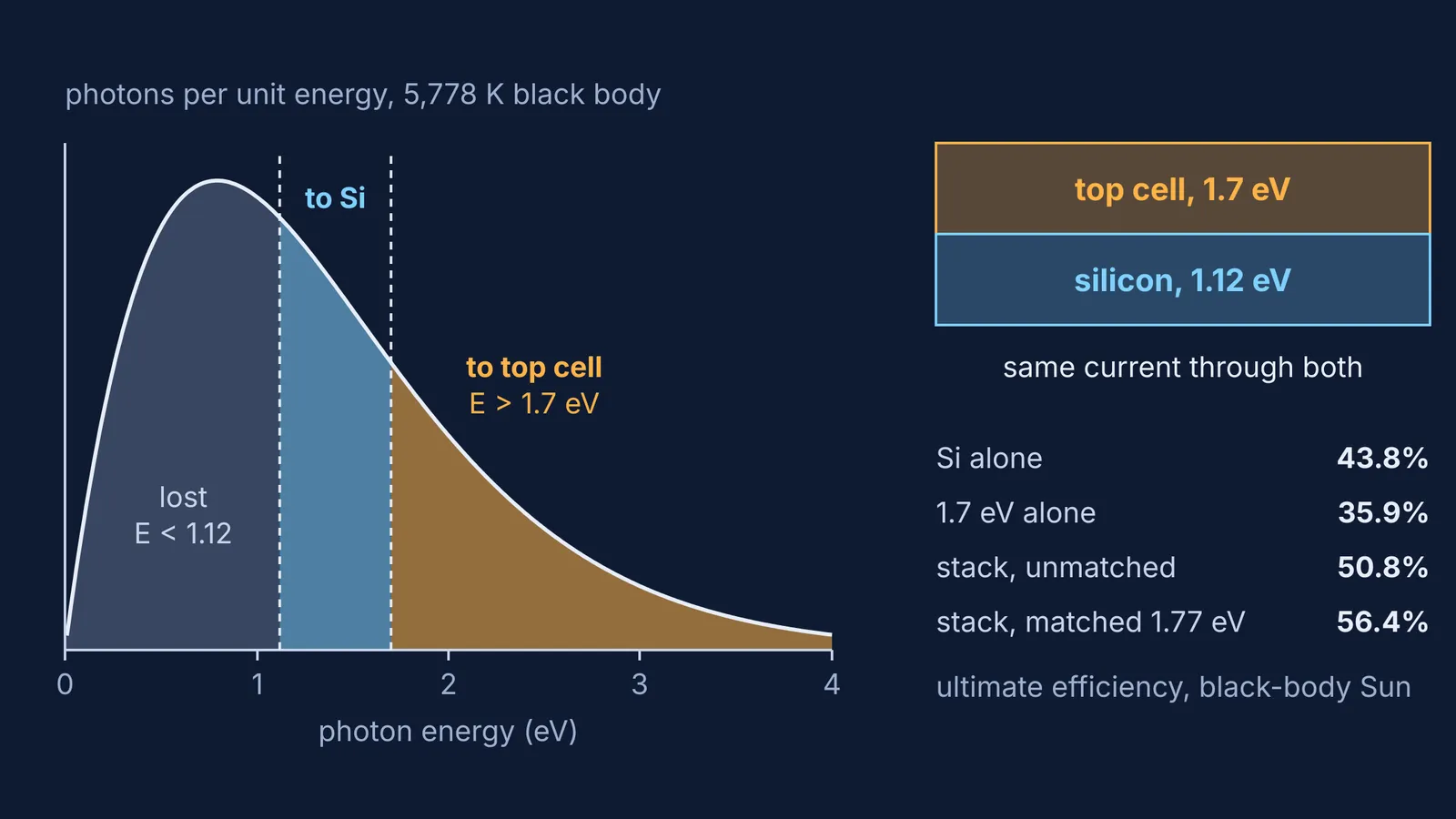
Silicon alone (1.12 eV). It absorbs 52.6% of the photons. The ultimate efficiency is 43.8%. Of the rest, 23.1% of the power is in photons below the gap and 33.1% is lost as heat from photons above it. Check: 43.8 + 23.1 + 33.1 = 100%.
A 1.7 eV cell alone. It absorbs only 28.4% of the photons and reaches 35.9%, worse than silicon.
Stack them. Put the 1.7 eV cell on top. It absorbs every photon above 1.7 eV (28.4% of all photons), and each now delivers 1.7 eV instead of 1.12 eV. Photons between 1.12 and 1.7 eV (24.2% of all photons) pass through to the silicon.
If each cell had its own wires. Total = (1.7 × 28.4% of photons + 1.12 × 24.2% of photons) as a fraction of the power, which comes to 56.1%.
If the cells are in series. In a two-terminal stack the same current flows through both cells, so the current is set by the cell that collects fewer photons: here the silicon, with 24.2%. The top cell's extra photons are wasted, and the efficiency is (1.7 + 1.12) eV × 24.2% of the photons, which is 50.8%.
Match the currents. Raise the top gap a little, so that it takes fewer photons and passes more to the silicon. The photon counts become equal, 26.3% each, at a top gap of about 1.77 eV, and the series stack then reaches 56.4%.
So in this model, a single silicon cell tops out at 43.8%, a mismatched 1.7 eV stack at 50.8%, and a current-matched stack at 56.4%.
Why do real tandem cells reach far less?
Each real cell gives a voltage noticeably below its band gap, and the real spectrum at the ground (with absorption by water vapour and other gases) is not a smooth black body. The current records come from the research-cell efficiency chart kept by the U.S. National Laboratory of the Rockies (NLR, the lab long known as NREL), the NLR cell efficiency chart and data table, in its July 2026 revision:
Perovskite on silicon, two-terminal: 35.2%, by LONGi, measured in February 2026 on a cell of about 1 cm².
Single-junction crystalline silicon: 28.1%, reached by both LONGi and Trina Solar in March 2026.
The same data table shows the series effect directly. The record tandem gives an open-circuit voltage of about 2.0 V, well below the 2.82 V that the sum of gaps like those in our example (1.7 + 1.12 eV) would suggest. That gap is the voltage loss. Its current density is about 20.6 mA/cm², roughly half of the 43 mA/cm² of a record silicon cell. The photons are shared between the two cells, so each carries about half the current, at a higher total voltage. Records change often, so check the chart for the newest figures.
If band gaps and photon energies still feel abstract, the Concept Library covers every concept in physics, chemistry, biology, mathematics and computing.
Quick checklist
A single cell loses photons below its gap and the energy above its gap.
λ (nm) = 1240/E (eV): 1.12 eV is 1,107 nm, 1.7 eV is 729 nm.
Ultimate efficiency (black-body Sun, each photon gives Eg): silicon 43.8%, 1.7 eV alone 35.9%.
1.7 eV on silicon: 56.1% with separate wires, 50.8% in series; matched at about 1.77 eV: 56.4%.
Series cells share one current, so the top gap must split the photons equally.
These are upper bounds, not records; check current records on the NLR chart.


