

On this page
At the Inter-University Accelerator Centre (IUAC) in New Delhi, a tall steel tank holds a terminal charged to millions of volts. A single voltage like that should give an ion an energy of q × V and no more. Yet the same terminal gives an oxygen ion several times 13 MeV. The trick is to use the voltage twice, by changing the ion's charge halfway. The machine is a tandem Pelletron, and every step of it is Class 12 electrostatics: potential energy qV, a stripped ion and a magnet that picks one charge.
What is the Pelletron at IUAC?
IUAC's Pelletron accelerator page describes a 15 UD tandem machine with these features:
Two stainless-steel pellet charging chains carry charge up to the terminal, "using Vande Graaff generator principle". Metal pellets on a chain take the place of the rubber belt, which is where the name Pelletron comes from.
The tank is filled with SF₆ insulating gas at about 80 psi, so the terminal can hold its voltage without sparking to the tank wall.
The terminal potential can be set between about +4 MV and +16 MV to suit each experiment.
Negative ions are pre-accelerated to about 300 keV before they enter the tank.
The terminal has a gas stripper and carbon-foil strippers.
Beams range from hydrogen through oxygen-16 to gold and lead, with energies up to 200 MeV depending on the ion.
The director's message on the IUAC home page adds that stable operation is currently limited to a maximum of 13 MV, so the worked example below uses 13 MV. The centre was set up for university scientists, as our guide to a career in nuclear physics in India explains. How a belt or chain builds up charge on a hollow terminal is explained in our post on the Van de Graaff generator working principle, so it is not repeated here.
How does a tandem accelerator use one voltage twice?
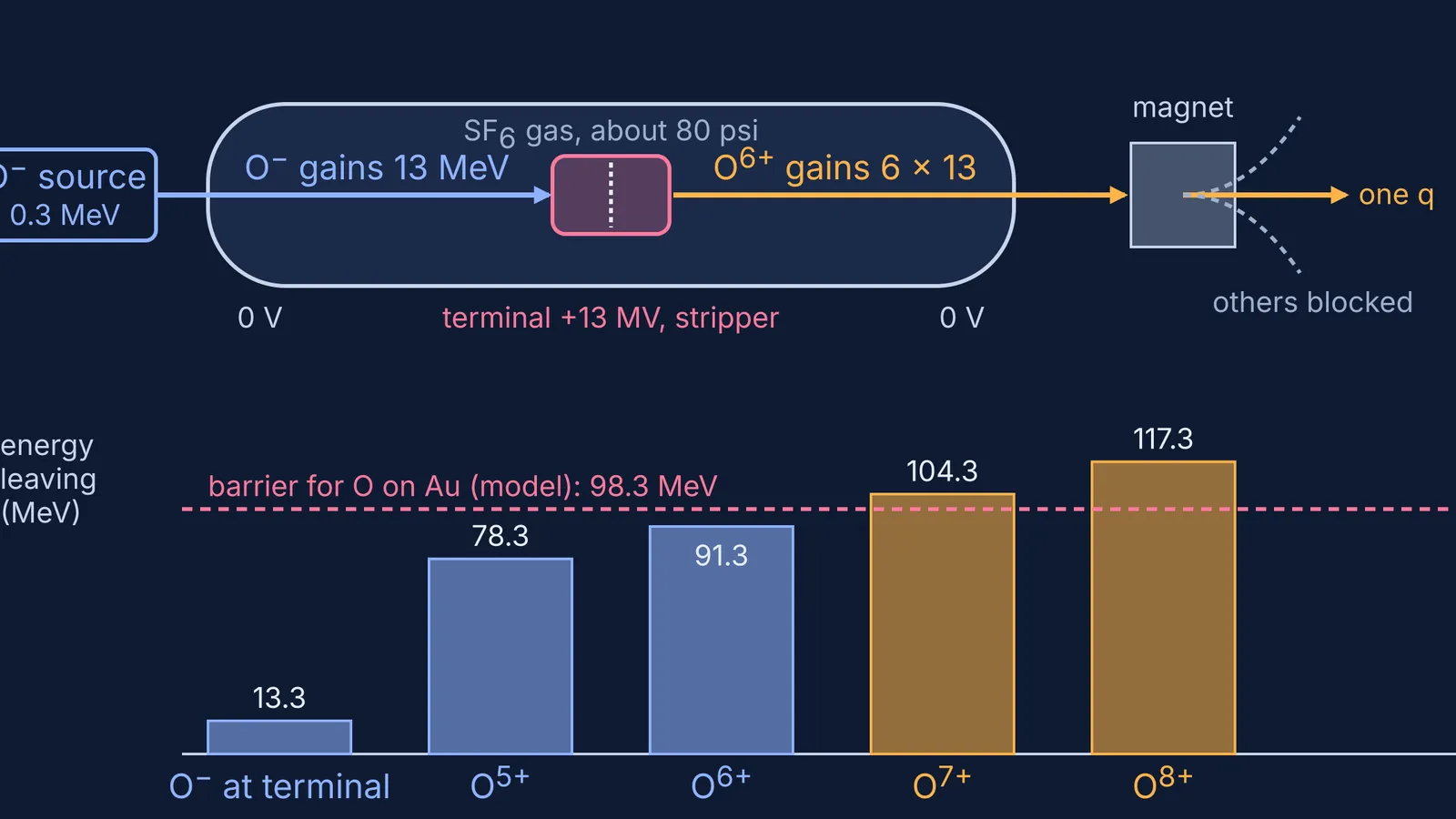
The terminal sits in the middle of the tank, at +13 MV. Both ends of the tank are at ground, 0 V.
First leg, ground to terminal. A negative ion, such as O⁻, starts at ground. The positive terminal attracts it. Its charge is −e and it falls through a potential difference of +13 MV, so it gains e × 13 MV = 13 MeV.
Stripping. Inside the terminal the ion passes through a thin carbon foil or a gas. Collisions knock off several electrons. The ion leaves with a positive charge +qe.
Second leg, terminal to ground. The terminal now repels the positive ion, which runs down 13 MV to ground and gains a further qe × 13 MV = 13q MeV.
So the energy after the tank is
E = E_injection + 13 MeV + q × 13 MeV.
The ion must start negative, otherwise the positive terminal would push it back. Not every element forms negative ions easily, which is one reason the choice of ion source matters.
How much energy does an oxygen ion get?
Here is the worked example with a 13 MV terminal and 0.3 MeV injection (IUAC's stated pre-acceleration of about 300 keV).
Injection. O⁻ leaves the ion source with 0.3 MeV.
Up to the terminal. Charge −e through 13 MV adds 13 MeV. Total 13.3 MeV.
Stripping to O⁶⁺. The ion now has charge +6e.
Down to ground. 6 × 13 = 78 MeV more. Total 91.3 MeV.
Other charge states give:
O⁵⁺: 13.3 + 5 × 13 = 78.3 MeV.
O⁷⁺: 13.3 + 7 × 13 = 104.3 MeV.
O⁸⁺ (all 8 electrons removed): 13.3 + 8 × 13 = 117.3 MeV.
Protons from H⁻ (stripped to H⁺, q = 1): 0.3 + 13 + 13 = 26.3 MeV.
Compare a single-ended machine at the same 13 MV with an O⁶⁺ source inside the terminal: the ion falls through the voltage once and gets 6 × 13 = 78 MeV. The tandem adds the first leg for free and keeps the ion source at ground, where it is easy to service.
Even at 104 MeV, oxygen is not relativistic. Its rest energy is about 14,900 MeV, so v ≈ √(2E/m) ≈ 0.12c, and the classical ½mv² is fine.
Why does the charge state chosen after stripping matter?
Stripping does not give every ion the same charge. It gives a spread of charge states. After the tank, an analysing magnet bends the beam, and since the radius of the path depends on momentum and charge, it selects one charge state and one energy to send on.
That choice decides which experiments are possible. Take oxygen-16 on a gold-197 target. To touch the gold nucleus, the oxygen must climb the Coulomb barrier. Using the touching-spheres model from exam questions:
Radii. R = 1.2(16^⅓ + 197^⅓) fm = 1.2 × (2.52 + 5.82) fm ≈ 10.0 fm.
Barrier. U = (e²/4πε₀) × Z₁Z₂/R = 1.44 MeV fm × 8 × 79 / 10.0 fm ≈ 91.0 MeV. This is the energy needed in the centre-of-mass frame.
Laboratory energy. The gold target is at rest, so only part of the beam's energy is available for the collision. E_lab = U × (16 + 197)/197 ≈ 98.3 MeV.
Compare. O⁶⁺ at 91.3 MeV falls short of 98.3 MeV. O⁷⁺ at 104.3 MeV gets over.
Treat this as a model answer, not a measured threshold. The touching-spheres estimate ignores the attraction of the nuclear force at contact and the fuzzy edges of real nuclei, both of which lower the true barrier. The point that survives is the method: the charge state selected after the stripper sets the energy, and the energy decides whether the nuclei meet. Our post on why nuclear fusion needs very high temperatures works the same barrier idea for light nuclei.
If you want more problems on potential energy and charged particles, the Fermi Problem Library has a step-by-step solver that explains the reasoning.
What mistakes cost marks on tandem accelerator questions?
Using the stripped charge for both legs. The first leg uses the negative ion's charge.
Forgetting the injection energy. It is small (0.3 MeV here) but it is there.
Thinking a positive ion could be injected at ground. A positive terminal would repel it.
Comparing a laboratory energy with a centre-of-mass barrier. Convert one to the other first.
Assuming the stripper gives one charge state. It gives a spread, and a magnet picks one.
Quick checklist
Tandem: negative ion up to a positive terminal, strip, positive ion down again.
E = E_injection + 1 × V + q × V, in MeV when V is in MV.
At 13 MV: O⁶⁺ 91.3 MeV, O⁷⁺ 104.3 MeV, protons 26.3 MeV.
A magnet after the tank selects one charge state, and so one energy.
Pelletron = Van de Graaff principle with a chain of metal pellets instead of a belt.


