On this page
In 1980 Luis and Walter Alvarez found that a thin clay layer from the end of the age of dinosaurs held far more iridium than ordinary rock. The amounts were parts per billion, far too small to weigh. They measured them with neutron activation analysis: put the sample in a nuclear reactor, let some of its atoms capture neutrons and become radioactive, then identify the elements by the gamma rays they give off. This post works out how fast a sample becomes radioactive, using 1 mg of gold as the example, and why there is no point leaving it in the reactor for weeks.
What is neutron activation analysis?
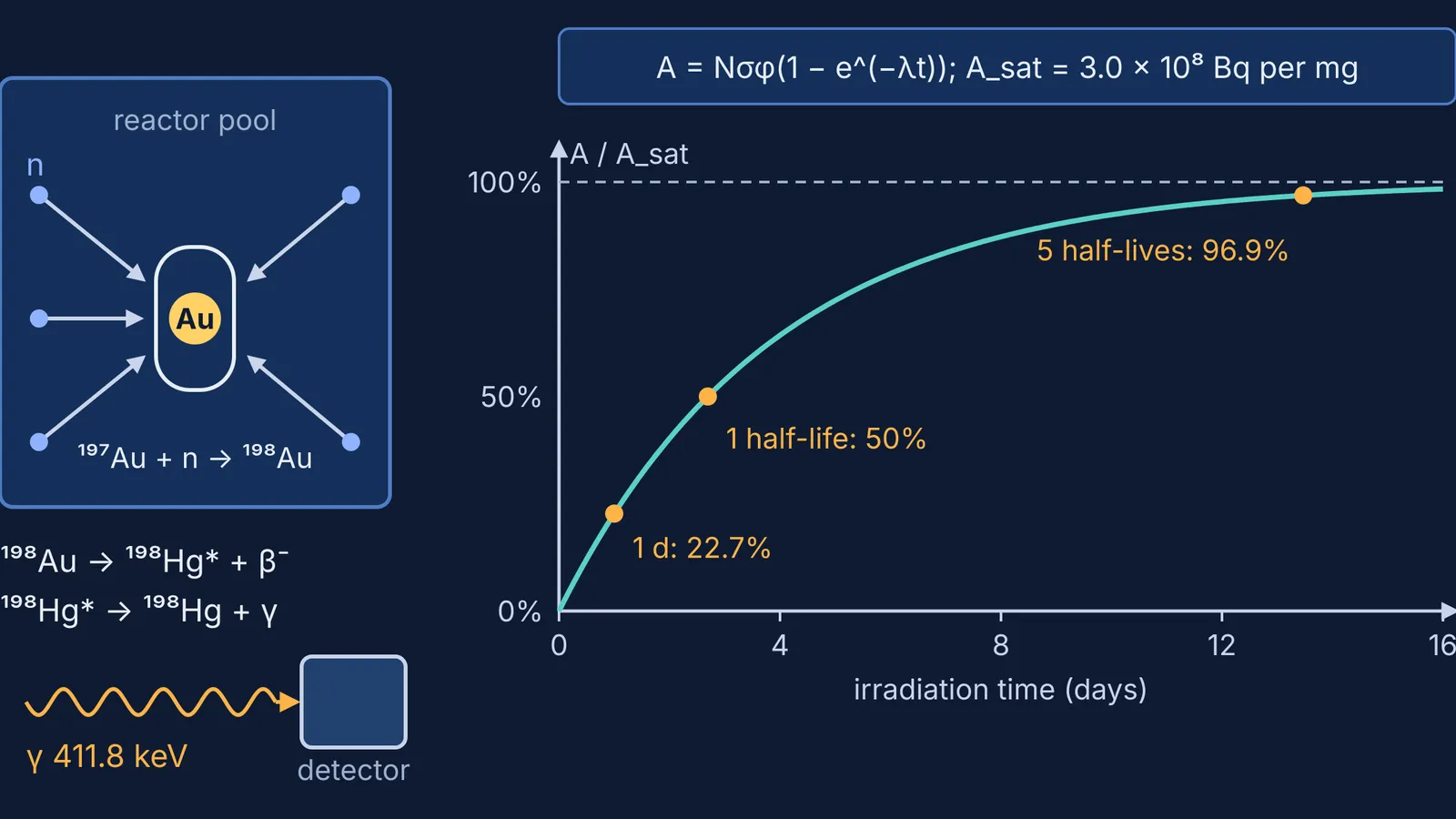
A research reactor has a region where slow (thermal) neutrons pass through every square centimetre at a steady rate. That rate is the neutron flux φ. A sample placed there is hit from all sides. Some nuclei capture a neutron and become a heavier isotope of the same element. For gold:
¹⁹⁷Au + n → ¹⁹⁸Au
Gold-198 is radioactive. It undergoes β⁻ decay to mercury-198, and the mercury nucleus is usually left in an excited state that drops to its ground state by emitting a gamma ray of 411.8 keV. That energy is a fingerprint. Find a 411.8 keV peak in the gamma spectrum, and the sample contained gold.
How likely a nucleus is to capture a neutron is given by its capture cross-section σ, measured in barns (1 barn = 10⁻²⁴ cm²). Slow neutrons are captured far more readily than fast ones, which is the discovery described in why Fermi's slow neutrons made silver more radioactive. The cross-sections used here are thermal values.
How fast does a sample become radioactive in a reactor?
If the sample has N target atoms, it makes new radioactive nuclei at a constant rate
R = Nσφ
At the same time, the ones already made are decaying at a rate λN′, where N′ is the number present. This is the production-and-decay equation dN′/dt = R − λN′, solved step by step in radioactive production and decay: how to find N at time t. The solution for the activity A = λN′ is
A = Nσφ(1 − e^(−λt))
Two things follow directly.
The activity cannot keep growing. It rises towards a ceiling, the saturation activity A_sat = Nσφ, reached when nuclei decay as fast as they are made.
The fraction of the ceiling reached depends only on t compared with the half-life, not on the element or the flux.
Worked example: 1 mg of gold in the reactor for one day
Data: thermal capture cross-section of gold-197, 98.66 barns (the IAEA 2017 neutron data standard); half-life of gold-198, 2.694 days, with the 411.8 keV gamma ray in about 96% of decays (NNDC NuDat decay data); flux 10¹² neutrons per cm² per second, a typical research-reactor value used here for illustration. We take the neutrons to be purely thermal and ignore small corrections.
Count the atoms. Molar mass of gold = 196.97 g/mol. N = (10⁻³ g ÷ 196.97 g/mol) × 6.022 × 10²³ mol⁻¹ = 3.06 × 10¹⁸ atoms.
Capture rate per atom. σφ = 98.66 × 10⁻²⁴ cm² × 10¹² cm⁻² s⁻¹ = 9.87 × 10⁻¹¹ s⁻¹. The units cancel to "per second", as a rate should.
Saturation activity. A_sat = Nσφ = 3.06 × 10¹⁸ × 9.87 × 10⁻¹¹ = 3.02 × 10⁸ Bq, about 302 MBq per milligram.
Decay constant. λ = 0.693 ÷ 2.694 days = 0.257 per day.
Fraction reached after 1 day. 1 − e^(−0.257) = 0.227, so 22.7%.
Activity. A = 0.227 × 3.02 × 10⁸ = 6.84 × 10⁷ Bq, or 68.4 MBq.
One day after removal. The activity simply decays: 68.4 × e^(−0.257) = 52.9 MBq.
How much gold actually changed? The fraction of atoms that capture a neutron in a day is σφ × 86,400 s = 8.5 × 10⁻⁶. Fewer than one gold atom in 100,000 is converted, yet the sample is strongly radioactive. Activity counts decays per second, and even 2.3 × 10¹³ gold-198 nuclei, a tiny fraction of the sample, give tens of millions of decays per second.
Why is irradiating past five half-lives wasted?
Use the same formula with different times:
1 day: 22.7% of saturation.
2.694 days (one half-life): 50%.
7 days: 83.5%.
13.5 days (five half-lives): 96.9%.
After one half-life you have half the ceiling. Each further half-life closes half of the remaining gap: 50%, 75%, 87.5%, 93.8%, 96.9%. Going from five half-lives to ten adds only about 3% more activity for twice the reactor time. That is why analysts choose the irradiation time from the half-life of the isotope they want to see. A short-lived product needs minutes; a long-lived one would need years to saturate, so it is never taken near saturation.
The same reasoning tells you that a short irradiation favours short-lived products. That is useful when several elements are present: you can pick a time that brings up the one you want and keeps others low, and then wait before counting so that short-lived products from other elements decay away.
How does the gamma ray identify the element?
The activity on its own says nothing about which element made it. The identification comes from the energy of the gamma ray, which belongs to one particular nucleus. Gold gives 411.8 keV. Other elements in the sample also become radioactive, each with its own lines, and a strong line from a major element can swamp a weak one from a trace element. So the method needs a detector that separates lines a few keV apart, which is why laboratories use cooled germanium detectors rather than ordinary scintillators.
The amount comes from the size of the peak. Since A is proportional to N, comparing the peak with one from a standard of known mass, irradiated alongside, gives the mass of the element without needing to know φ exactly.
Why can it find a nanogram?
Scale the worked example down a million times. One nanogram of gold irradiated for one day gives 68 Bq, about 68 decays per second, of which about 96% send out the 411.8 keV gamma ray. Over a counting time of an hour that is a few hundred thousand gamma rays emitted, enough for a detector to build a clear peak even though it catches only some of them. This is how the Alvarez team could compare iridium at parts per billion between clay layers, a story told in the iridium clue to the dinosaurs' end.
If you want to practise the production-and-decay algebra on more problems, the Fermi Problem Library has a step-by-step solver that explains the reasoning at each stage.
Quick checklist
Capture rate: R = Nσφ, with σ in cm² (1 barn = 10⁻²⁴ cm²) and φ per cm² per second.
Activity during irradiation: A = Nσφ(1 − e^(−λt)), which saturates at Nσφ.
One half-life gives 50% of saturation; five give about 97%.
After removal the activity just decays: A = A₀e^(−λt).
The gamma-ray energy identifies the element; the peak size gives the amount.
Cross-sections like 98.66 barns are for slow neutrons; fast neutrons are captured far less.