On this page
Some nuclei are made and decay at the same time: a target irradiated in a nuclear reactor or an accelerator, or a daughter fed by a long-lived parent. The question is always how many there are at time t.
How do you set up dN/dt = R − λN?
Two things change N. Production adds R nuclei per second, and decay removes λN nuclei per second. The quantity λN is called the activity, and MIT's Applied Nuclear Physics lecture on radioactive-series decay writes production at a constant rate Q₀ as dN/dt = Q₀ − λN. We call the rate R here.
Gain minus loss gives dN/dt = R − λN, a first-order linear differential equation with constant coefficients, as the MIT notes put it. If you are unsure why it counts as linear, see how to check whether a differential equation is linear.
How do you solve it for the number of nuclei at time t?
Take N = 0 at t = 0.
Separate the variables: dN/(R − λN) = dt.
Integrate N from 0 to N and t from 0 to t: −(1/λ) ln[(R − λN)/R] = t.
Undo the log: R − λN = R e^(−λt).
Rearrange: N(t) = (R/λ)(1 − e^(−λt)).
This matches equation 12.9 in the MIT lecture. Starting from N₀ instead, the same steps give N(t) = R/λ + (N₀ − R/λ)e^(−λt): N₀ at t = 0, settling at R/λ.
What is the saturation value, and how fast is it reached?
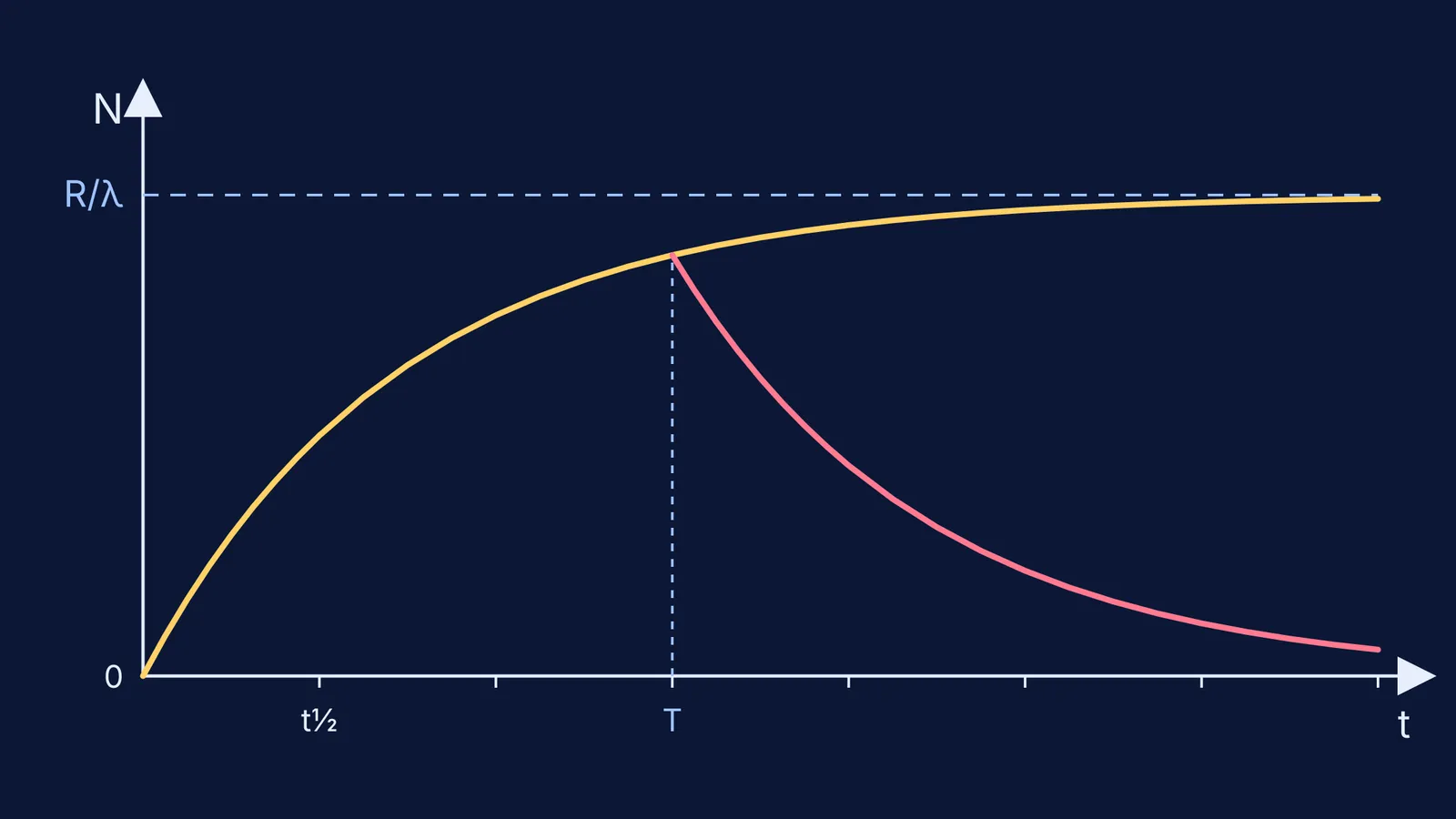
The saturation value is N_sat = R/λ, where the activity λN equals R: nuclei decay as fast as they are made. In the MIT notes, N rises towards Q₀/λ, and if production stops at time T it decays as N(t) = N(T)e^(−λ(t − T)).
After n half-lives, N/N_sat = 1 − (1/2)ⁿ, so you get 50%, then 75%, then 87.5%. You never quite reach 100%, for the same reason a sample is not fully decayed after two half-lives. Reaching 99% takes ln 100/ln 2, or about 6.6 half-lives.
Worked example 1, build-up then switch-off: a nucleus with a half-life of 10 minutes is produced at R = 2.0 × 10⁹ nuclei per second.
λ = 0.693/600 s = 1.155 × 10⁻³ s⁻¹.
N_sat = R/λ = 2.0 × 10⁹/1.155 × 10⁻³ ≈ 1.73 × 10¹².
After 20 minutes (two half-lives): N = 1.73 × 10¹² × (1 − 1/4) ≈ 1.30 × 10¹², and the activity is 1.5 × 10⁹ Bq.
Production stops at 30 minutes, when N = 0.875 × 1.73 × 10¹² ≈ 1.52 × 10¹². Twenty minutes later only a quarter of that remains, about 3.8 × 10¹¹.
How does a parent-daughter chain use the same equation?
For a parent (1) decaying into a daughter (2), the MIT lecture writes dN₂/dt = λ₁N₁ − λ₂N₂. Same equation, with the parent's activity λ₁N₁ as the production rate. Starting with N₁₀ parent nuclei and no daughter, its solution (one of the Bateman equations) is N₂ = N₁₀ λ₁/(λ₂ − λ₁) × (e^(−λ₁t) − e^(−λ₂t)).
If the parent lives much longer than the daughter, λ₁N₁ hardly changes, so it acts like a constant R. The daughter then saturates at N₂ ≈ λ₁N₁/λ₂, which means λ₁N₁ ≈ λ₂N₂. The lecture calls this condition of approximately equal activities secular equilibrium. It uses this to estimate the half-life of uranium-238: in uranium minerals, N(U-238)/N(Ra-226) has been measured as 2.8 × 10⁶, and radium-226 has a half-life of 1620 years, so U-238's half-life is about 2.8 × 10⁶ × 1620 ≈ 4.5 × 10⁹ years.
Worked example 2, molybdenum-99 and technetium-99m: a 2014 report to the US Nuclear Science Advisory Committee gives technetium-99m a half-life of 6.0 hours and its parent molybdenum-99 a half-life of 66 hours. This idealised version assumes every Mo-99 decay feeds Tc-99m.
λ₂/λ₁ = 66/6 = 11, and λ₂ − λ₁ = 0.693 × (1/6 − 1/66) ≈ 0.105 per hour.
The daughter peaks when dN₂/dt = 0. At that moment λ₁N₁ = λ₂N₂, so the two activities are equal.
Time of the peak: t = ln(λ₂/λ₁)/(λ₂ − λ₁) = ln 11/0.105 ≈ 23 hours.
Long after that, the activity ratio A₂/A₁ settles at λ₂/(λ₂ − λ₁) = 1.1. This is transient equilibrium, which Oregon State's course notes on decay chains describe as the case where the daughter's half-life is considerably, but not negligibly, shorter than the parent's.
If a step trips you up, the Fermi Problem Library has worked problems with a step-by-step solver that explains the reasoning rather than printing an answer. To see randomness become a smooth curve, try our radioactive decay simulation.
What should you check before writing the final answer?
Do λ and R use the same time unit?
Does N(t) give the right value at t = 0, and tend to R/λ?
Was N or activity asked for?
Has production stopped? Then switch to plain decay from N(T).
If the decay constant itself feels shaky, start with the Fermi Concept Library, then come back to these examples.