

On this page
When you encounter differential equations in Class 12 mathematics, classifying them correctly is the essential first step before attempting any solution method. A differential equation relates an unknown function to its derivatives, and identifying whether it is linear determines whether you can apply standard tools like integrating factors, characteristic polynomials, or linear superposition. The standard definition, formalized in textbooks such as OpenStax Calculus Volume 3, states that an nth-order ordinary differential equation is linear if it can be expressed in the form aₙ(x) y⁽ⁿ⁾ + aₙ₋₁(x) y⁽ⁿ⁻¹⁾ + ... + a₁(x) y′ + a₀(x) y = r(x). The Fermi Concept Library covers every concept in physics, chemistry, biology, mathematics and computing, each with its own lesson and its place in the map.
What makes a differential equation linear?
To qualify as linear, an equation must satisfy three strict algebraic conditions regarding the dependent variable y and all its derivatives:
Every derivative of y, as well as y itself, must appear only to the first power (degree 1).
There are no products involving y and any of its derivatives, nor products of derivatives with each other.
The dependent variable y and its derivatives must never appear as arguments of nonlinear functions, such as sin(y), eʸ, or ln(y).
Crucially, these restrictions apply only to the dependent variable and its derivatives. The independent variable x is completely unrestricted. Coefficients can be complicated functions of x, such as sin(x), eˣ, or x⁴, without disturbing linearity. Under the CBSE Senior Secondary Curriculum, students must distinguish between the order of an equation and its algebraic linearity before choosing an analytical route. If you need a refresher on classifying derivatives, review our guide on the order and degree of a differential equation.
What are the three tests to check for linearity?
You can quickly determine whether any ordinary differential equation is linear by running this three-step inspection checklist:
Circle every term containing y, dy/dx, d²y/dx², or any higher derivative.
Check the exponent on every circled expression. If any circled term has an exponent other than 1—such as y², (dy/dx)³, or √y—the equation is nonlinear.
Check for multiplications and nonlinear functions. If two circled terms are multiplied together, such as y(dy/dx) or (dy/dx)(d²y/dx²), or if a circled term sits inside a sine, cosine, logarithm, or exponential, the equation is nonlinear.
What are the trickiest examples and common exam traps?
Examiners frequently design questions that prey on common visual misunderstandings. Here are four tricky examples:
The independent variable trap: Consider (d²y/dx²) + x⁴ (dy/dx) + cos(x) y = e³ˣ. Many students see powers of x and trigonometric functions and assume the equation is nonlinear. However, because y, dy/dx, and d²y/dx² all appear to the first power without products, this equation is strictly linear.
The higher power on lower derivatives: Consider (d³y/dx³) + x (dy/dx)² + y = 0. The highest derivative is of order 3 and power 1, but the presence of (dy/dx)² immediately makes the entire equation nonlinear.
The transcendental derivative trap: In dy/dx + sin(dy/dx) = x, the derivative sits inside the sine function. Because expanding this term would introduce infinite polynomial powers of dy/dx, the equation is nonlinear.
The reciprocal trap: In dy/dx + 1/y = x, the dependent variable appears in the denominator as y⁻¹. Clearing fractions yields y(dy/dx) + 1 = xy, introducing the product y(dy/dx). This equation is nonlinear.
How can swapping variables turn a nonlinear equation linear?
One of the most effective problem-solving strategies in competitive examinations like JEE Main and JEE Advanced is testing whether an equation becomes linear when the roles of x and y are reversed. Consider the equation (x + 2y³) (dy/dx) = y. Treated with y as the dependent variable, this equation is nonlinear and cannot be solved with a standard integrating factor.
However, dividing both sides and taking the reciprocal of dy/dx gives dx/dy = (x + 2y³) / y. Splitting the right-hand fraction yields dx/dy = (1/y)x + 2y², which rearranges to dx/dy - (1/y)x = 2y². In this inverted form, x is the dependent variable and y is the independent variable. Both x and dx/dy appear only to the first power with no products of x, making the equation a first-order linear differential equation that can be solved directly. For systematic approaches to solving these forms, see our tutorials on the integrating factor method for linear differential equations and spotting differential equation types for JEE. The Fermi Problem Library features worked problems with a step-by-step solver that explains the reasoning rather than printing an answer.
Why does linearity matter in physical models?
Linearity is not merely a classification formality; it governs the fundamental physics of wave mechanics, circuits, and quantum systems. As highlighted in undergraduate courses like MIT's 18.03SC Differential Equations, linear differential equations obey the principle of superposition. If y₁(x) and y₂(x) are two independent solutions to a homogeneous linear differential equation, then any linear combination c₁y₁(x) + c₂y₂(x) is also an exact solution.
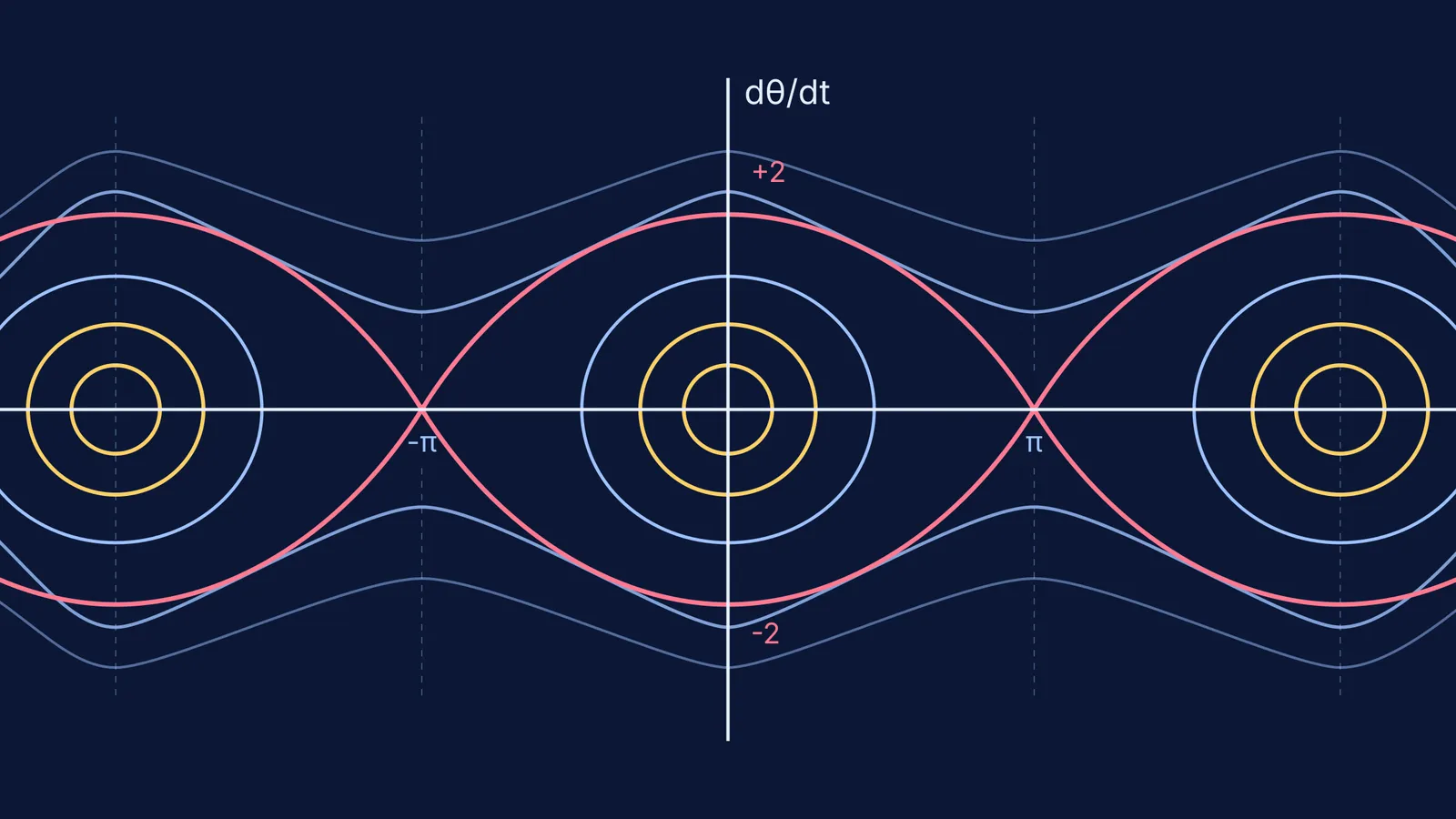
In nonlinear systems, superposition fails completely. For a simple pendulum governed by the nonlinear equation d²θ/dt² + (g/L) sin(θ) = 0, doubling the starting angle alters the oscillation period, and adding two wave motions together distorts the waveform. When you encounter challenging differential equations, Fermi's AI tutor notices where a student is stuck, decides whether to explain, ask or show, and checks understanding as you work through the solution.


