

On this page
On 22 October 1934, Enrico Fermi and his colleagues at the University of Rome found that neutrons slowed down by hydrogen atoms produce far more induced radioactivity, as physicists Emanuele Goldoni and Ledo Stefanini recount in their paper on a forgotten Fermi lecture. That result is the idea behind a reactor's moderator, and it rests on a collision formula from Class 11.
What did Fermi's team find in October 1934?
The Rome group spent 1934 firing neutrons at element after element and measuring the radioactivity left behind. In his 1938 Nobel lecture, Fermi names his collaborators as Amaldi, d'Agostino, Pontecorvo, Rasetti and Segrè.
Then the readings started to depend on the furniture. In an October 1935 talk in Palermo, quoted by Goldoni and Stefanini, Fermi said a silver sample irradiated on a wooden table became more active than the same sample on a stone support, and that pieces of lead placed nearby also increased the effect, which at first made no sense.
The decisive test used paraffin wax. Fermi's Nobel lecture states that surrounding both the source and the sample with paraffin "increases in some cases the intensity of activation by a very large factor (up to 100)", and that water does the same.
The team's full report, Artificial radioactivity produced by neutron bombardment II in the Proceedings of the Royal Society A (1935), calls the effect of hydrogenated substances "by far the most interesting new result". Fermi's 1938 Nobel Prize in Physics cites his "related discovery of nuclear reactions brought about by slow neutrons".
Why does paraffin slow neutrons down?
Paraffin is a hydrocarbon, packed with hydrogen atoms, and a hydrogen nucleus is a single proton. Fermi's explanation in his Nobel lecture is that the neutron and the proton have approximately the same mass, so an elastic hit shares the neutron's kinetic energy with the proton. He adds that a neutron starting at about a million electron-volts reaches thermal energy after about 20 impacts against hydrogen atoms.
Heavy nuclei are poor at this: a table-tennis ball bouncing off a cricket ball keeps almost all its speed. As HyperPhysics puts it, the maximum transfer of energy occurs when the target nucleus is comparable in mass to the projectile. Fermi's lecture records the same pattern: substances without hydrogen sometimes showed similar effects, "though extremely less pronounced".
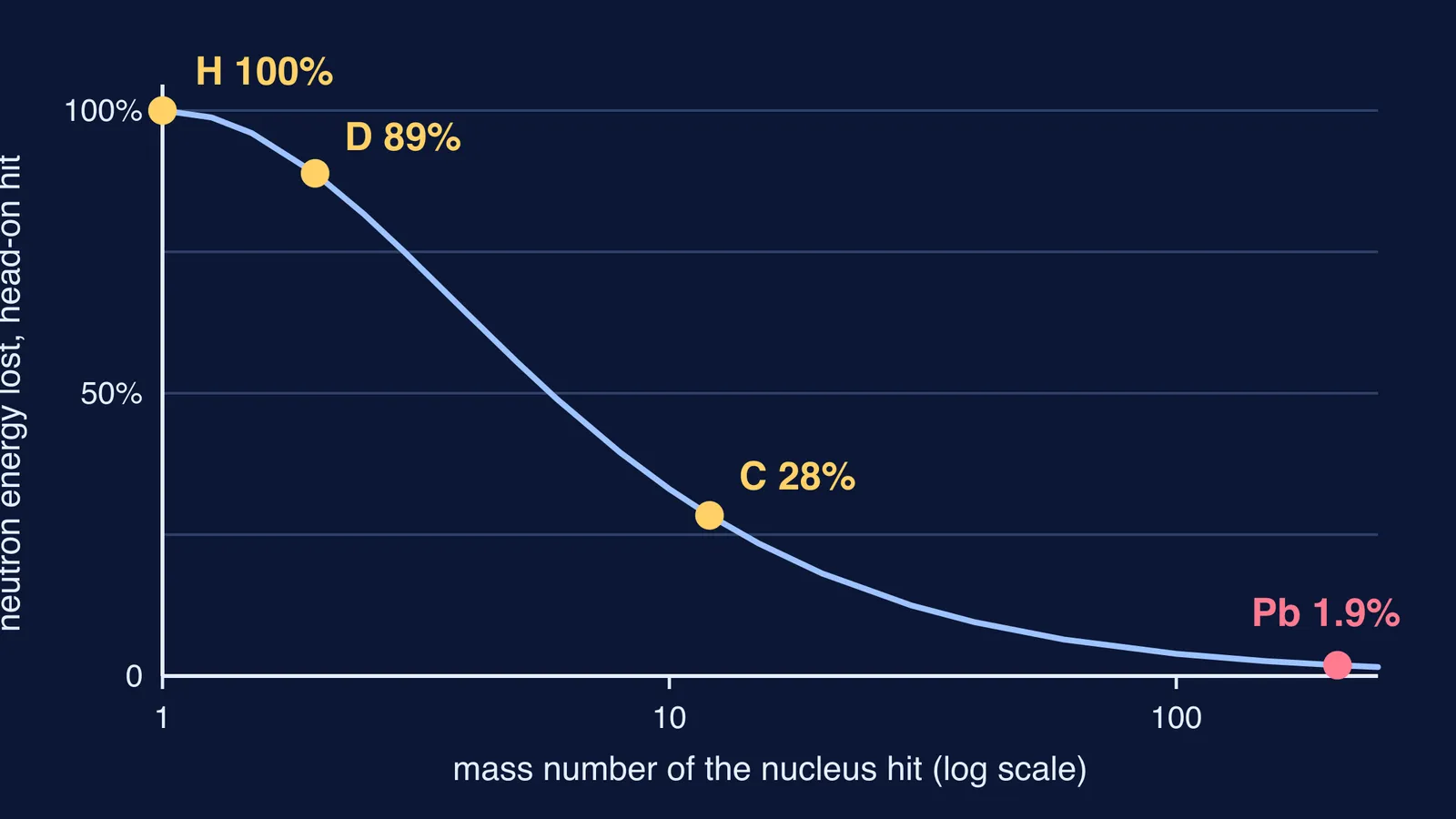
Here is the worked example. A neutron of mass m hits a nucleus of mass Am at rest, head-on and elastically. Conserving momentum and kinetic energy, the fraction of the neutron's energy handed to the nucleus is 4A / (1 + A)².
Hydrogen, A = 1: 4/4 = 1. The neutron can stop dead and give away all its energy.
Deuterium, A = 2: 8/9, about 89%.
Carbon, A = 12: 48/169, about 28%.
Lead, A = 208: 832/43,681, about 1.9%.
Glancing hits remove less. Our step-by-step derivation of this formula works through the algebra. If you understand collisions better by watching them, the Fermi Simulation Lab has interactive simulations for the ideas that are easier to see than to read.
Why are slow neutrons better at causing reactions?
In the Nobel lecture, Fermi writes that theory and experiment both show certain neutron reactions, especially capture, where the nucleus absorbs the neutron, have a much larger cross-section for slow neutrons than for fast ones. A cross-section is the effective target area a nucleus offers to an incoming neutron. That, he says, accounts for the stronger activation seen inside a large mass of paraffin or water.
Why do nuclear reactors need a moderator?
Nobody understood uranium fission in 1934; a footnote in Fermi's December 1938 lecture cites Hahn and Strassmann's new finding of barium in bombarded uranium. How Bohr and Wheeler explained fission with a liquid drop covers what came next, and Leo Szilard's 1933 chain-reaction idea shows why each fission must lead to another.
The US Nuclear Regulatory Commission defines a moderator as "a material, such as ordinary water, heavy water, or graphite, that is used in a reactor to slow down high-velocity neutrons, thus increasing the likelihood of fission".
The Rajasthan Atomic Power Station shows the trade-off. A Nuclear Power Corporation of India safety evaluation states that it uses natural uranium oxide as fuel and heavy water as primary coolant and moderator. Ordinary hydrogen slows neutrons best but also captures some of them; HyperPhysics notes that heavy water avoids this loss. As the worked example above shows, deuterium still slows neutrons effectively.
How do you explain the paraffin result in an exam answer?
Use this checklist for a five-mark answer or a viva:
Who and when: Fermi's group in Rome, October 1934.
What they saw: paraffin or water around source and sample made the induced radioactivity much stronger.
Why: elastic collisions with hydrogen nuclei of nearly equal mass drain the neutron's energy.
The formula: a head-on hit removes 4A / (1 + A)² of the energy.
The consequence: slow neutrons have a much larger capture cross-section.
The application: a reactor moderator such as water, heavy water or graphite.
If the collision algebra is where you get stuck, the Fermi Problem Library has worked problems with a step-by-step solver that explains the reasoning rather than printing an answer.


