

On this page
In January 1939, Niels Bohr arrived in New York aboard the ocean liner SS Drottningholm carrying astonishing news from Europe. Chemists Otto Hahn and Fritz Strassmann had detected barium after bombarding uranium with neutrons, and physicists Lise Meitner and Otto Frisch had formulated the physical explanation in Nature (Meitner & Frisch, 1939). The uranium nucleus was not merely chipping off a particle; it was splitting in two. Frisch coined the term "nuclear fission", using George Gamow's concept of a nuclear fluid to calculate an energy release of roughly 200 MeV per event (Meitner & Frisch, 1939). You can explore the experimental timeline in our account of Lise Meitner and Otto Frisch's discovery of nuclear fission.
What is the liquid drop model of nuclear fission?
At Princeton University, Bohr collaborated with 27-year-old physicist John Archibald Wheeler. Together, they developed the first quantitative theory of fission in their landmark paper, "The Mechanism of Nuclear Fission" (Bohr & Wheeler, 1939).
Building upon Carl Friedrich von Weizsäcker's semi-empirical mass formula (Weizsäcker, 1935), Bohr and Wheeler treated the nucleus as an incompressible droplet of positively charged fluid governed by two competing forces:
Surface tension: The attractive strong nuclear force binds nucleons together. Nucleons at the surface have fewer neighbours, producing an effective surface tension that pulls the droplet into a sphere to minimise surface area, contributing an energy proportional to A^(2/3).
Coulomb repulsion: Protons inside the nucleus repel one another electrostatically. This repulsion pushes outward with an energy proportional to Z²/A^(1/3), striving to disrupt the droplet.
In lighter nuclei, surface tension dominates, locking the nucleus into a spherical shape. But in heavy nuclei containing more than 90 protons, electrostatic repulsion creates severe internal strain (Weizsäcker, 1935).
When does electrostatic repulsion tear the nucleus apart?
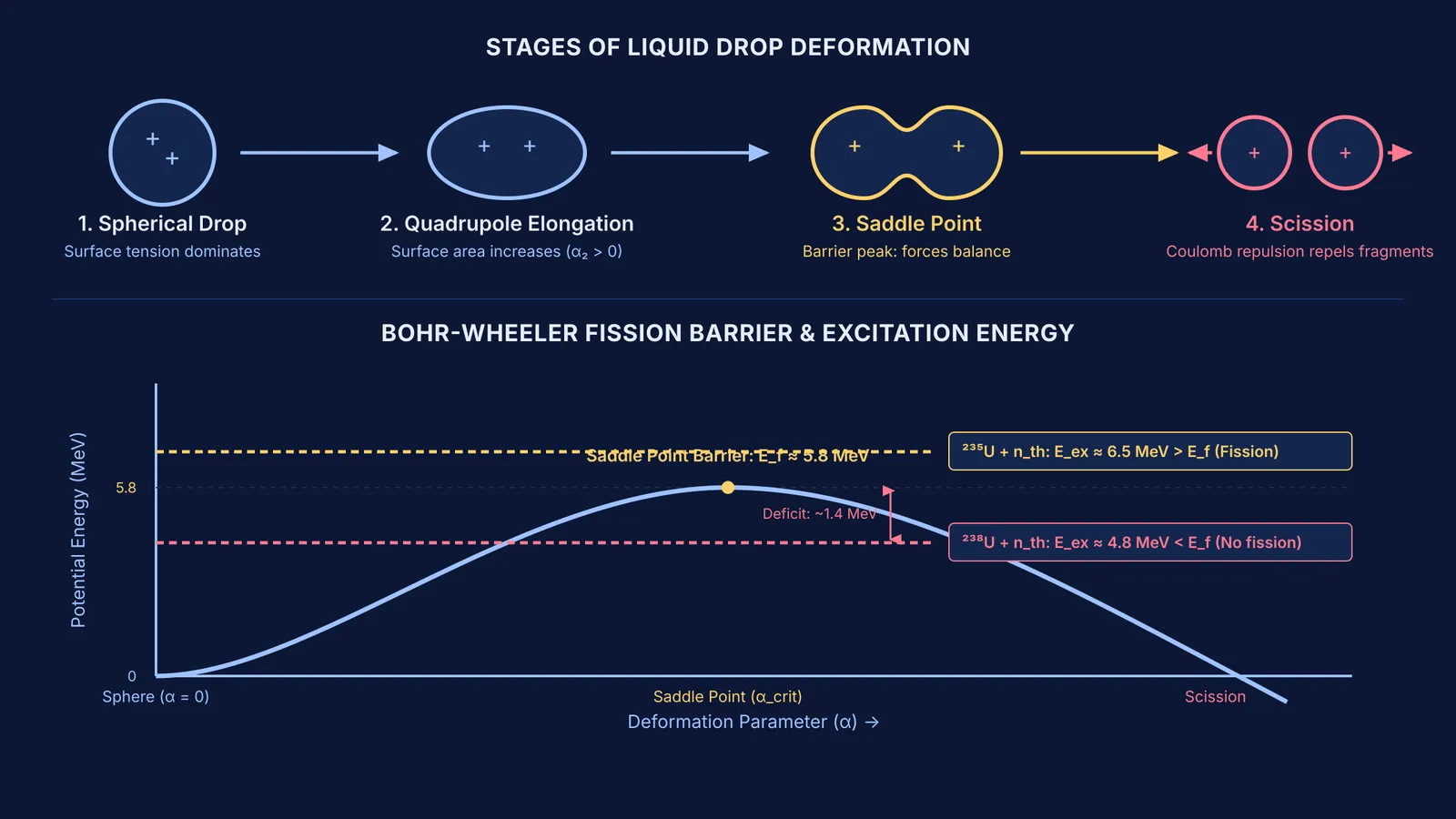
Bohr and Wheeler analysed what happens when a spherical drop undergoes a small quadrupole distortion into an ellipsoid with deformation parameter α₂ (Bohr & Wheeler, 1939).
Stretching increases surface area, raising surface energy by (2/5) E_surface^(0) α₂². Simultaneously, protons move farther apart, reducing Coulomb repulsion by (1/5) E_coulomb^(0) α₂². The net energy change ΔE is:
ΔE = (2/5) E_surface^(0) α₂² × (1 − x)
Here, x is the fissility parameter defined by Bohr and Wheeler:
x = E_coulomb^(0) / (2 E_surface^(0)) = (Z² / A) / (Z² / A)_crit
Bohr and Wheeler calculated that the critical threshold (Z² / A)_crit is approximately 47.8 (Bohr & Wheeler, 1939). When x exceeds 1, any deformation lowers total energy, causing instantaneous spontaneous fission. For uranium-235, Z² / A is roughly 36.0 (x ≈ 0.75); for uranium-238, Z² / A is roughly 35.6 (x ≈ 0.74) (Bohr & Wheeler, 1939). Because both have x < 1, their spherical ground states are stable against spontaneous collapse.
Visualising how fluid drops deform and vibrate can be challenging from static diagrams alone. The Fermi Simulation Lab provides interactive simulations for the ideas that are easier to see than to read, helping students observe how droplet surface tension and charge interact during deformation.
Why does uranium-235 split with slow neutrons while uranium-238 does not?
In 1939, experiments revealed a puzzle: natural uranium fissioned with slow thermal neutrons, but intermediate-energy neutrons were captured without fission.
Bohr realised that natural uranium consists of 99.28% uranium-238 and only 0.72% uranium-235 (Nier et al., 1940). Slow-neutron fission was caused entirely by the rare uranium-235 isotope.
The explanation rests on quantum pairing energy (Weizsäcker, 1935). Nucleons gain stability when paired:
Uranium-235 has 92 protons and 143 neutrons (an odd neutron number). Capturing a slow neutron with roughly 0.025 eV of kinetic energy pairs up the 143rd neutron. In Bohr and Wheeler's original paper, this releases about 6.4 MeV of excitation energy against a 5.6 MeV fission barrier in uranium-236, clearing the threshold by 0.8 MeV (Bohr & Wheeler, 1939). Modern evaluations place these values at roughly 6.5 MeV of excitation versus a 5.8 MeV barrier.
Uranium-238 has 92 protons and 146 neutrons (an even-even nucleus). Adding a neutron forms uranium-239, leaving the new neutron unpaired. Bohr and Wheeler calculated an excitation energy of 5.2 MeV against a 5.9 MeV barrier, leaving a deficit of 0.7 MeV (Bohr & Wheeler, 1939). Modern measurements place the excitation at 4.8 MeV and the barrier at 6.2 MeV, meaning a deficit of 1.4 MeV remains. Fission requires fast neutrons with kinetic energy greater than 1 MeV.
In March 1940, Alfred O. Nier separated uranium isotopes with a mass spectrometer, and John Dunning's team at Columbia bombarded them with neutrons, confirming that uranium-235 alone splits with slow neutrons (Nier et al., 1940).
How can you predict whether a nucleus will fission?
To evaluate whether a heavy nuclide fissions with thermal neutrons, use this four-step framework based on the liquid drop model (Bohr & Wheeler, 1939):
Count the target neutrons: Check whether neutron number N is odd or even. An odd neutron count provides an immediate pairing bonus of roughly 1.2 to 1.7 MeV upon neutron capture.
Determine excitation energy: Odd-N targets (such as U-233, U-235, and Pu-239) release 6.4 to 6.8 MeV of excitation energy, while even-N targets release only 4.8 to 5.3 MeV.
Compare excitation with the fission barrier: If excitation energy exceeds the saddle-point barrier E_f, the nuclide is fissile with zero-kinetic-energy thermal neutrons.
Identify threshold energy: If excitation falls below E_f, calculate the deficit. Fast neutrons with kinetic energy exceeding this threshold are necessary to induce fission.
This energetic balance underpins nuclear binding energy and mass defect calculations and explains how nuclear fission and fusion energy release sustains controlled chain reactions.
When working through nuclear reaction equations and threshold calculations, breaking problems into explicit binding and activation steps clarifies the underlying physics. The Fermi Problem Library has worked problems with a step-by-step solver that explains the reasoning rather than printing an answer. For exploring related topics across science, the Fermi Concept Library covers every concept in physics, chemistry, biology, mathematics and computing, each with its own lesson and its place in the map.
By translating the complex quantum dynamics of the nucleus into the familiar language of droplets and surface tension, Bohr and Wheeler gave physics the first complete mechanism of nuclear fission.


