

On this page
When a moving object strikes a stationary target, the kinetic energy it passes on depends entirely on the ratio of their masses. This principle dictates everything from billiard balls stopping dead on a table to how nuclear reactors control their chain reactions.
What is the fraction of kinetic energy transferred?
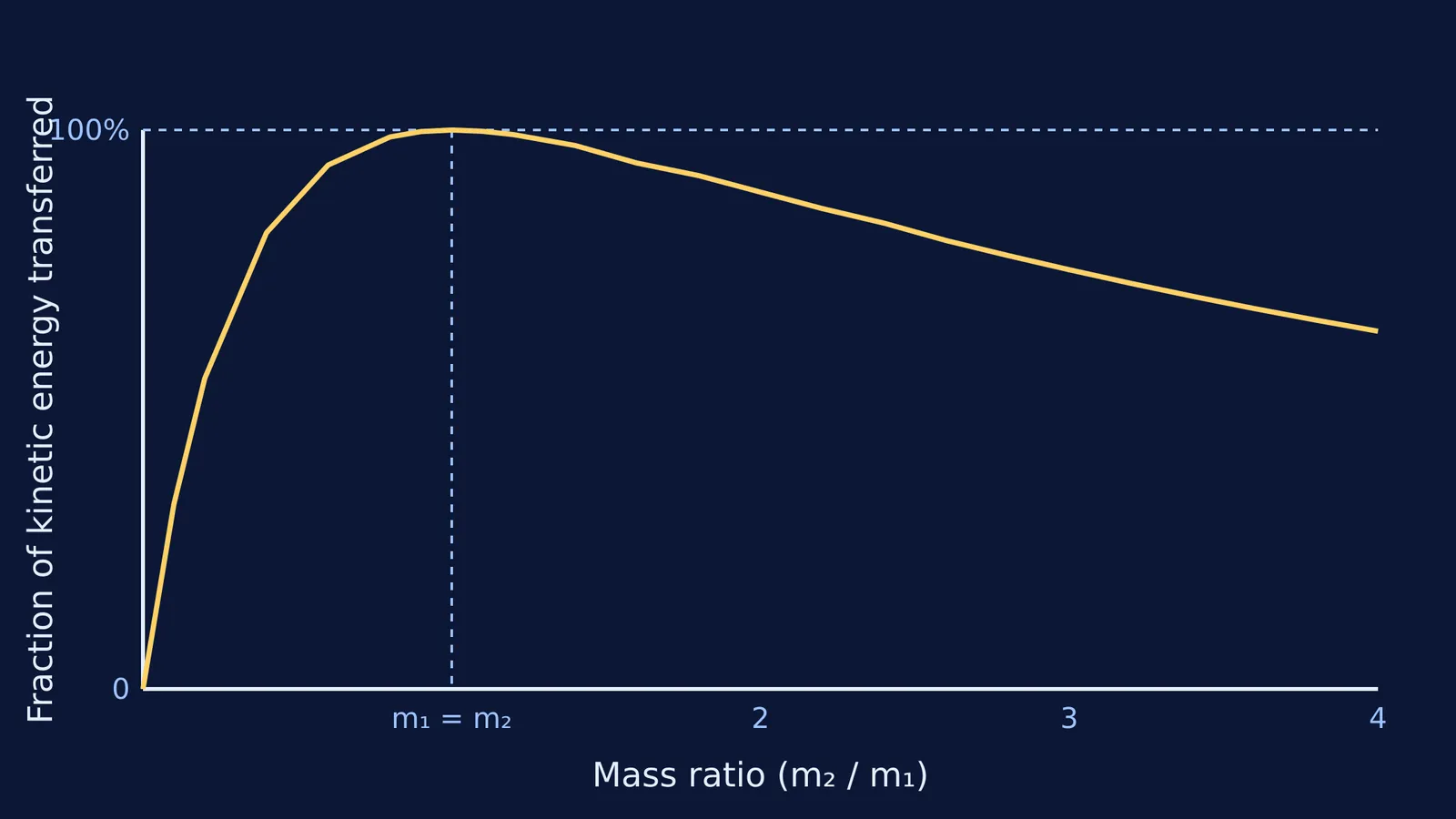
In a head-on elastic collision with a stationary target, the fraction of kinetic energy transferred is given by the formula 4m₁m₂ / (m₁ + m₂)², where m₁ is the mass of the incoming object and m₂ is the mass of the target [[1]](http://hyperphysics.phy-astr.gsu.edu/hbase/elacol2.html).
This relationship comes directly from solving the equations for the conservation of momentum and the conservation of kinetic energy simultaneously. The fraction tells you what portion of the original energy is given to the target, while the remainder is retained by the incoming object.
Why do equal masses transfer the most energy?
If you substitute equal masses (m₁ = m₂) into the formula, the fraction of energy transferred is exactly 100% [[1]](http://hyperphysics.phy-astr.gsu.edu/hbase/elacol2.html). The moving object transfers all of its kinetic energy and comes to a complete stop, while the target shoots forward with the incoming object's exact initial velocity.
When the masses are very different, the transfer is highly inefficient. If a light object hits a very heavy target, it bounces back with almost all its original speed. If a heavy object hits a light target, it ploughs through almost unaffected. In both extreme cases, the fraction of kinetic energy transferred approaches 0%. This works differently when the collision is not head-on.
Why do reactors use water to slow down neutrons?
This mass-matching principle is the foundation of neutron moderation in nuclear power. When uranium undergoes fission, it releases fast neutrons with kinetic energies around 1 MeV [[2]](http://hyperphysics.phy-astr.gsu.edu/hbase/NucEne/moder.html). However, a reactor needs these neutrons to be slowed down to thermal energies of about 1 eV so they can be captured to trigger further fission and sustain the chain reaction [[2]](http://hyperphysics.phy-astr.gsu.edu/hbase/NucEne/moder.html).
To slow them down, reactors use a material called a neutron moderator. Because a neutron and a hydrogen nucleus (a single proton) have almost exactly the same mass, a head-on collision between them transfers the maximum possible energy. This makes ordinary light water, which is rich in hydrogen, an exceptionally effective moderator for slowing fast neutrons quickly [[2]](http://hyperphysics.phy-astr.gsu.edu/hbase/NucEne/moder.html).
A worked example: neutron hitting a carbon nucleus
To see why hydrogen is a better moderator than carbon (graphite), we can calculate the energy transfer fraction directly.
Identify the masses: A neutron has a mass of approximately 1 amu (m₁ = 1). A carbon-12 nucleus has a mass of 12 amu (m₂ = 12).
Calculate the fraction: Substitute these into the formula 4m₁m₂ / (m₁ + m₂)².
Solve: This gives (4 × 1 × 12) / (1 + 12)² = 48 / 169.
Result: 48 / 169 is approximately 28.4%. A neutron transfers only about 28.4% of its kinetic energy in a head-on collision with carbon, compared to 100% with hydrogen. This is why a graphite-moderated reactor requires many more collisions to thermalise a neutron.
Working through collision numericals
Setting up collision problems involves careful algebra. You must establish a coordinate system, write the conservation equations, and avoid sign errors when substituting expressions. This is true whether you are tracking billiard balls or calculating the recoil of the daughter nucleus in alpha decay.
If you are struggling with the core ideas behind conservation laws, the Fermi Concept Library can help. It covers every concept in physics, chemistry, biology, mathematics and computing, each with its own lesson and its place in the map.
Once you understand the physics, you still need to apply it. If you keep dropping marks because of algebraic slips or wrong assumptions about the final velocities, the Fermi Problem Library is a step-by-step solver that explains the reasoning rather than printing an answer, allowing you to trace exactly where your method diverged from the correct path.


