

On this page
Labs that need to know exactly which radioactive isotopes are in a sample, whether it is soil after a reactor leak, food, or a nuclear physics experiment, use a germanium detector. It is a lump of very pure germanium crystal that sits at the end of a metal rod dipped in liquid nitrogen at 77 K, about −196 °C. Switch it on warm and it is useless. Cool it and it measures gamma-ray energies to about one part in a thousand. Both facts come straight from the semiconductor physics in your Class 12 syllabus, and this post works out the numbers.
How does a germanium detector measure gamma-ray energy?
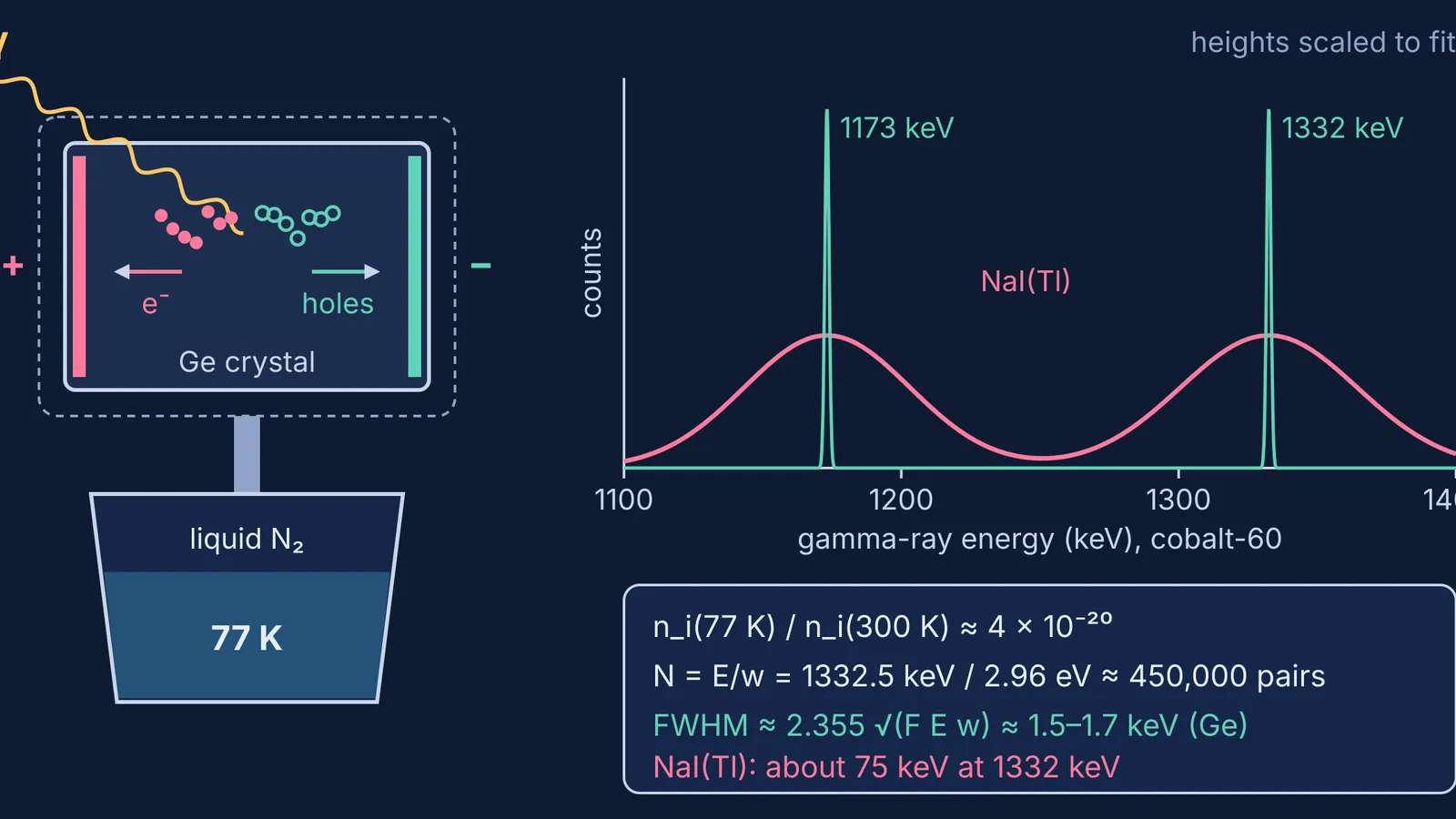
A germanium detector is a large reverse-biased p–n junction, or a p-i-n structure, with a few thousand volts across it. Reverse bias sweeps out free carriers, so the crystal becomes a thick depletion region with a strong electric field and almost no current.
A gamma ray enters and knocks an electron out of an atom (photoelectric effect or Compton scattering).
That fast electron ploughs through the crystal and creates a trail of electron–hole pairs.
The field drives the electrons to the positive electrode and the holes to the negative electrode.
The total charge collected is proportional to the energy deposited. A charge-sensitive amplifier turns it into a pulse, and a multichannel analyser sorts pulses by height into a spectrum.
Germanium is used rather than silicon for gamma rays because its atomic number is 32 against silicon's 14, so it stops gamma rays far better, and it can be grown as crystals several centimetres across.
Why does a germanium detector need liquid nitrogen?
The signal from one gamma ray is tiny, a few hundred thousand electrons. Any current that flows without a gamma ray, the leakage current, adds noise and can swamp it. Most of that leakage comes from electron–hole pairs made by heat alone, and their number is set by the intrinsic carrier concentration n_i.
Germanium's band gap is small, about 0.66 eV at 300 K, which is why it leaks more than silicon (see why silicon is preferred over germanium for diodes). The standard result, covered in why intrinsic semiconductor resistance falls with temperature, is n_i ∝ T^(3/2) e^(−E_g/2kT). Run it the other way: cool the crystal and n_i collapses.
Purity matters as much as cooling. For the depletion region to fill a crystal centimetres thick at a few thousand volts, the net impurity concentration must be about 10¹⁰ atoms per cm³, roughly one impurity atom in 4 × 10¹² germanium atoms (Raut and colleagues, Journal of Instrumentation 2020). That is why these crystals are called high-purity germanium, or HPGe.
Worked example: how much does cooling to 77 K cut n_i?
Use the temperature-dependent gap for germanium, E_g(T) = 0.7437 − 4.774 × 10⁻⁴ T²/(T + 235) eV, the Varshni fit quoted by Wei, Wang and Mei, Journal of Instrumentation 2017.
Band gaps. At 300 K: E_g = 0.7437 − 4.774 × 10⁻⁴ × 90,000/535 = 0.663 eV. At 77 K: E_g = 0.7437 − 4.774 × 10⁻⁴ × 5,929/312 = 0.735 eV. The gap widens as the crystal cools.
Thermal energy. kT = 8.617 × 10⁻⁵ eV/K × 300 K = 0.0259 eV at room temperature, and 0.00664 eV at 77 K.
Exponents. E_g/2kT = 0.663/(2 × 0.0259) = 12.8 at 300 K, and 0.735/(2 × 0.00664) = 55.4 at 77 K.
Ratio. n_i(77)/n_i(300) = (77/300)^(3/2) × e^(−55.4 + 12.8) = 0.130 × e^(−42.6) ≈ 4 × 10⁻²⁰.
So cooling cuts the thermally generated carriers by a factor of about 2 × 10¹⁹, twenty billion billion. If you kept the gap fixed at 0.663 eV the factor would still be about 10¹⁷; the widening gap adds roughly another factor of 200. This simple formula ignores the slow temperature change of the effective masses, so treat the answer as an order of magnitude.
Compare with the impurities. At room temperature germanium's n_i is about 2 × 10¹³ per cm³, a standard textbook value, which is a thousand times the 10¹⁰ impurity level, so the crystal is a fair conductor. At 77 K the same formula gives about 10⁻⁶ per cm³: effectively zero.
Why is the resolution about 1.5 keV?
Take the 1,332.5 keV gamma ray from cobalt-60.
Number of pairs. N = E/w = 1,332,500 eV / 2.96 eV ≈ 450,000 pairs. The value of w is about 3 eV at 77 K (Wei, Wang and Mei).
If every pair were independent. The count would follow Poisson statistics, with standard deviation √N = 671, or 0.15% of N. The full width at half maximum (FWHM) is 2.355 standard deviations: 2.355 × 671 × 2.96 eV = 4.7 keV.
With the Fano factor. The pairs are not independent: the total energy is fixed, so if one part of the cascade makes more pairs, less energy is left for the rest. The variance shrinks by the Fano factor F, so FWHM = 2.355 √(F E w). Published values of F for germanium run from about 0.1 up to 0.13 (the paper above uses 0.13). F = 0.1 gives 1.48 keV; F = 0.13 gives 1.69 keV.
Real detectors. Electronic noise and imperfect charge collection add to this. An ORTEC datasheet lists maximum widths of 1.7 to 1.8 keV at 1.33 MeV for its safeguards coaxial detectors (ORTEC SGD-GEM datasheet), close to the statistical limit.
How does a germanium detector compare with a sodium iodide scintillator?
A sodium iodide scintillator turns the gamma-ray energy into light, then a photomultiplier turns the light into charge. Far fewer information carriers survive that chain, so its peaks are much wider. A Canberra specification for a sodium iodide detector gives about 8% FWHM at 662 keV (Canberra Model 802 specification), which is 53 keV. Scaling roughly as √E gives about 75 keV at 1,332 keV, some 40 times wider than germanium.
For cobalt-60 the two lines are 159 keV apart, so a scintillator still shows two broad humps. But two lines 10 or 20 keV apart, common in spectra of fission products, merge into a single hump on sodium iodide and stay cleanly separate on germanium. Scintillators win on cost, size and working at room temperature; how their photomultipliers multiply the light signal is covered in how one photon becomes a million electrons.
If you want to practise problems on n_i and band gaps, the Fermi Problem Library has a step-by-step solver that explains the reasoning.
Quick checklist
An HPGe detector is a reverse-biased germanium diode; the charge collected measures the gamma-ray energy.
Its small band gap makes thermal leakage huge at 300 K; at 77 K n_i falls by about 2 × 10¹⁹ times.
Use n_i ∝ T^(3/2) e^(−E_g/2kT), and remember the gap widens from 0.66 to 0.73 eV on cooling.
Pairs = E/2.96 eV, not E/E_g: about 450,000 pairs for 1,332.5 keV.
FWHM = 2.355 √(F E w): 4.7 keV with F = 1, about 1.5 to 1.7 keV with F = 0.1 to 0.13.
Net impurity about 10¹⁰ per cm³ is what makes the crystal fully depleted.


