

On this page
When you learn about p-n junctions and the energy bands of conductors and insulators, two elements always come up: silicon and germanium. Both are Group 14 semiconductors that have played a foundational role in the history of electronics. However, while early transistors and diodes were often made of germanium, silicon completely dominates the semiconductor industry today. The reason for this shift comes down to a few key physical properties, along with manufacturing advantages that make silicon much more practical for modern applications.
How does the energy band gap affect leakage current?
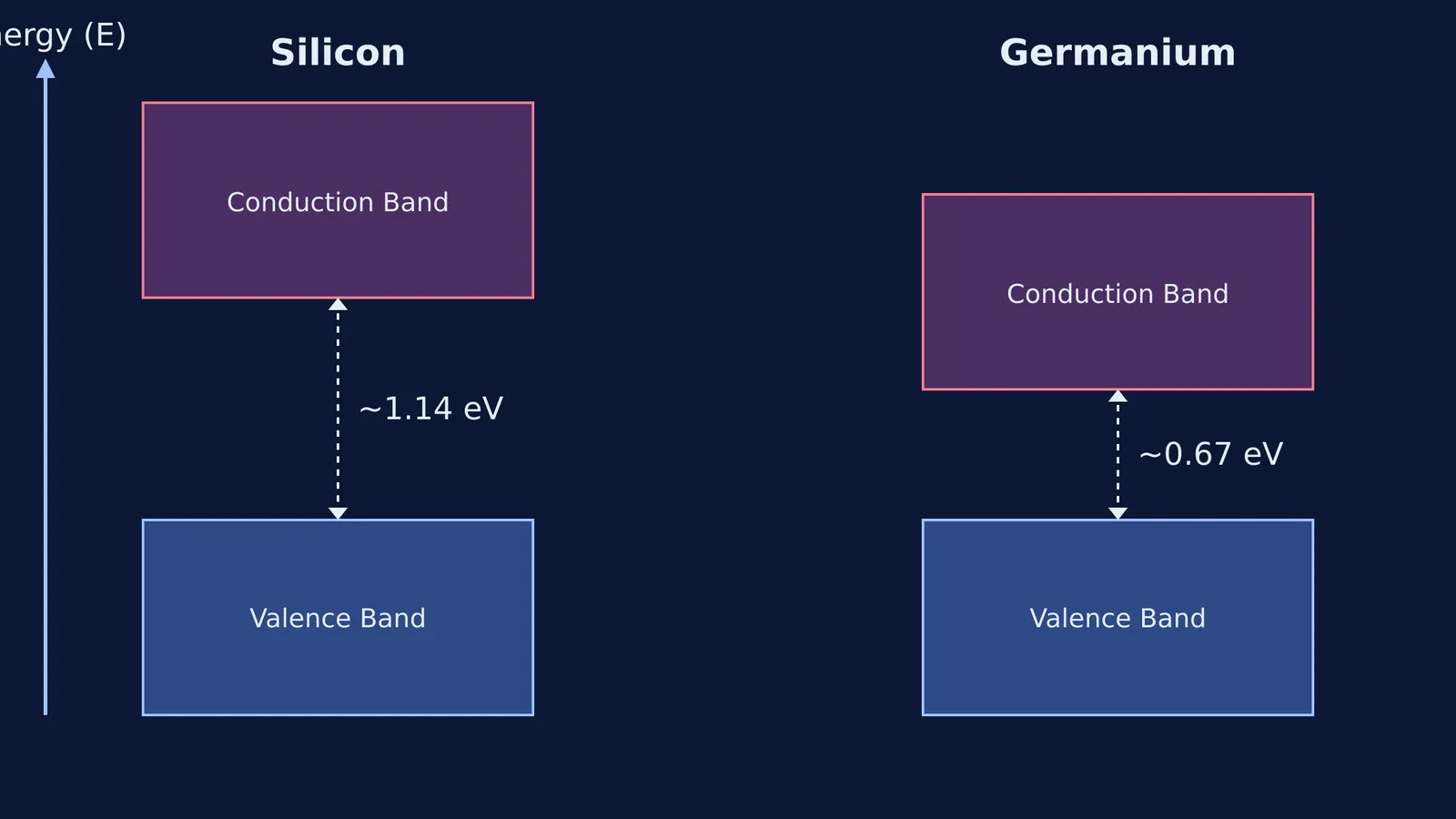
The most fundamental difference between these two materials is the width of their energy band gap. Silicon has an energy band gap of approximately 1.14 eV at room temperature, while germanium's gap is narrower at 0.67 eV [[1]](https://en.wikipedia.org/wiki/Band_gap). This wider gap means that fewer electrons in silicon possess enough thermal energy to jump from the valence band to the conduction band purely due to room-temperature heat.
Because of that narrower band gap, a germanium diode produces significantly more minority charge carriers when heated. This leads to a much higher reverse saturation current, commonly known as leakage current. When a diode is reverse-biased—meaning it is supposed to act as an open switch and block current—some tiny amount of current still flows. In a silicon diode, this leakage current is extremely small. In a germanium diode, the leakage current is significantly higher, often orders of magnitude larger than that of a comparable silicon device.
Why does temperature stability matter in practice?
This sensitivity to heat directly limits a diode's operating environment and its ability to handle power. When leakage current flows, it dissipates power in the form of heat. If the semiconductor cannot shed this heat quickly enough, its temperature rises, which generates even more minority carriers. This creates a dangerous positive feedback loop known as thermal runaway.
Because germanium's leakage current is already relatively high at room temperature, it hits the threshold for thermal runaway at much lower temperatures than silicon. Silicon diodes can reliably operate at much higher junction temperatures without losing their rectifying properties. For power supplies, automotive alternators, and modern computers where significant heat generation is unavoidable, silicon's thermal robustness is essential.
What about the barrier voltage difference?
Germanium does have one distinct advantage over silicon: its forward voltage drop, or barrier potential. A typical silicon p-n diode needs about 0.6 V to 0.7 V of forward bias to start conducting significantly. In contrast, a germanium diode turns on at just 0.25 V to 0.3 V [[2]](https://en.wikipedia.org/wiki/Diode).
This lower turn-on voltage makes germanium diodes uniquely useful in very low-voltage applications. For example, in old crystal radios or specialised signal detection circuits, the incoming radio frequency signals are incredibly weak. A silicon diode would block these tiny signals completely, but a germanium diode can successfully rectify them.
Are there other reasons for silicon's dominance?
Beyond pure electrical performance, silicon holds massive advantages in manufacturing and cost. Silicon is one of the most abundant elements in the Earth's crust, found everywhere in the form of silica sand. This makes the raw material incredibly inexpensive compared to germanium, which is relatively rare and usually extracted as a by-product of mining other metals.
Furthermore, silicon easily forms a stable, strong insulating layer of silicon dioxide when exposed to oxygen at high temperatures. This natural oxide layer is crucial for modern semiconductor fabrication, allowing manufacturers to easily etch, dope, and build complex microchips. Germanium lacks a similarly stable native oxide, making it much harder to process using standard planar manufacturing techniques.
If you want to review the underlying physics behind these materials, the Fermi Concept Library contains detailed lessons on semiconductor physics. When you are working through n-type and p-type carrier concentrations or solving diode circuit problems, keeping track of these threshold voltages is crucial. If you get stuck on whether to apply the threshold voltage drop or treat the diode as ideal in a loop equation, Fermi's AI tutor can help. The tutor will walk you through setting up the node equations step by step, drawing the circuit on the board and asking questions to ensure you understand rather than just handing over the final current value.


