On this page
A fan that spins is nice. A fan that spins, plus a graph showing where your panel gives the most power and why, is a project judges remember.
Most parts of India receive 4-7 kWh of solar energy per square metre each day, with 250 to 300 days of clear sunny weather a year, according to Invest India. On many school days you can take readings outdoors.
Which solar powered project should you build?
Pick one that gives you numbers, not just a working gadget.
Solar fan. A small panel driving a DC motor. Measure motor voltage in full sun, light cloud and with half the panel covered.
Solar charger. A panel feeding a ready-made charge controller module and rechargeable cells. Time the charge at different hours. Never wire a panel straight to a battery or phone.
Maximum power point finder. A panel, a voltmeter and five resistors: the cheapest project, with the most physics. Worked example below.
Heat test. Measure the unconnected panel's voltage on a cool morning and at hot noon. Our explainer on why solar panels lose power in heat covers the reason.
If you need the basics of what happens inside the cell first, start with how solar panels make electricity.
How do you measure a solar panel's real output?
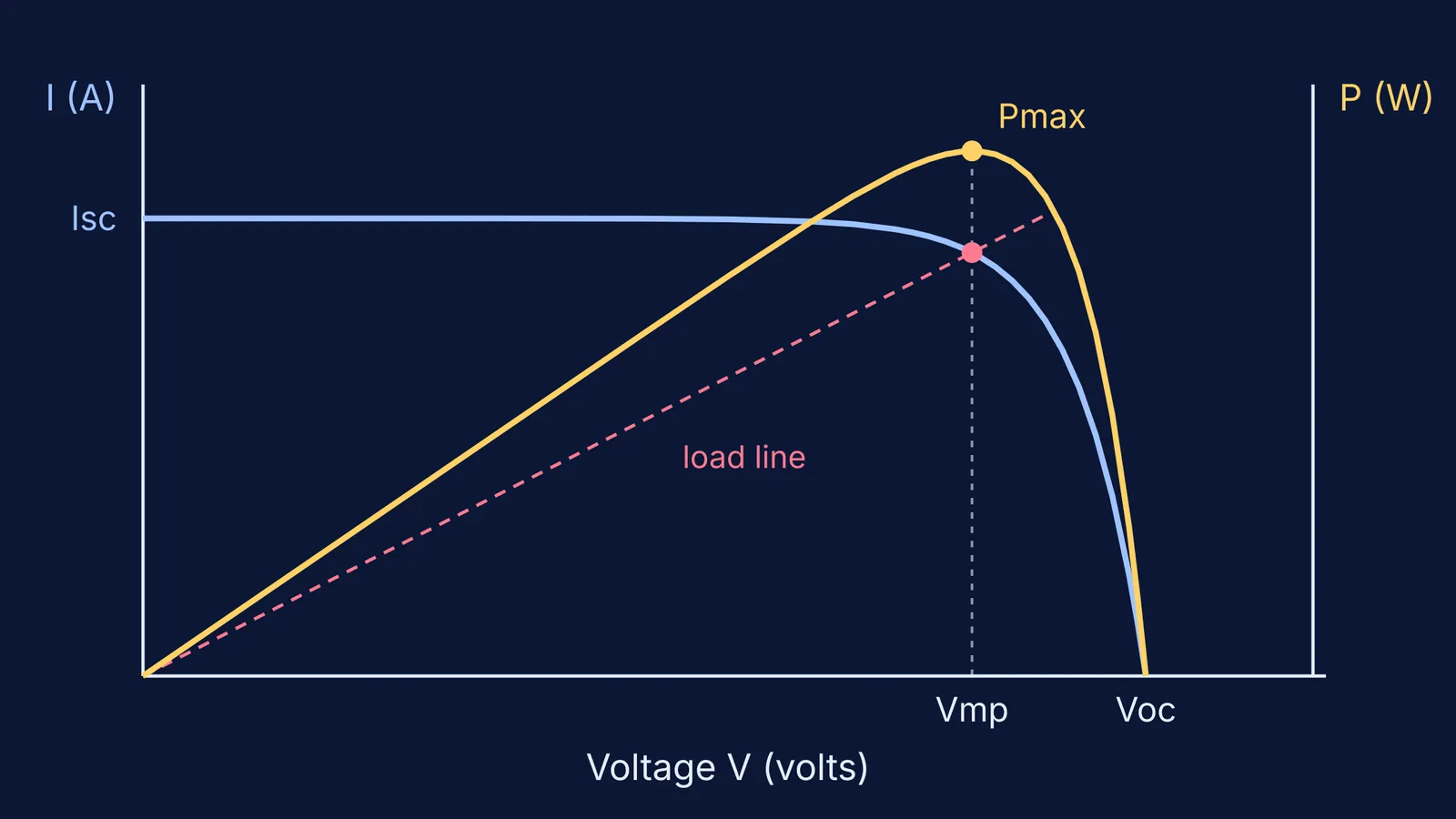
Power is voltage times current, but a panel has no single fixed power. It depends on what you connect to it. PVEducation describes a cell with three numbers:
Open-circuit voltage (Voc): the voltage with nothing connected.
Short-circuit current (Isc): the current when the terminals are joined through an ammeter.
Maximum power point (Pmax): the point on the current-voltage curve where V times I is largest.
Fill factor is the maximum power divided by Voc times Isc, and a typical commercial silicon cell reaches a fill factor of about 0.83 at best, according to PVEducation's fill factor page.
How do you find the maximum power point?
Say your panel reads Voc = 6.0 V and Isc = 0.20 A in noon sun. Connect each resistor across the panel in turn, read the voltage V across it, and work out power as P = V squared divided by R. The readings below come from the standard solar-cell equation for such a panel, so yours will differ, but the shape will match:
10 ohm: 2.00 V, so P = 0.40 W
22 ohm: 4.33 V, so P = 0.85 W
27 ohm: 4.97 V, so P = 0.91 W
47 ohm: 5.63 V, so P = 0.67 W
100 ohm: 5.86 V, so P = 0.34 W
Power rises, peaks near 27 ohm, then falls. The fill factor is 0.91 divided by (6.0 x 0.20), which is about 0.76. Plot power against voltage and you get the yellow curve in the graph at the top of this post. Use resistors rated 2 W or more, and take all five readings within a few minutes so the sunlight stays the same.
Panel ratings are measured under a standard spectrum carrying 1000 W per square metre, according to PVEducation. That gives you an efficiency estimate.
What should you tell the judges about the physics?
Expect questions like these three. Prepare a two-line answer for each.
How does light make electricity? Light frees electrons in the silicon, and the built-in electric field at the p-n junction pushes them one way round your circuit.
Why does power peak in the middle? With a small resistance you get nearly full current but almost no voltage. With a large one you get nearly full voltage but almost no current. The product is largest in between.
Why is your noon reading lower than you expected? Often, heat. For silicon cells, open-circuit voltage falls by about 2.2 mV for every 1 degree Celsius rise, while short-circuit current rises only about 0.06 percent per degree, according to PVEducation. A panel with 12 cells in series would lose roughly 26 mV per degree.
If p-n junctions still feel shaky, the Fermi Concept Library gives each concept its own lesson and shows its place in the map, so you can fill the gap before the fair. Then rehearse out loud with our guide to writing a science exhibition explanation script.
What goes wrong on project day?
Run through this checklist the evening before.
Clouds or an indoor hall. Bring your outdoor graph, and a lamp so the fan still turns.
Loose crocodile clips. They add resistance. Use a terminal block.
Tilt. Record the angle; it changes the output.
Units. Label every axis.
Limits. Say what you could not control, such as changing sunlight.
If you are not sure where to begin with the physics, Fermi's AI tutor can work out what you already know and build a plan for the session.
Build the simplest version this weekend, take five readings and draw one graph. That graph is your project.