On this page
Most students rehearse their exhibition explanation by reading it aloud until it sounds smooth. Then a judge asks one question you never practised. An AI chatbot can help with that part: asking "why?" until you find the gaps.
Why does your explanation fall apart when a judge asks "why"?
Feeling that you understand something is not the same as being able to explain it. In a set of 12 studies, psychologists Leonid Rozenblit and Frank Keil found that people think they understand how things work in far more depth than they really do, and named this the illusion of explanatory depth. They found the illusion is most robust for explanations of things with visible mechanisms. That describes most exhibition models.
Being questioned helps. In a meta-analysis of research on learning by teaching, Keiichi Kobayashi found that teaching someone face to face beat explaining to yourself or teaching indirectly. One explanation the paper gives is that direct teaching "has the additional advantage of asking and answering questions". An AI that plays the judge gives you some of that back and forth before the day itself.
What do science exhibition judges actually mark?
Check your own school's rubric first. For the state-level exhibitions in India, NCERT's 2024-25 guidelines for the Rajya Stariya and Rashtriya Bal Vaigyanik Pradarshani suggest these weightages:
Children's own creativity and imagination: 20 per cent
Originality and scientific and mathematical innovations: 15 per cent
Scientific thought, principle or approach: 15 per cent
Technical skill, workmanship and craftsmanship: 15 per cent
Utility for society and scalability: 15 per cent
Low cost, portability and durability: 10 per cent
Presentation, including demonstration, explanation and display: 10 per cent
The same guidelines say "the tendency of procuring the ready-made exhibits or models must be ruled out", and ask judges to decide whether a model is traditional, an improvement on the traditional one, or an innovation. So a judge's follow-up questions are really checking two things: that the work is yours, and that you understand it.
How do you get an AI to play the judge?
Write a 150-word description of your model in your own words: what it is, what it shows, the science behind it and any numbers you measured. Then paste it in with this prompt:
"You are a judge at a school science exhibition. Here is a student's explanation of their model. Ask me one follow-up question at a time, the way a curious scientist would. Push on the science principle, any numbers I quote, what is new about the model, what it costs and who it helps. Don't explain anything or give me answers. After 8 questions, list the answers where I was vague, wrong or contradicted myself."
Answer out loud before you type.
What does a worked example look like?
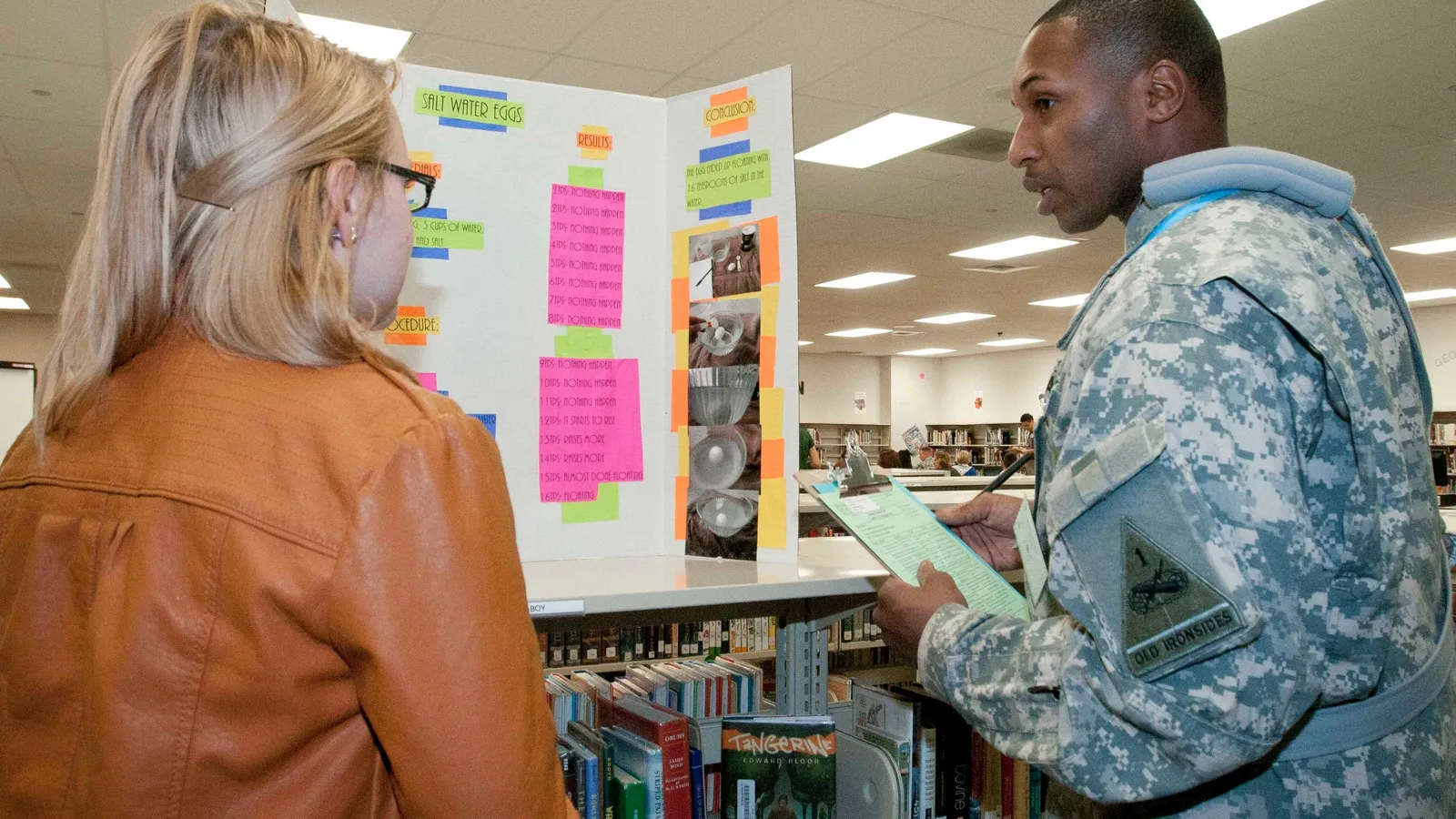
Say your model shows an egg sinking in tap water and floating once you stir in salt. Your first draft says: "Salt makes the water heavier, so the egg floats."
The AI judge asks: "Heavier than what? The egg weighs the same as before. What changed?"
If you can't answer, that's a weak spot. A defensible version: "Dissolving salt raises the density of the water. By Archimedes' principle, the upward push on the egg equals the weight of water it displaces. Once the salt water is denser than the egg, that push is bigger than the egg's weight, so it rises until it floats."
Next question: "How much salt did you need?" If you didn't measure it, don't invent a number; say how you would measure it. "I haven't tested that yet; here's how I would" is easier to defend than a confident guess.
Which parts of your explanation should you fix first?
After a few rounds, go through this list. Rewrite any line you can't defend in two sentences:
The main principle, in one sentence with no jargon you can't define.
Every number on your chart: where it came from and how you measured it.
What is new compared with the textbook version of this model.
What it cost and what you would change to make it cheaper or tougher.
Who it could help, and what stops it working at a larger scale.
One honest limitation, said before anyone asks.
AI tools can get science wrong too. If the "judge" contradicts your NCERT textbook, check with your teacher first.
Where can you go when a question shows you don't understand the concept?
Sometimes the gap is in the concept itself. The Fermi Concept Library has a lesson for every concept in physics, chemistry, biology, mathematics and computing, so you can rebuild the idea before rewriting your answer. For ideas that are easier to see than to read, try the Fermi Simulation Lab. And Fermi's AI tutor is built to teach rather than hand you answers: it decides whether to explain, ask or show, and checks your understanding as it goes.
The night before, run the judge prompt once more, without your notes. If you can answer every question in your own words, you're ready.