

On this page
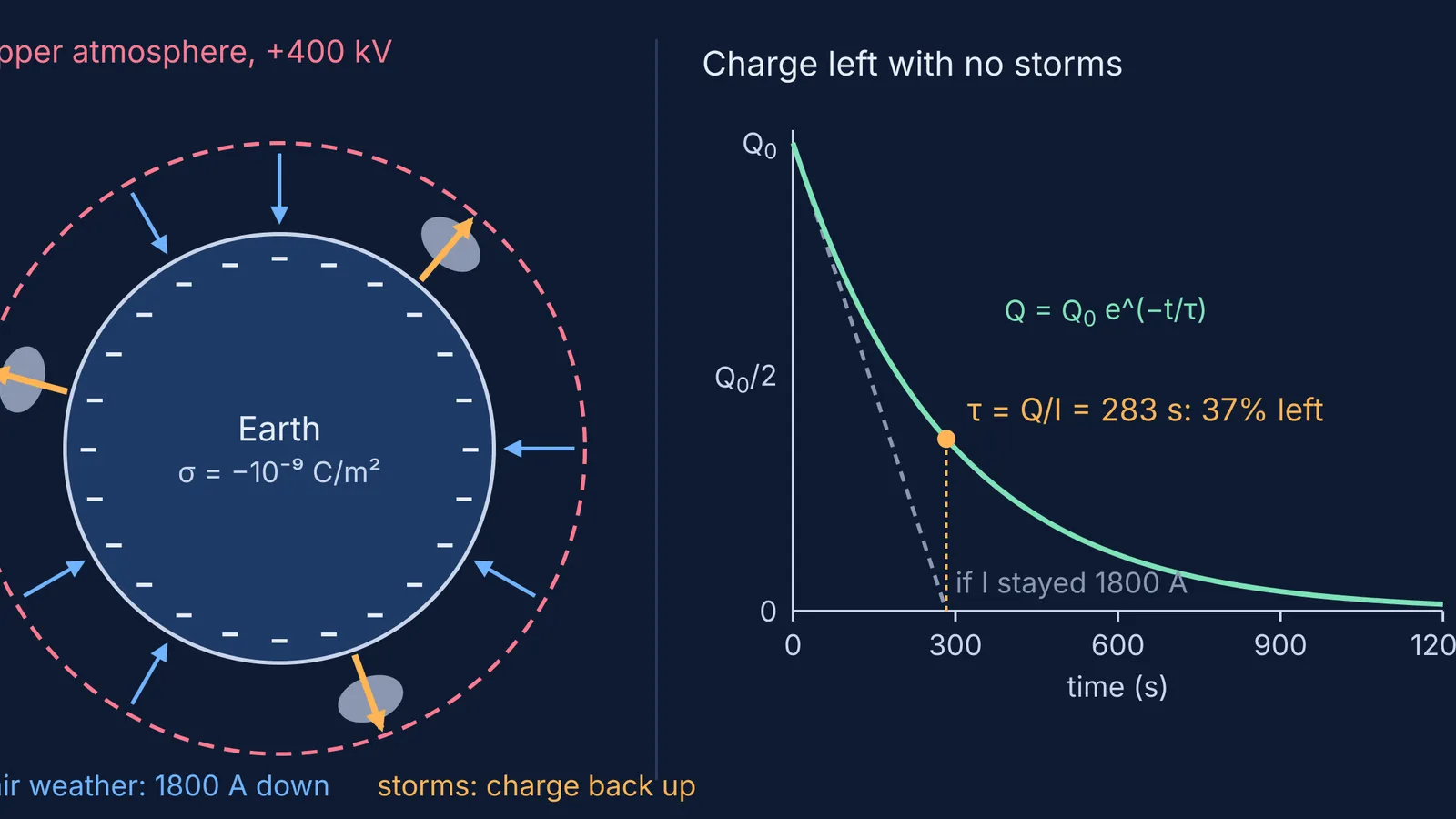
On a fine, cloudless day the ground under your feet carries a negative charge, and the air above it carries a small electric current down to the ground everywhere on the planet. An NCERT Class 12 Current Electricity exercise asks a simple question about this: if nothing replaced the charge, how long would that current take to neutralise the Earth's surface? The answer is under five minutes. Since the Earth plainly stays charged, something must be recharging it all the time, and that something is the world's thunderstorms.
What is the global atmospheric circuit?
Think of the planet as a giant leaky capacitor.
One plate is the conducting ground and sea, with a negative surface charge.
The other plate is the conducting upper atmosphere, a few hundred thousand volts positive relative to the ground.
The leak is the air between them. Air is a very poor conductor, but cosmic rays and natural radioactivity keep making a few ions in it, so a tiny current flows.
Because the upper atmosphere is positive and the ground negative, the electric field near the ground points downward. Positive ions drift down and negative ions drift up, so the conventional current flows downward. Each positive charge that arrives cancels some of the ground's negative charge. This steady leak in fine weather is called the fair-weather current. A clear account of the whole circuit is in The Feynman Lectures on Physics, Volume II, chapter 9, which is where the 400 kV and 1800 A figures used by NCERT are discussed.
NCERT's data, all order-of-magnitude values:
Surface charge density σ = −10⁻⁹ C/m².
Potential difference between the upper atmosphere and the ground: 400 kV.
Total fair-weather current over the whole globe: 1800 A.
Earth's radius R = 6.37 × 10⁶ m.
Worked example: how long would the surface charge last?
Surface area of the Earth. A = 4πR² = 4π × (6.37 × 10⁶ m)² = 5.10 × 10¹⁴ m². Use the surface area, not the volume, because the charge sits on the surface.
Total charge. |Q| = |σ| × A = 10⁻⁹ C/m² × 5.10 × 10¹⁴ m² = 5.1 × 10⁵ C. The sign is negative: the ground carries about half a million coulombs of negative charge.
Time to neutralise at a steady current. t = Q/I = 5.1 × 10⁵ C ÷ 1800 A = 283 s, about 4.7 minutes.
Units check. C ÷ (C/s) = s.
Three more numbers come out of the same data:
Resistance of the whole atmosphere: R = V/I = 400 000 V ÷ 1800 A = 222 Ω.
Power dissipated: P = VI = 400 000 × 1800 = 7.2 × 10⁸ W, or 720 MW.
Average current density: 1800 A ÷ 5.10 × 10¹⁴ m² = 3.5 × 10⁻¹² A/m², a few picoamperes through each square metre of ground.
Does the charge really reach zero after 283 s?
No. The calculation assumes the current stays at 1800 A until the very end, but it cannot. The current is driven by the voltage, and the voltage is proportional to the charge. As the charge leaks away, the voltage falls, so the current falls too.
With a fixed resistance R and capacitance C, the charge decays exponentially:
Q(t) = Q₀ e^(−t/τ), with τ = RC
Check with NCERT's numbers. The capacitance of the Earth and the upper atmosphere together is C = Q/V = 5.1 × 10⁵ C ÷ 4.0 × 10⁵ V = 1.27 F. Then RC = 222 Ω × 1.27 F = 283 s. The NCERT answer is the time constant, not the moment the charge reaches zero.
After 283 s, about 37% of the charge is left.
After about 4.6 τ, roughly 22 minutes, only 1% is left.
Either way the Earth would lose almost all its charge within half an hour. A capacitance of 1.27 F may look strange if you have learnt that an isolated sphere the size of the Earth has only about 0.7 mF. The difference is the second plate: a conducting layer of air above the ground raises the capacitance enormously, just as bringing two plates closer does. The isolated-sphere case is worked out in why Earth's capacitance is only 0.7 mF.
Why does the leak time not depend on the size of the Earth?
Near the ground the field is E = |σ|/ε₀ = 10⁻⁹ ÷ 8.85 × 10⁻¹² = 113 V/m. That matches the field of roughly 100 V/m measured near the ground on fine days, which Feynman's chapter also quotes.
Ohm's law for the air in local form is J = σ_air E, where σ_air is the conductivity of the air. The time constant is then
τ = Q/I = |σ|A/(JA) = ε₀E/(σ_air E) = ε₀/σ_air
The area cancels. The leak time depends only on how well the air conducts. From NCERT's numbers, σ_air = J/E = 3.5 × 10⁻¹² ÷ 113 ≈ 3 × 10⁻¹⁴ S/m. Ordinary air near the ground conducts about 10²¹ times worse than copper, and that is still enough to drain the planet in minutes.
If ε₀ and conductivity feel like separate topics to you, the Concept Library covers each concept in physics on its own, so you can fill the gap before coming back.
What keeps the Earth charged?
Thunderstorms. Inside a storm cloud, collisions between ice particles separate charge, usually leaving the lower part of the cloud negative. Lightning strokes to the ground mostly carry negative charge down, and charge also leaks from sharp points such as trees and buildings below storm clouds, the same corona discharge described in how lightning conductors use sharp points. Above the storm, current flows up to the upper atmosphere. Together, storms act as the battery and the fair-weather regions as the load.
Storms are active somewhere on Earth at every moment, so the circuit never runs down. Feynman's chapter notes that the fair-weather field rises and falls through the day in step with world thunderstorm activity, peaking at the same universal time everywhere. Why storms are common on summer afternoons is covered in why thunderstorms often come in the afternoon.
Quick checklist
Charge on the Earth: |Q| = |σ| × 4πR² ≈ 5.1 × 10⁵ C, negative.
Leak time: Q/I = 5.1 × 10⁵ ÷ 1800 ≈ 283 s, under five minutes.
283 s is a time constant; the real decay is exponential, with 37% left after one τ.
Atmosphere: about 222 Ω, 720 MW, and a ground field of about 113 V/m.
τ = ε₀/σ_air does not depend on the Earth's size.
Conventional current flows downward in fair weather; thunderstorms recharge the ground.


