

On this page
A single metal sphere far from everything has a capacitance too. The formula is short, the Earth result is surprisingly small, and the same idea solves the classic JEE question of two spheres joined by a wire.
What is the capacitance of an isolated sphere?
Put charge Q on a conducting sphere of radius R. Outside the sphere, the field is the same as that of a point charge Q at the centre, so the potential of the surface, measured from infinity, is V = Q/(4πε₀R). Capacitance is charge per unit potential, so C = Q/V = 4πε₀R. HyperPhysics derives the same result by taking a spherical capacitor and letting its outer shell go to infinity. That is what "isolated" means: the second plate is at infinity.
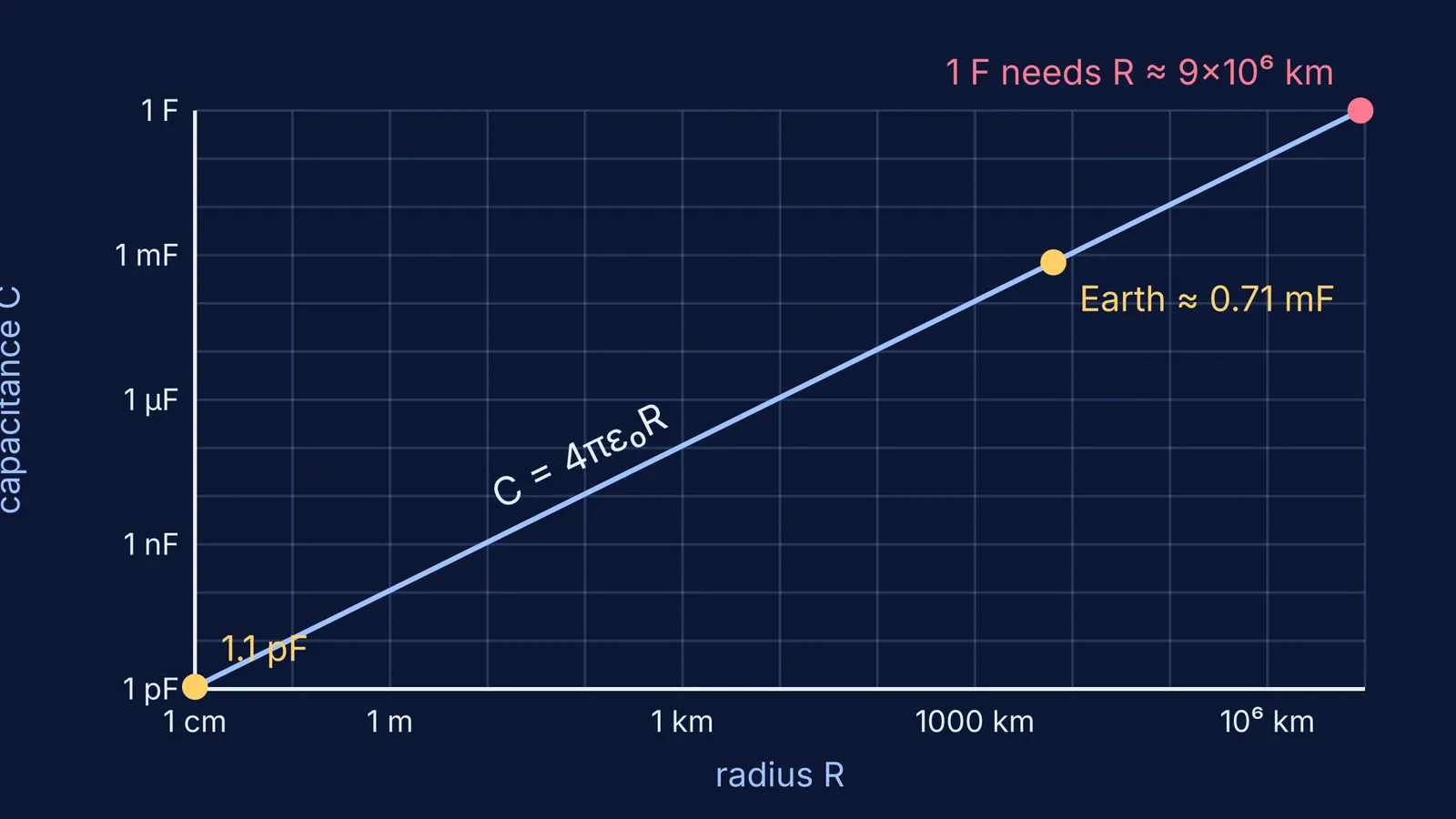
The vacuum permittivity is ε₀ = 8.8541878188 × 10⁻¹² F/m, the CODATA 2022 value listed by NIST. Multiply by 4π and you get 4πε₀ ≈ 1.113 × 10⁻¹⁰ F/m, so every metre of radius adds about 111 pF. A sphere of radius 1 cm has about 1.1 pF. For the finite version with both shells, see our post on spherical and cylindrical capacitors, derived.
Why is Earth's capacitance only about 0.7 mF?
Treat the Earth as a conducting sphere. NASA's Earth fact sheet gives a volumetric mean radius of 6,371 km. Then:
C = 4πε₀R = (1.113 × 10⁻¹⁰ F/m) × (6.371 × 10⁶ m)
C ≈ 7.09 × 10⁻⁴ F, about 0.71 mF
Turn the question round: a sphere of 1 F needs R = 1/(4πε₀) ≈ 8.99 × 10⁹ m, about 9 million km. The Sun's mean radius is 695,700 km according to NASA's Sun fact sheet, so that sphere would be roughly 13 times wider than the Sun.
Textbooks still treat the Earth as a bottomless store of charge at zero potential because lab charges are tiny. Add 1 µC to the Earth and its potential rises by Q/C = 10⁻⁶/(7.09 × 10⁻⁴) ≈ 1.4 mV.
What happens when you join two spheres with a wire?
Keep the spheres far apart, so each keeps C = 4πε₀R, and join them with a thin wire:
The wire makes them one conductor, so charge flows until both are at the same potential.
Total charge is conserved.
Since q = CV and V is shared, charge splits in the ratio of the radii: q₁/q₂ = R₁/R₂.
Surface charge density is q/(4πR²), so σ₁/σ₂ = R₂/R₁. The smaller sphere ends up with less charge but a denser layer of it and a stronger field at its surface. This is the same reason charge crowds onto sharp points. For more variations, read two charged spheres joined by a wire.
Worked example: 3 cm and 1 cm spheres
Sphere A (R = 3 cm) carries 8 nC. Sphere B (R = 1 cm) is neutral. Join them.
Capacitances: C_A = 1.113 × 10⁻¹⁰ × 0.03 ≈ 3.34 pF; C_B ≈ 1.11 pF.
Potential: V_A = 2.40 kV before; after, V = Q/(C_A + C_B) = 8 nC / 4.45 pF ≈ 1.80 kV.
Charges: q_A = 6 nC and q_B = 2 nC (ratio 3:1, the ratio of the radii).
Surface densities: σ_B/σ_A = 3, so the small sphere has the stronger surface field.
Energy: Q²/2C falls from about 9.59 µJ to 7.19 µJ, a loss of 2.40 µJ. That is one quarter, C_B/(C_A + C_B), because B started neutral.
The lost energy becomes heat in the wire and a little radiation, just as in charge sharing between capacitors.
What does earthing a sphere do to its charge?
Earthing is the same problem with sphere B replaced by the Earth. In this far-apart model, the charge left on a sphere of radius R is the fraction R/(R + R_Earth). For the 3 cm sphere that is 0.03/(6.371 × 10⁶) ≈ 4.7 × 10⁻⁹, so of the original 8 nC only about 3.8 × 10⁻¹⁷ C remains. With the elementary charge at 1.602 × 10⁻¹⁹ C (NIST), that is about 235 electrons out of roughly 50 billion. For any exam, the sphere is left neutral and at zero potential.
A four-step check for sphere problems
Is the sphere isolated (C = 4πε₀R), or is there another shell nearby (use the spherical capacitor)?
After connecting, write one equation for equal potentials and one for conserved charge.
Check that the charge ratio matches the radius ratio before you compute fields or σ.
For energy, compare Q²/2C before and after; the loss is zero only if the spheres started at the same potential.
If the potentials are where you get stuck, the Fermi Concept Library has a lesson on each idea, with its place in the map. To practise the numbers, the Fermi Problem Library has worked problems with a step-by-step solver that explains the reasoning rather than printing an answer.


