On this page
Your bag rolls into a tunnel and a screener sees it in orange, green and blue. Each colour is the machine's estimate of what a material is made of, and it rests on Class 12 physics: how atoms absorb X-rays.
How do airport baggage scanners work?
An X-ray tube on one side of the tunnel sends a thin fan of X-rays through your bag. Detectors on the other side measure how much gets through, and the moving belt builds the picture slice by slice. (For how the tube makes X-rays, see why the X-ray cutoff wavelength depends on tube voltage.)
A plain X-ray picture only shows how much each spot blocked. That is not enough, because a thick paperback and a thin steel blade can block the same amount. So checkpoint scanners measure at two energies. A Smiths Detection patent describes dual-energy detectors with “two spectrally selective energy channels”, one for high-energy and one for low-energy X-rays, and says the colour-coding principle is used in viewing “X-ray images of baggage at airport checkpoints” (US patent 12,498,334). The estimated density and effective atomic number are then turned into a pseudo-coloured image using a look-up table (Akcay and Breckon, a survey of X-ray security imaging).
Why do two X-ray energies tell materials apart?
At these energies an X-ray photon is mainly removed in two ways. In the photoelectric effect an atom absorbs the whole photon and throws out an electron. In Compton scattering the photon bounces off an electron and carries on with less energy.
The photoelectric cross-section is proportional to about the fourth or fifth power of the atomic number, while the Compton cross-section grows only roughly in step with it, according to a Tsinghua University and Nuctech patent (US patent 9,464,997). The photoelectric effect also fades quickly as photon energy rises. So the low-energy beam is very sensitive to heavy atoms, while the high-energy beam mostly senses how much matter is in the way.
A worked example with real numbers
A beam passing through a thickness t of material drops as I = I₀e^(−μt). Write μ as (μ/ρ) × ρ, where μ/ρ is the mass attenuation coefficient, and take logs: ln(I₀/I) = (μ/ρ) × ρt. Measure at a low and a high energy and divide one log by the other. The ρt cancels, leaving a ratio R = (μ/ρ)low ÷ (μ/ρ)high that depends only on the material.
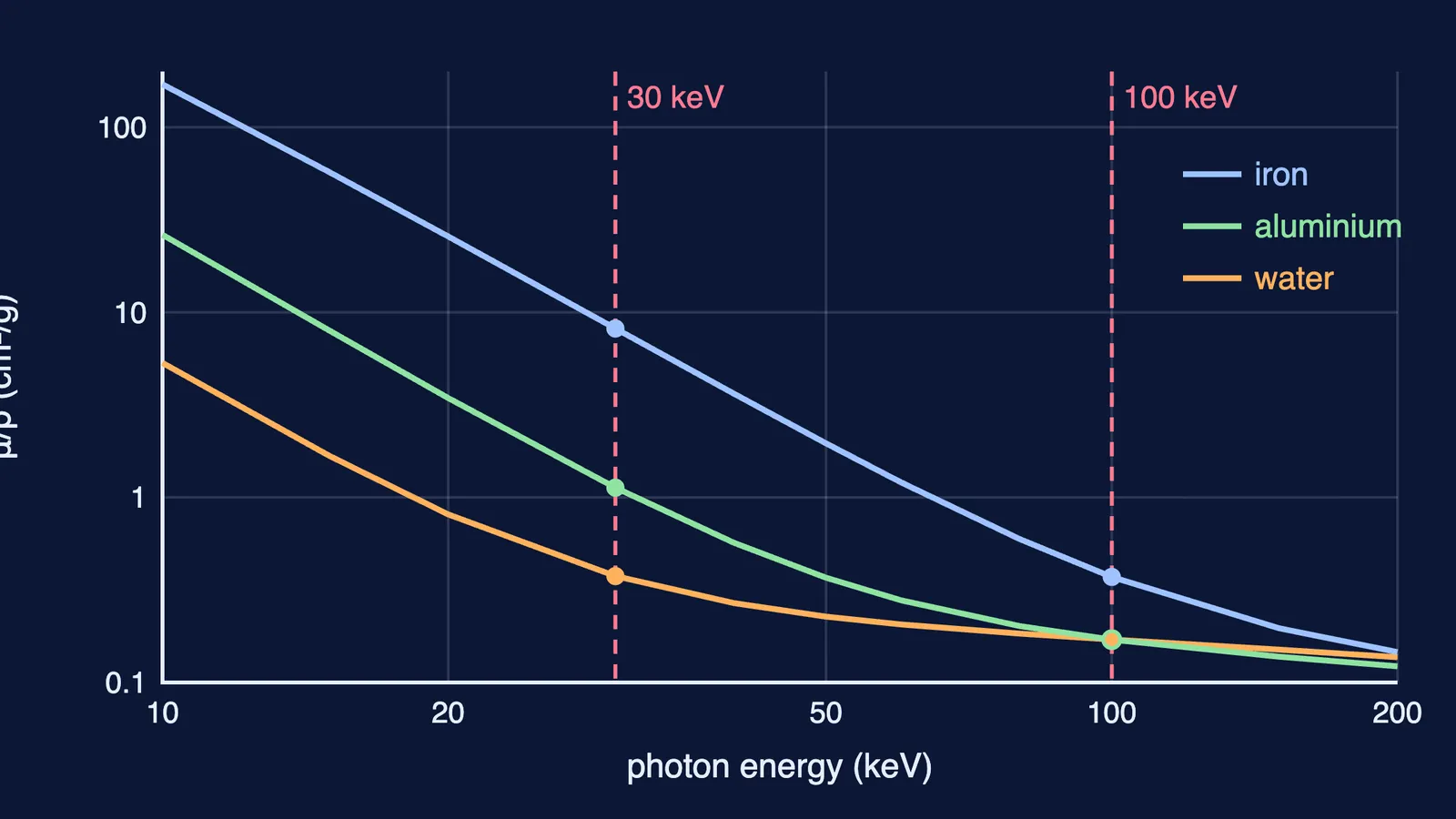
Here is R at 30 keV and 100 keV, using mass attenuation coefficients from NIST, the US measurement-standards laboratory (water, aluminium, iron):
Water, standing in for organic material: 0.3756 ÷ 0.1707 ≈ 2.2
Aluminium (Z = 13): 1.128 ÷ 0.1704 ≈ 6.6
Iron (Z = 26): 8.176 ÷ 0.3717 ≈ 22
Look at 100 keV alone: water and aluminium absorb almost exactly the same per gram, 0.1707 and 0.1704 cm²/g. A single high-energy picture could not tell them apart. The low-energy reading separates them by a factor of three.
Real X-ray tubes give a spread of energies, not two clean values, so real scanners map the readings to colours with a look-up table rather than this exact calculation. The idea is the same. To try it yourself:
Open the NIST table for another element, such as copper.
Read μ/ρ at 0.03 MeV and 0.1 MeV.
Divide, and predict whether the result lands nearer water or iron before you check.
If the exponential law or the photoelectric effect still feels shaky, the Fermi Concept Library has a lesson for each concept in physics and chemistry, with its place in the map.
Why are organic items orange and metals blue?
Organic materials largely have an atomic number of about 10 or less, and metals more than 10, according to the Smiths Detection patent (US patent 12,498,334). The same patent says inspection machines colour pixels of mainly organic material orange, mainly metallic material blue, and a mixture of the two green.
An L-3 patent gives an example scale: items with an effective atomic number between five and ten may be coloured orange, and items between seventeen and twenty-two blue (US patent 8,165,268). It adds that the ranges are preset and may be set by the manufacturer, so exact shades differ from machine to machine.
Organic means compounds built mainly of carbon, hydrogen, oxygen and nitrogen: food, clothes, paper, plastics. The L-3 patent notes that orange can also mean an organic explosive.
What can fool the colours?
Each detector sees everything stacked along one line through the bag. The L-3 patent explains that when an explosive is covered by a sheet of metal, a display of average atomic number shows it in the colour of the metal, not as an orange organic object (US patent 8,165,268). So overlapping items are harder to read from colour alone.
Finding hidden metal with X-rays is an old idea: read how Marie Curie's mobile X-ray cars found bullets in World War 1.
To work through a problem like this step by step, Fermi's AI tutor teaches alongside you, drawing the figure and checking your understanding as it goes.