On this page
Bridges, pipelines and aircraft wings stretch by tiny amounts when they carry load. One way to measure that stretch uses no wires at the sensor at all. A short piece of ordinary glass fibre is given a pattern inside its core that turns it into a mirror for one narrow colour of infrared light. Stretch the fibre and that colour moves. Measure the colour and you know the strain. This sensor is the fibre Bragg grating, and the physics behind it is the same constructive interference you meet in thin films and X-ray diffraction.
What is a fibre Bragg grating?
An optical fibre guides light along its core by total internal reflection. How that guiding works, and the acceptance angle it sets, is covered in acceptance angle and numerical aperture of an optical fibre, so it is not repeated here.
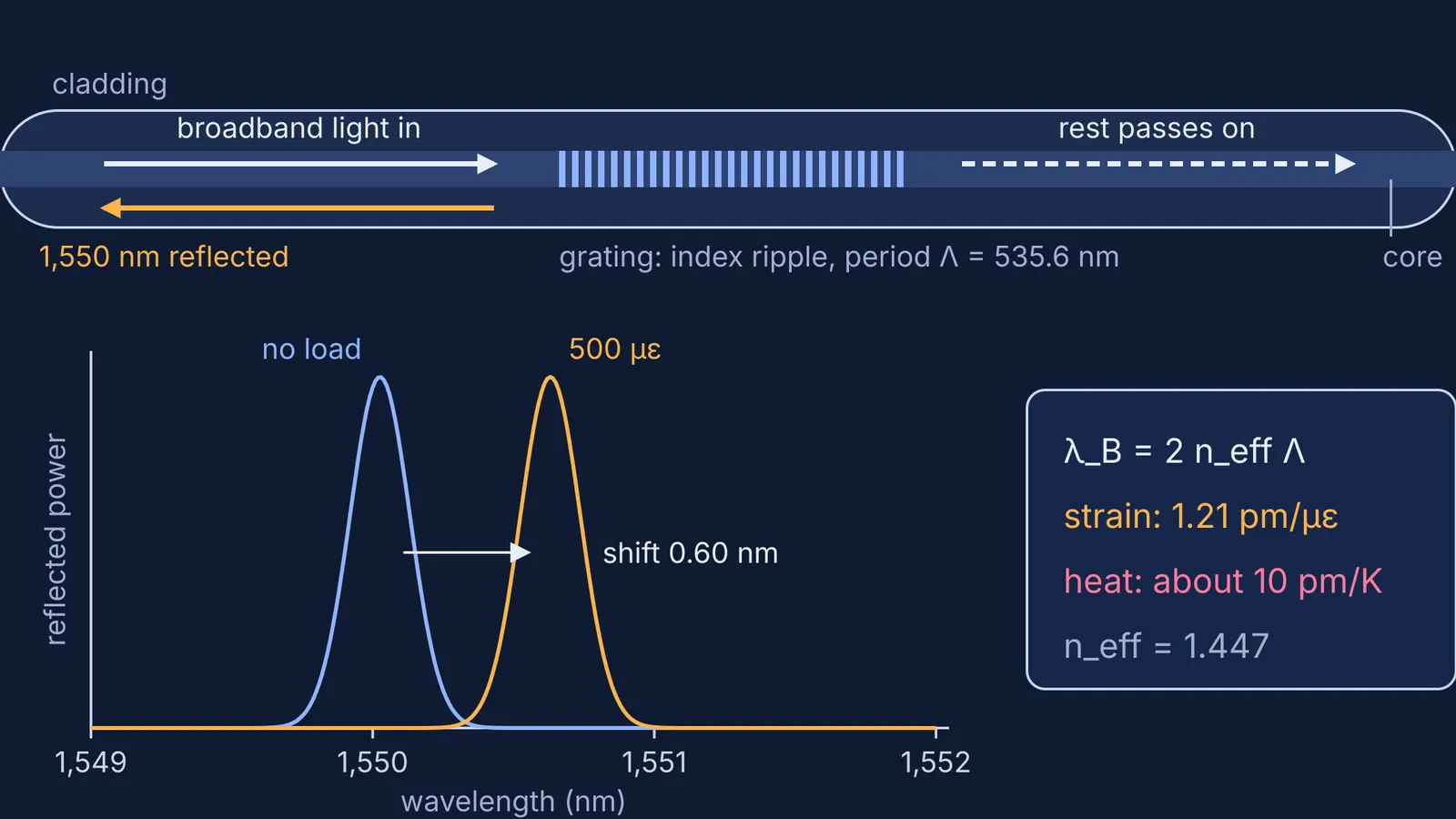
A fibre Bragg grating (FBG) adds one thing. Over a length of about a centimetre, the refractive index of the core is made to rise and fall in a regular ripple, with period Λ (lambda, capital). The ripple is written with ultraviolet light, which changes the index of the glass very slightly. Each high-index band reflects a tiny fraction of the light that reaches it. On its own, one band does almost nothing. Thousands of bands together act as a single, very selective mirror.
Why does the grating reflect only one wavelength?
Think of each band as a weak partial mirror. Light reflected from one band and light reflected from the next band have travelled different distances: the second reflection goes Λ further in and Λ back out, an extra 2Λ. For all the reflections to add up, this extra path must be a whole number of wavelengths, measured inside the glass.
Inside the fibre, light travels as if the refractive index were n_eff, the effective index of the guided mode. Its wavelength in the glass is λ/n_eff. Setting one wavelength in the glass equal to the round trip gives the Bragg condition:
λ/n_eff = 2Λ, so λ_B = 2n_effΛ
The factor 2 is the round trip. It is the same factor as in Bragg's law for X-rays, nλ = 2d sin θ, with the light hitting the planes head-on so that sin θ = 1. The X-ray version, and how it maps crystal planes, is in Lawrence Bragg and the X-ray law that maps atoms in crystals.
At any other wavelength the reflections from different bands arrive out of step and cancel. So the grating reflects one narrow band around λ_B and lets every other wavelength pass straight through.
How much does the reflected wavelength shift with strain?
Stretch the fibre by a strain ε and two things happen.
The period grows. Λ becomes Λ(1 + ε), which on its own would raise λ_B by the fraction ε.
The index drops slightly. Stretching glass changes its refractive index, the photoelastic (strain-optic) effect. This pulls λ_B back down by a fraction p_eε, where p_e is the effective strain-optic coefficient.
Together:
Δλ/λ_B = (1 − p_e)ε
For silica fibre p_e is about 0.22. At 1,550 nm this gives (1 − 0.22) × 1,550 nm = 1,209 nm per unit strain. One microstrain (µε) is 10⁻⁶, so the shift is about 1.21 pm per microstrain. This matches the "~1.2 pm/µε" listed on a manufacturer's datasheet for a standard sensing grating, the Luna os1100 FBG data sheet. Exact values depend on the fibre and its coating, so treat 1.2 pm/µε as typical, not exact.
A picometre is 10⁻¹² m, which is why the reading needs a precise wavelength meter, called an interrogator. Compare this with the foil strain gauge in how a digital weighing scale measures weight, which turns strain into a change of resistance. The FBG turns strain into a change of colour, so long cables and electrical noise do not affect the reading.
Why does temperature spoil the reading, and how is it fixed?
Heat also moves λ_B. The glass expands a little, and, more importantly, its refractive index rises with temperature. The same datasheet gives a thermal response of about 9.9 pm per kelvin for that bare grating.
Divide by the strain sensitivity: 9.9 ÷ 1.21 ≈ 8.2. So a 1 K warm-up looks like about 8.2 µε of stretch. A 5 K change in the afternoon sun would look like 41 µε, which on steel (E = 200 GPa) means a false 8.2 MPa of stress.
The usual fix is a second, reference grating that feels the temperature but not the load. If it is bonded to an unloaded piece of the same material, it sees the glass's own thermal shift plus the material's thermal expansion. Subtracting its shift from the working grating's shift leaves only the part caused by load.
Worked example: how much stress is a steel beam carrying?
A grating is written with n_eff = 1.447 and Λ = 535.6 nm. It is bonded along a steel beam (E = 200 GPa). A reference grating sits on an unloaded steel strip beside it. Under load on a warm day, the working grating's reflection moves up by 0.725 nm and the reference grating's by 0.120 nm. Find the stress in the beam.
Unloaded Bragg wavelength. λ_B = 2 × 1.447 × 535.6 nm = 1,550.0 nm.
Strain sensitivity. (1 − p_e)λ_B = 0.78 × 1,550.0 nm = 1,209 nm per unit strain, or 1.209 pm/µε.
Remove temperature. Shift due to load = 0.725 − 0.120 = 0.605 nm = 605 pm.
Strain. ε = 605 pm ÷ 1.209 pm/µε = 500 µε = 5.0 × 10⁻⁴. Strain has no unit, as it should.
Stress. σ = Eε = 200 × 10⁹ Pa × 5.0 × 10⁻⁴ = 1.0 × 10⁸ Pa = 100 MPa.
Check what the reference saved. Without it, ε = 725 ÷ 1.209 = 600 µε and σ = 120 MPa, 20% too high.
How can one fibre carry many sensors?
Each grating reflects only its own λ_B and passes everything else. Write gratings with slightly different periods at different points along one fibre, and each returns its own colour. The interrogator reads all the peaks at once and tells them apart by wavelength.
The only rule is that the peaks must never overlap, even at full strain. The same manufacturer offers standard centre wavelengths from 1,460 to 1,620 nm in 4 nm steps and says dozens of gratings can share one fibre. A 4 nm slot allows a peak to move ±2 nm, which at 1.21 pm/µε is about ±1,650 µε. Work out the period for each slot with the same formula: Λ = λ_B/(2n_eff).
If path difference and constructive interference still feel shaky, the Concept Library builds each idea up from the start.
Quick checklist
Bragg condition for a fibre grating: λ_B = 2n_effΛ; the 2 is the round trip.
n_eff is the effective index of the guided mode, not the vacuum value 1.
Strain shift: Δλ/λ_B = (1 − p_e)ε, about 1.2 pm/µε at 1,550 nm.
Temperature shift: about 10 pm/K, equal to roughly 8 µε per kelvin.
Subtract a reference grating's shift before converting to strain.
Stress = E × strain; check that strain is dimensionless.