

On this page
Put a bag of atta on a kitchen scale and a number appears almost at once. What the scale actually measures is a tiny bend in a piece of metal, read as a change in resistance: force, elastic deformation and electricity in one gadget.
What is inside a digital weighing scale?
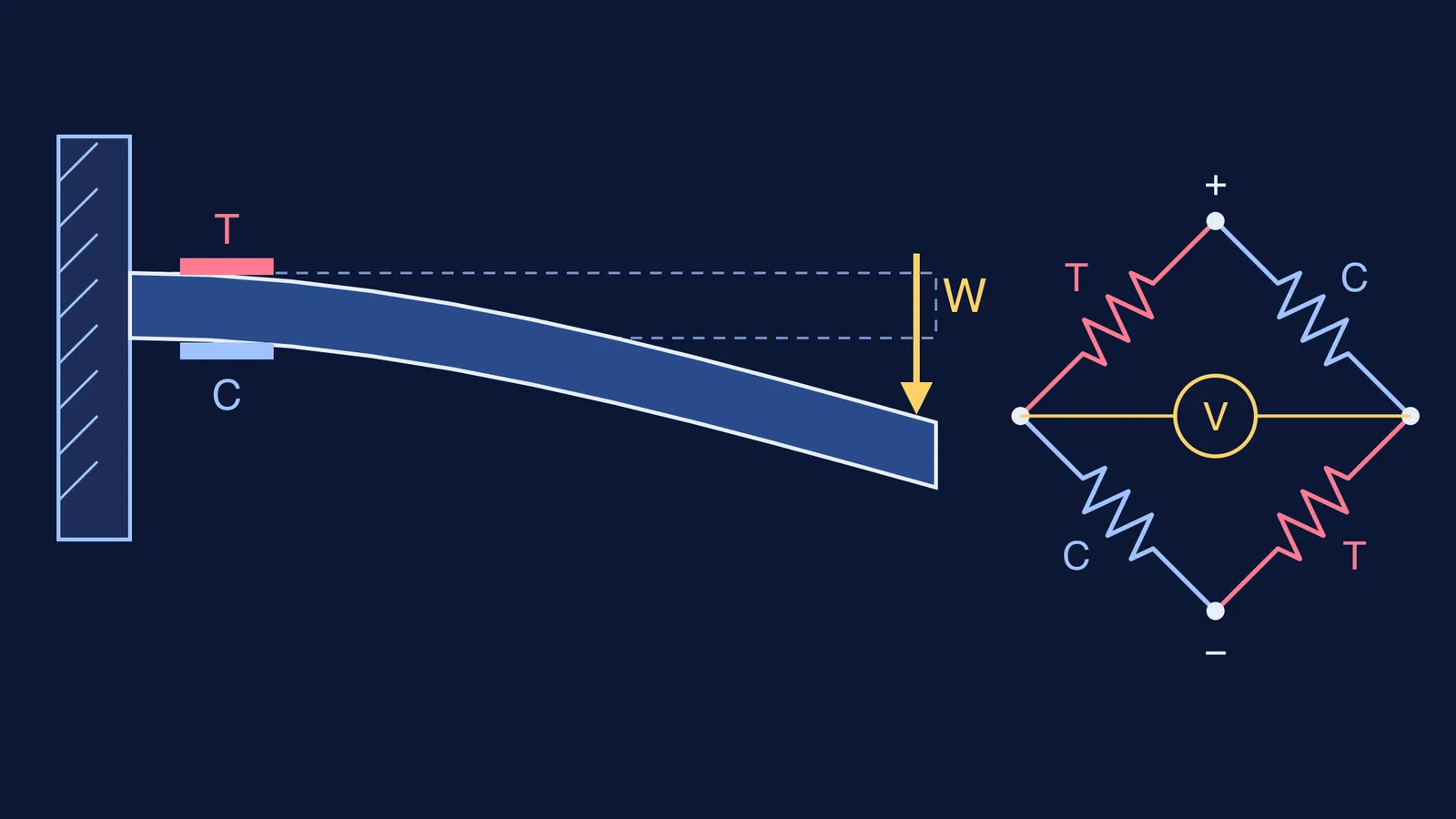
Under the platform sits a load cell: a metal body, usually aluminium, alloy steel or stainless steel, with strain gauges secured to it (Wikipedia: Load cell). When force is applied, this spring element deforms slightly and, unless overloaded, always returns to its original shape (same source).
That springing back is the whole trick. The load cell is a stiff spring working inside its elastic limit, so twice the force gives twice the bend, as in the Hooke's law spring extension graph.
How does a strain gauge turn bending into resistance?
A strain gauge is a thin zigzag of metal foil bonded to the load cell. When a conductor is stretched within its elastic limit, it becomes narrower and longer, which increases its resistance end to end (Wikipedia: Strain gauge). Squeeze it and the resistance falls. This is R = ρL/A from your textbook: longer L and smaller A both raise R.
Strain is the change in length divided by the original length (NI: Measuring strain with strain gages). The gauge factor links strain to resistance, ΔR/R = GF × strain, and for metallic strain gauges the gauge factor is usually around 2 (same source).
The changes are tiny. In NI's example, a strain of 500 microstrain on a 120 Ω gauge with a gauge factor of 2 changes its resistance by only 0.12 Ω, and the most common gauge resistances are 120 Ω, 350 Ω and 1000 Ω (NI).
Why does a scale need a Wheatstone bridge?
A fraction of an ohm is too small to read directly, so a load cell uses four strain gauges wired as a Wheatstone bridge, arranged in alternating tension and compression (Wikipedia: Load cell). One face of the bent metal stretches and the other is squeezed, so two gauges gain resistance and two lose it.
With the pan empty the bridge is balanced and outputs zero, the condition in the derivation of the balanced Wheatstone bridge. Under load, one output node rises in voltage while the other falls, so the four changes add instead of cancelling. NI gives about 2.0 mV/V for a full bridge at 1000 microstrain, against about 0.5 mV/V for a single active gauge (NI).
So load cells are rated in millivolts per volt at full load: a 2.96 mV/V cell gives 29.6 mV at full load when powered with 10 V (Wikipedia: Load cell). A chip then amplifies and digitises the signal. The HX711 is a 24-bit analog-to-digital converter designed for weigh scales, with gain settings of 32, 64 or 128 (Soldered: HX711, how it works).
If circuits are easier to see than to read, the Fermi Simulation Lab has interactive simulations for ideas like this.
See it in how a weighing scale reading changes in an accelerating lift.
Worked example: how big is one gram's signal?
Take a kitchen scale whose load cell is rated 5 kg at 2 mV/V and powered at 5 V. These are illustrative numbers inside the typical 1 to 3 mV/V range (Wikipedia: Load cell), using the gauge factor and full-bridge figures from NI.
Full-scale output: 2 mV/V × 5 V = 10 mV at 5 kg.
Per gram: 10 mV ÷ 5000 g = 2 microvolts.
After a gain of 128: 2 µV × 128 = 256 µV per gram, before the 24-bit converter digitises it.
Strain: a full bridge gives about 2 mV/V at 1000 microstrain, so at 5 kg each gauge stretches or shrinks by about 0.1%.
Resistance: on a 350 Ω gauge with a gauge factor of 2, ΔR = 350 × 2 × 0.001 = 0.7 Ω at 5 kg, or about 0.00014 Ω per gram.
So weighing a single gram of sugar means detecting a resistance change of roughly one ten-thousandth of an ohm.
How does the scale turn microvolts into grams?
Because the metal stays elastic, signal is proportional to load, so two readings fix the whole line. Try this calibration with made-up converter counts:
Empty pan: 8,400 counts. With a 500 g test weight: 58,400 counts.
Counts per gram: (58,400 − 8,400) ÷ 500 = 100.
A bowl reads 31,400 counts, so it weighs (31,400 − 8,400) ÷ 100 = 230 g.
Press tare with the bowl on. The scale stores 31,400 as its new zero, so adding 150 g of flour gives 46,400 counts and the display shows 150 g.
This is y = mx + c; tare only changes c. It also explains the maximum capacity on every scale: an overloaded load cell can deform permanently, which can shift its zero and spoil its linearity (Wikipedia: Load cell).
If bridge numericals keep going wrong at one step, the Fermi Problem Library has worked problems with a step-by-step solver that explains the reasoning rather than printing an answer.


