

On this page
NCERT's Class 12 Physics chapter on ray optics (NCERT Physics Part 2, Chapter 9) describes each fibre as a core and a cladding, with the core's refractive index higher than the cladding's. When light is "directed at one end of the fibre at a suitable angle", it undergoes repeated total internal reflections along the fibre. The acceptance angle makes "suitable angle" precise, and the numerical aperture (NA) is its sine.
What is the acceptance angle of an optical fibre?
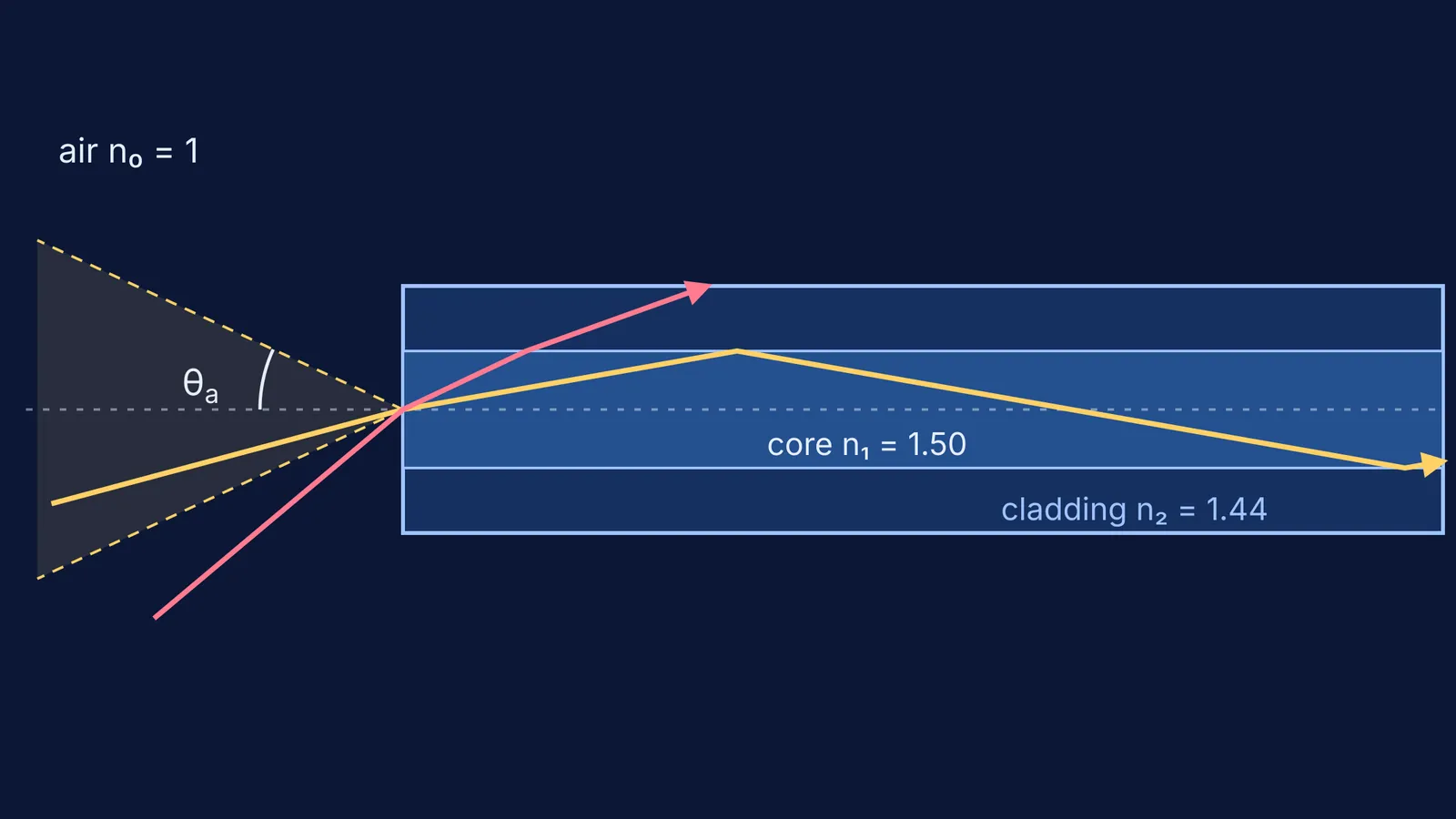
The acceptance angle θa is the largest angle, measured from the fibre's axis, at which a ray can enter the end face and still be totally internally reflected at the core-cladding boundary (Numerical aperture, Wikipedia). Spin it around the axis and you get the acceptance cone. Rays inside the cone stay trapped; rays outside it refract into the cladding and are lost.
Total internal reflection needs light travelling from a denser to a rarer medium, and an angle of incidence larger than the critical angle, where sin θc = n₂/n₁ (NCERT, section 9.4). If the critical angle still feels shaky, read our explainer on why the critical angle between glass and water is about 61° first.
How do you derive the numerical aperture formula?
Let n₀ be the outside medium (1 for air), n₁ the core and n₂ the cladding. Follow the ray that only just makes it.
At the end face, Snell's law gives n₀ sin θa = n₁ sin r, where r is the ray's angle to the axis inside the core.
The core-cladding wall runs parallel to the axis, so its normal is perpendicular to the axis. The angle of incidence on the wall is therefore 90° − r.
For the limiting ray, 90° − r equals the critical angle, so sin r = cos θc = √(1 − n₂²/n₁²).
Substitute: n₀ sin θa = n₁ √(1 − n₂²/n₁²) = √(n₁² − n₂²).
The right-hand side is the numerical aperture: NA = √(n₁² − n₂²), and n₀ sin θa = NA (Numerical aperture, Wikipedia). The bigger the index gap between core and cladding, the wider the cone.
Worked example: core 1.50, cladding 1.44
Question: a fibre has a core of index 1.50 and a cladding of index 1.44. Find the critical angle at the core-cladding boundary, the NA, and the acceptance angle in air and in water (n = 1.33).
Critical angle: sin θc = 1.44/1.50 = 0.96, so θc ≈ 73.7°.
NA = √(1.50² − 1.44²) = √(2.25 − 2.0736) = √0.1764 = 0.42.
In air: sin θa = 0.42, so θa ≈ 24.8°. The full cone is about 49.7° across.
Check: inside the core, sin r = 0.42/1.50 = 0.28, so r ≈ 16.3°. Then 90° − 16.3° = 73.7°, exactly the critical angle.
In water: sin θa = 0.42/1.33 ≈ 0.316, so θa ≈ 18.4°. A denser outside medium narrows the cone.
Why do real fibres have such a small numerical aperture?
The Wikipedia article on optical fibre gives a typical telecom single-mode fibre as a pure silica cladding with index 1.444 at 1500 nm and a doped core of about 1.4475 (Optical fiber, Wikipedia). Put those into the formula and NA ≈ 0.10, which in ray optics would mean θa ≈ 5.8°. The same article says most modern fibre is "weakly guiding", with a core-cladding index difference typically less than 1%, and that single-mode fibre has a small NA.
Treat that 5.8° as a classroom estimate, not a property of the real fibre. The Wikipedia article on numerical aperture notes that for single-mode fibre an acceptance angle cannot be defined from the refractive indices alone (Numerical aperture, Wikipedia). The ray picture fits step-index multimode fibre, and it is what board and JEE numericals expect.
Low loss is what makes long fibres useful. NCERT notes that in silica glass fibres it is possible to transmit more than 95% of the light over a fibre length of 1 km (NCERT, section 9.4.1). To watch rays stay in or leak out as you change the angle, try our post on the optical fibre simulation: predict when light stays trapped.
What mistakes cost marks on this question?
Measuring θa from the end face instead of from the axis.
Forgetting n₀ when the fibre sits in water or oil.
Writing NA = n₁ − n₂ instead of √(n₁² − n₂²).
Writing sin θc = n₁/n₂; the ratio must be less than 1.
Assuming one cone for all colours. Refractive index depends on wavelength; see why the critical angle differs for different colours.
If you get stuck at step 3 of the derivation, the Fermi Problem Library has worked problems with a step-by-step solver that explains the reasoning rather than printing an answer. If Snell's law or the critical angle is the real gap, start with the lesson in the Fermi Concept Library, then redo the worked example from memory.


