

On this page
You can memorise "light is trapped by total internal reflection" and still get the exam question wrong. The fix is to predict, before you press play, which rays will stay in the glass. Here are the numbers, then a plan for testing them.
What decides whether light stays inside a fibre?
Above the critical angle "there will be total internal reflection"; below it, part of the light is reflected and part is transmitted (HyperPhysics: total internal reflection). So a ray below the critical angle leaks at every bounce.
In a fibre, the angle that matters is at the side wall, measured from the normal to that wall. A ray running almost along the axis meets the wall at nearly 90°, which counts as large. A steep ray meets it at a smaller angle and escapes. Steep entry means a small wall angle.
How do you calculate the critical angle from refractive indices?
Set the refraction angle to 90° in Snell's law. OpenStax gives the result as θc = sin⁻¹(n₂/n₁), valid only when n₁ is greater than n₂ (OpenStax University Physics Volume 3). Its examples: 48.6° from water to air, 24.4° from diamond to air, and 42.2° from polystyrene (n = 1.49) to air.
The indices come from tables. HyperPhysics lists water at 20 °C as 1.33, fused quartz as 1.46 and typical crown glass as 1.52 (HyperPhysics index of refraction table).
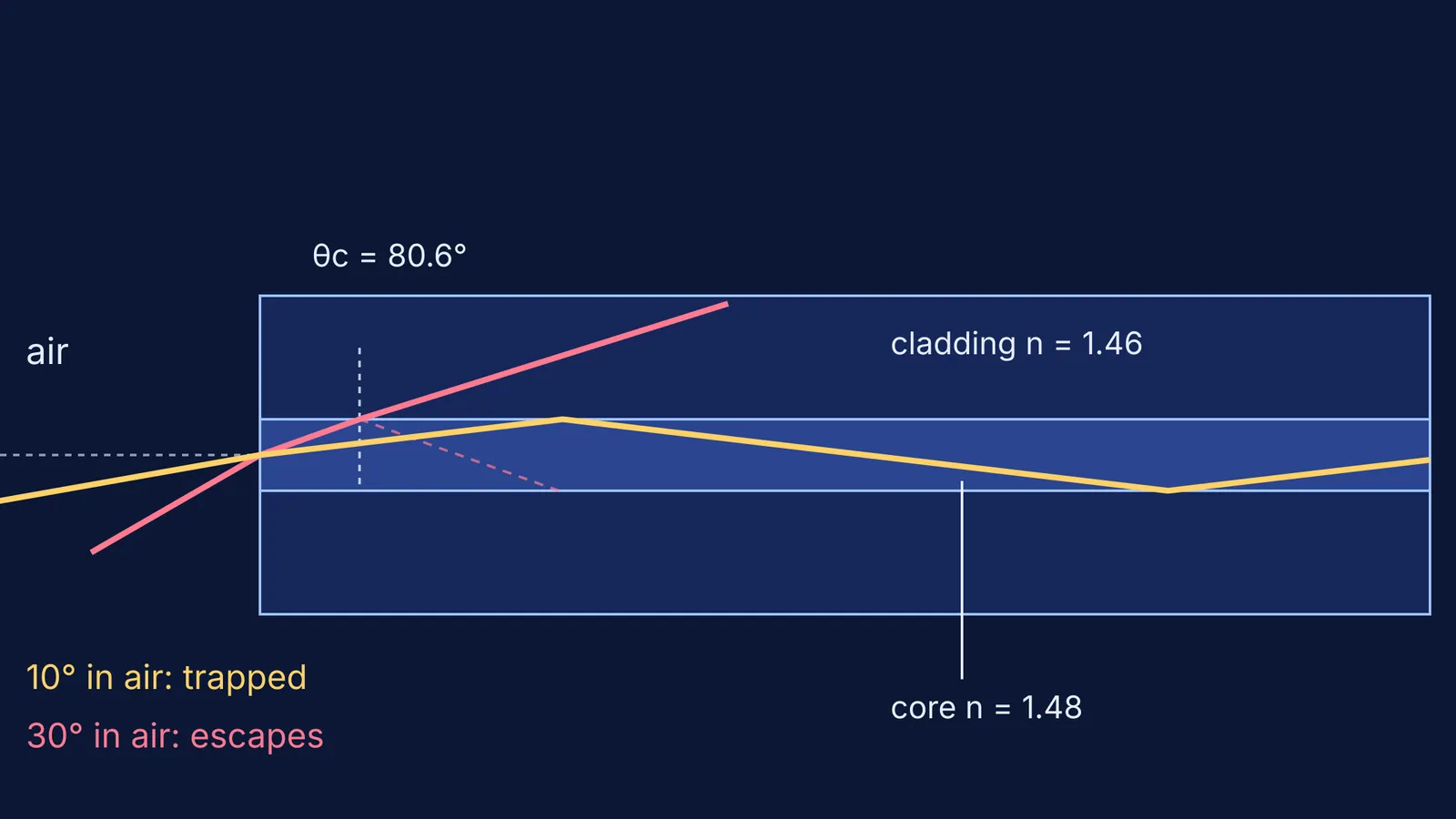
Worked example: a teaching fibre with core n₁ = 1.48 and cladding n₂ = 1.46 (round numbers near fused quartz, not a product datasheet).
Critical angle at the core–cladding wall: sin θc = 1.46/1.48 = 0.9865, so θc ≈ 80.6°.
A ray enters the flat end from air at 10° to the axis. Snell's law at the end face gives sin r = sin 10°/1.48, so r ≈ 6.7°. The wall angle is 90° − 6.7° = 83.3°, bigger than 80.6°: trapped.
A ray enters at 30°. Now r ≈ 19.7° and the wall angle is about 70.3°, smaller than 80.6°: it refracts into the cladding and leaves the core.
The largest entry angle that still traps light: sin αmax = √(n₁² − n₂²) = √(1.48² − 1.46²) ≈ 0.243, so αmax ≈ 14°. This quantity is the fibre's numerical aperture. HyperPhysics notes that light introduced "within the confines of the numerical aperture" keeps reflecting almost losslessly off the walls (HyperPhysics: fiber optics).
Why does an optical fibre need cladding with a lower index?
First, total internal reflection needs a lower index outside. If the cladding matched the core, sin θc would be 1, θc would be 90°, and no ray could beat it. OpenStax on fibre bundles: "Since no light gets into the cladding (there is total internal reflection back into the core), none can be transmitted between clad fibers that are in contact with one another" (OpenStax).
A bare fibre's surroundings also vary. By the same formula, a 1.48 core has θc ≈ 42.5° in air but about 64° in water (1.33), so a wet patch lets out rays that air would trap. Cladding keeps the wall the same everywhere.
Second, the index step is kept small on purpose. With the cladding index only slightly below the core's, the critical angle is close to 90° and only rays nearly parallel to the axis survive. Steeper rays travel further, arrive later and broaden each pulse, limiting how many pulses per second the fibre carries (UNSW Physclips: optical fibres and cladding).
Purity matters too: in 1966 Charles Kao calculated that a fibre of the purest glass could carry light signals over 100 kilometres, against 20 metres for 1960s fibres (Nobel Prize in Physics 2009 press release). Read more in Charles Kao and the pure glass fibres that carry the internet.
How should you test this in a simulation?
Use any ray simulation that lets you set two indices and an entry angle. The Fermi Simulation Lab has interactive simulations for ideas that are easier to see than to read. Write each prediction down before you run it.
Bare core in air (1.48 and 1.00). Predict θc ≈ 42.5° with OpenStax's critical angle formula, then hunt for an entry angle that leaks. There is none: √(1.48² − 1) is above 1, so every ray entering a straight, flat end is trapped.
Add cladding at 1.46. Predict a cut-off near 14°. Try 10°, 14° and 20°.
Set the cladding to 1.48. Predict that the wall disappears: light crosses straight into the cladding.
Set the cladding to 1.50, above the core. Predict no total internal reflection at any angle.
Watched first, every result looks obvious; writing θc first tests your understanding. For more on what simulations do well, read what PhET research says interactive physics simulations are good for, and for exam-style numericals, try critical angle problems and optical fibres. If your answer disagrees with the screen, the Fermi Problem Library has worked problems with a step-by-step solver that explains the reasoning, so you can see which step went wrong.


