

On this page
Put a glass prism in a tank of water and some rays that were trapped inside it by total internal reflection now leak out. One ratio explains why. Below, we work out the critical angle between glass and water from NCERT's own numbers, show why it is larger than the glass-air value, and give you a four-step check for any critical angle numerical in CBSE or JEE Main.
What is the critical angle between glass and water?
The critical angle is the angle of incidence in the denser medium for which the angle of refraction is 90°, as defined in the NCERT Class 12 Physics chapter on ray optics. NCERT writes Snell's law at that angle as sin i_c = n21, where n21 is the refractive index of the rarer medium relative to the denser one. With absolute refractive indices, for a ray going from glass into water, that becomes:
sin C = n(water) / n(glass)
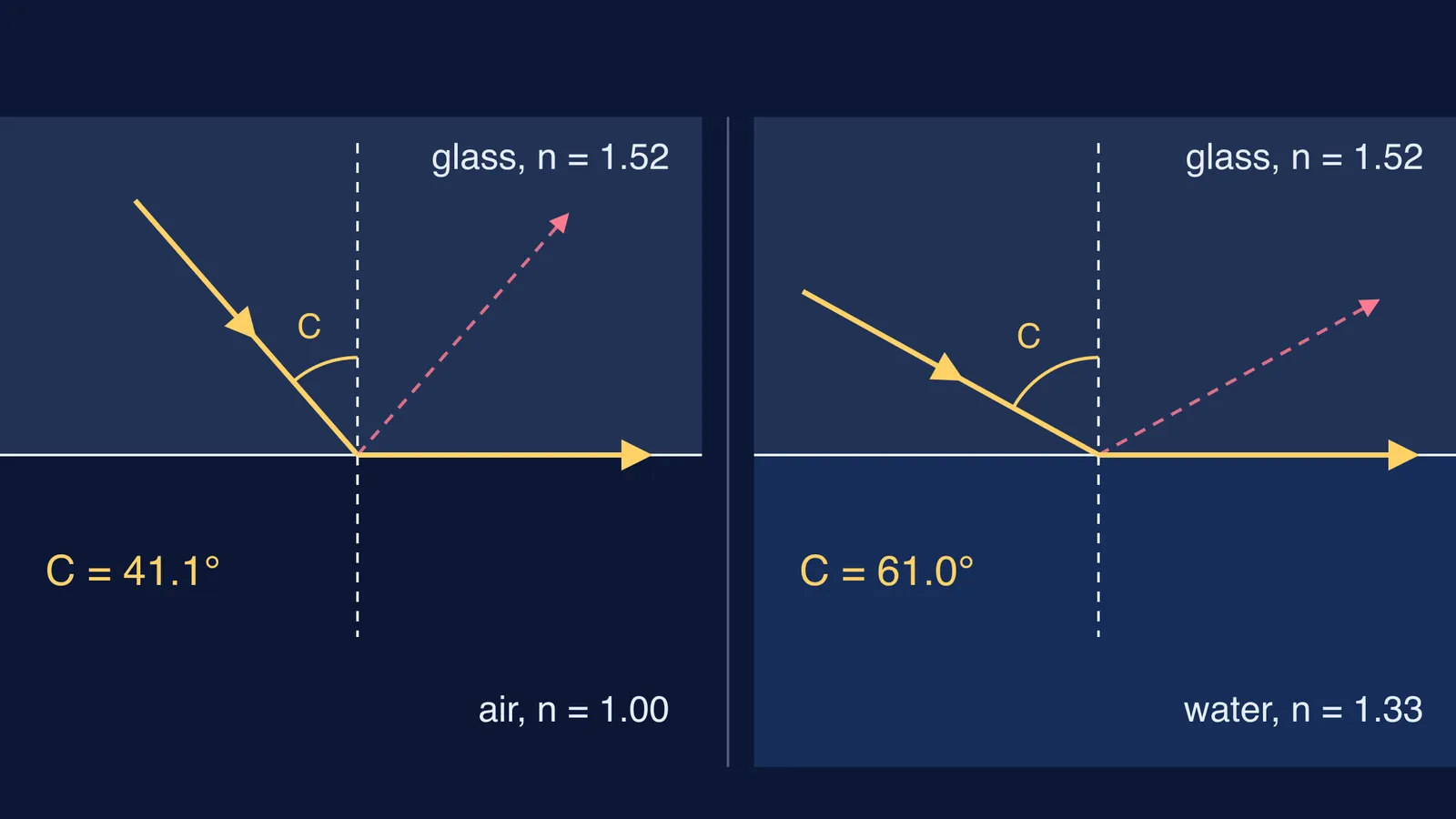
NCERT's Table 9.1 gives the refractive index of water as 1.33 and of crown glass as 1.52. The same table lists their critical angles with respect to air as 48.75° for water and 41.14° for crown glass.
Here is the calculation:
sin C = 1.33 / 1.52 = 0.875
C = sin⁻¹(0.875), which is about 61.0°
Check: 61.0° is larger than 41.14°, the glass-air value, and still below 90°
If your question uses dense flint glass (1.62 in the same NCERT table), sin C = 1.33 / 1.62, about 0.821, so C is about 55.2°. Many textbook problems round glass to 1.5. Then sin C is about 0.887 and C is about 62.5°.
Why is the critical angle larger under water?
The critical angle depends only on the ratio of the two indices. Air's index is about 1, far below crown glass's 1.52 in NCERT's Table 9.1, so a ray leaving glass into air bends sharply away from the normal. It reaches 90° (grazing the surface) when the angle of incidence is just 41.14°.
Water's 1.33 is much closer to 1.52. Light crossing from glass into water bends only a little, so the incident ray has to arrive much more obliquely, about 61° from the normal, before the refracted ray grazes the surface. Push the ratio all the way to 1 (two media with the same index) and the boundary vanishes optically: C would be 90° and total internal reflection could never happen.
You can also get the glass-water answer straight from the two air values, because sin C for each material in air is 1/n. Dividing, sin 41.14° / sin 48.75° = 0.658 / 0.752, which is 0.875 again. This helps when a question gives you critical angles instead of refractive indices.
If flipping ratios is a habit, our guide on calculating relative refractive index without flipping it walks through the notation.
What happens to a prism under water?
The NCERT chapter explains that prisms designed to bend light by 90° or 180° rely on total internal reflection, so the glass must have a critical angle below 45°. In air, crown glass at 41.14° qualifies.
Now drop that right-angled prism into water. The ray still meets the long face at 45°, but the critical angle is now about 61°. Since 45° is less than 61°, the ray is not totally reflected. Snell's law gives 1.52 × sin 45° = 1.33 × sin r, so sin r is about 0.808 and r is about 53.9°. Most of the light leaves into the water and only a weak partial reflection stays behind. Dense flint glass fails too, because 45° is still below its glass-water value of about 55.2°.
NCERT also notes that n21 depends on the wavelength of light, so each colour has a slightly different critical angle. Our post on Cauchy's relation between refractive index and wavelength explains why.
How do you solve critical angle questions without mistakes?
Use the same four steps every time:
Find the denser medium (higher n). Total internal reflection is only possible for light travelling from it into the rarer one.
Write sin C = n(rarer) / n(denser), the absolute-index form of NCERT's Eq. 9.12, and check the ratio is below 1.
Compare the given angle of incidence with C. If it is larger, the ray is totally reflected. If it is smaller, find the refracted angle with Snell's law.
Sanity-check: the closer the two indices, the larger C.
For practice with the water-air value, try the classic question on the radius of the circle of light from a source under water.
If you keep getting the setup wrong, the Fermi Problem Library has worked problems with a step-by-step solver that explains the reasoning rather than printing an answer. If total internal reflection itself feels shaky, it has its own lesson in the Fermi Concept Library.


