

On this page
Relative refractive index sums in Class 10 are short, usually two lines. A common way to lose marks on them is to write the ratio upside down. Here is the definition, a worked example and a check that catches the flip.
What is relative refractive index?
The NCERT Class 10 Science textbook, in Chapter 9 (Light – Reflection and Refraction), defines it in terms of speed. The refractive index of medium 2 with respect to medium 1 is the speed of light in medium 1 divided by the speed of light in medium 2, written n₂₁ = v₁/v₂ (NCERT Class 10 Science, Chapter 9).
The same chapter defines the reverse quantity as n₁₂ = v₂/v₁, so n₁₂ is simply 1/n₂₁. When medium 1 is vacuum or air, you get the absolute refractive index, n = c/v. Here c is the speed of light in air and v is its speed in the medium.
Combining these: if n₁ = c/v₁ and n₂ = c/v₂, then n₂/n₁ = v₁/v₂. So:
n₂₁ = n₂/n₁ = v₁/v₂
The medium the light goes into is on top of the n ratio.
The medium the light comes from is on top of the v ratio.
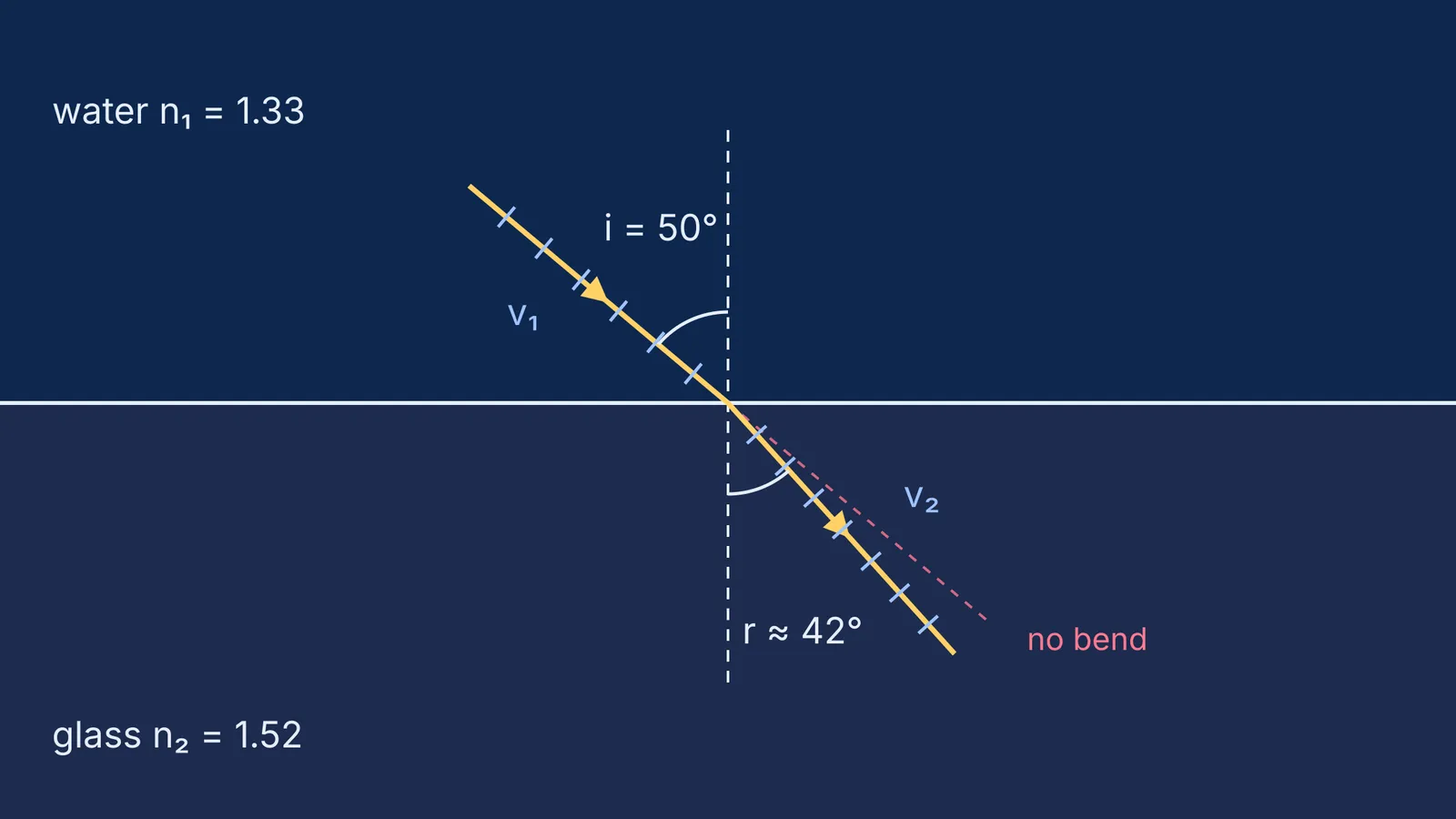
How do you calculate it for light going from water into glass?
NCERT's Table 9.3 gives the absolute refractive index of water as 1.33 and of crown glass as 1.52 (NCERT Class 10 Science, Table 9.3). The chapter takes the speed of light in vacuum as 3 × 10⁸ m/s. That is a rounded value; the defined value is exactly 299,792,458 m/s (NIST CODATA).
Name the media. The light starts in water (medium 1) and goes into glass (medium 2). You want n₂₁, the index of glass with respect to water.
Use the n form: n₂₁ = n₂/n₁ = 1.52/1.33 ≈ 1.14.
Check it with speeds. In water, v₁ = (3 × 10⁸)/1.33 ≈ 2.256 × 10⁸ m/s. In glass, v₂ = (3 × 10⁸)/1.52 ≈ 1.974 × 10⁸ m/s.
v₁/v₂ = 2.256/1.974 ≈ 1.14. Both routes give the same answer. Rounding the speeds to 2.26 and 1.97 first would give 1.15.
Think about the reverse. If light goes from glass into water instead, the answer is 1.33/1.52 ≈ 0.875.
An answer below 1 is not wrong. It just means light speeds up as it crosses, because water is optically rarer than glass. For why this is not about mass, see our post on optical density vs mass density.
Why do students flip the ratio in speed-of-light sums?
The two forms run in opposite directions. In n₂/n₁, medium 2 is on top. In v₁/v₂, medium 1 is on top. It is easy to remember "2 over 1" and apply it to the speeds too. That gives v₂/v₁, which is the reciprocal of the right answer.
Watch for it in three kinds of question:
Speeds given, index asked. For example: "Light travels at 2.25 × 10⁸ m/s in medium A and 2 × 10⁸ m/s in medium B. Find the refractive index of B with respect to A." The correct answer is v_A/v_B = 2.25/2 = 1.125, not 0.89.
Index given, speed asked. NCERT itself asks for the speed of light in glass of refractive index 1.50 (NCERT Class 10 Science, Chapter 9 questions). Since v = c/n, the answer is (3 × 10⁸)/1.50 = 2 × 10⁸ m/s. If you multiply instead, you get 4.5 × 10⁸ m/s, which is faster than light in vacuum.
Two liquids compared. If light goes from water (1.33) into kerosene (1.44), the index of kerosene with respect to water is 1.44/1.33 ≈ 1.08, using the same table.
A checklist to run before you write the answer
Write "from ___ into ___" in the margin before touching numbers.
Write the formula with subscripts, n₂₁ = n₂/n₁ = v₁/v₂, then substitute.
Ask which medium is optically denser. Denser on top of the n ratio means the answer is above 1.
For a speed answer, confirm it is below 3 × 10⁸ m/s, the speed of light in vacuum as NCERT rounds it.
Check units. Refractive index has none, and speed is in m/s.
For light crossing several boundaries, see refraction through parallel layers. For how to set out the steps in sums like these, see how to write physics numericals in the CBSE board exam.
If you keep getting the direction wrong, try a few more sums in the Fermi Problem Library. Its step-by-step solver explains the reasoning rather than printing an answer, so you can see where a ratio got flipped. To revise refraction itself first, look up refractive index in the Fermi Concept Library, which gives each concept its own lesson.


