

On this page
A CBSE physics numerical is not marked only on the final number. CBSE's marking schemes split answers into steps, and each step you show can earn marks. CBSE's Class 12 Physics sample paper for 2026-27 is 70 marks in 3 hours, has 33 questions, and does not allow calculators. So how you lay out your working matters as much as the arithmetic.
How are CBSE physics numericals marked?
The 2026-27 Physics marking scheme, published with the sample paper on CBSE Academic, puts marks beside the lines of working. Three of its numericals show the pattern:
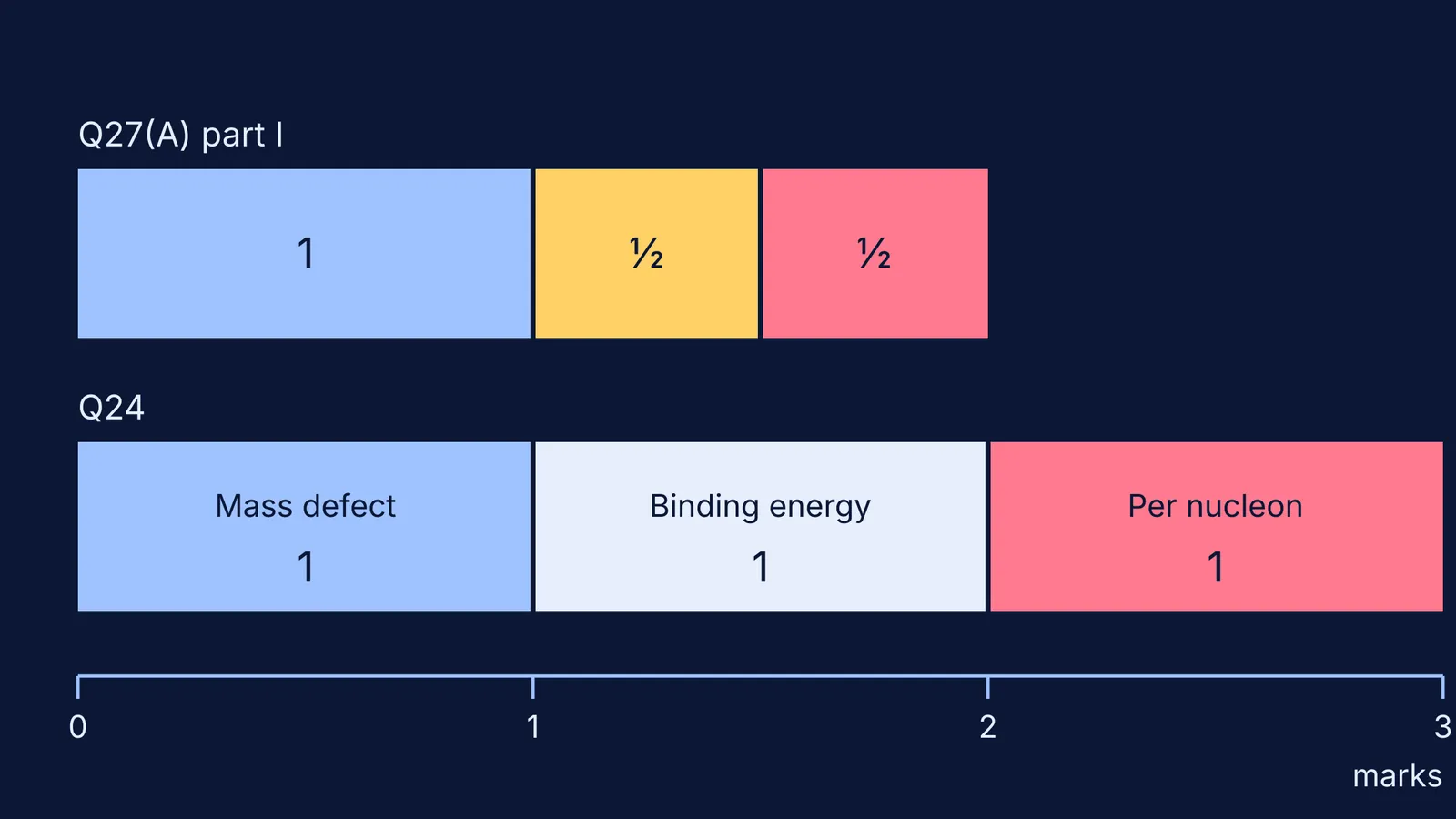
Part I of Question 27(A), the shunt resistance for an ammeter, carries 2 of the question's 3 marks, split 1, ½ and ½ across the formula S = IgG/(I − Ig), the substitution and the answer, 2 Ω.
Question 24, the binding energy per nucleon of oxygen-16, is worth 3 marks: 1 for working out the mass defect, 1 for the binding energy and 1 for the value per nucleon.
Question 31(B)(II), the minimum radius of a sphere held at 5 × 10⁵ V without air breakdown, gives four half marks along the way to 0.2 m.
In Question 27(A), the marks sit beside the formula and substitution lines, not just the 2 Ω at the end, so a bare final number leaves marks on the table. Our guide to using CBSE marking schemes to write answers that earn the marks shows how to read these schemes for every subject.
What should each step of a numerical look like?
Write every numerical in the same order, one step per line:
Given. Each quantity with symbol, value and unit, converted to SI units here.
To find. The quantity you want, with its symbol.
Formula. In symbols, before any numbers.
Substitution. Numbers with units, put into the formula exactly as written.
Simplification. Keep powers of ten apart from the digits so the sum works without a calculator.
Answer. Value with unit (and sign or direction if needed), underlined.
In Question 12 the marking scheme changes 10 cm to 0.10 m before putting it into B = μ0I/4R. If you are not sure of a unit, our post on the seven SI base units is a quick refresher.
A model answer: binding energy per nucleon
Question 24 of the 2026-27 sample paper gives the atomic mass of oxygen-16 as 15.99493 u and asks for the binding energy per nucleon. Here is a full answer, with the marks from CBSE's scheme in brackets.
Given: M = 15.99493 u, Z = 8, N = 16 − 8 = 8, mp = 1.00727 u, mn = 1.00866 u, 1 u = 931.5 MeV/c²
To find: binding energy per nucleon, B/A
Formula: Δm = Zmp + Nmn − M, then B = Δm × 931.5 MeV/u
Mass defect: Δm = 8(1.00727 u) + 8(1.00866 u) − 15.99493 u = 16.12744 u − 15.99493 u = 0.13251 u [1 mark]
Binding energy: B = 0.13251 u × 931.5 MeV/u ≈ 123.4 MeV [1 mark]
Per nucleon: B/A = 123.4 MeV ÷ 16 ≈ 7.71 MeV per nucleon [1 mark]
Which slips cost marks in physics numericals?
Question numbers below refer to the 2026-27 marking scheme.
Skipping the formula. In Question 27(A), marks start at the formula line, so leaving it out costs marks before you start.
Dropping the unit. The final answers in the scheme's numericals carry their units: 2 Ω, 0.2 m, 7.71 MeV. Copy that habit.
Sign convention in optics. In Question 32(A) the scheme puts in u = −2.2 cm for the objective of a microscope (f = 2 cm) and gets v = 22 cm. Drop the minus sign and you get about 1.05 cm, a different answer. Our guide to ray diagrams in the Class 12 physics paper helps you check signs against a sketch.
Missing a part. Long questions are split, for example 2+2+1. Label each part (I), (II), (III).
How should you practise numericals before the board exam?
Each week, solve one section of the sample paper against the clock. Then mark it with CBSE's scheme, step by step. Circle each half mark you lost and note the slip: formula, unit, sign or arithmetic. After three weeks, the list shows which habit to fix first.
If you keep choosing the wrong formula, the problem is your method, not your layout. The Fermi Problem Library has worked problems with a step-by-step solver that explains the reasoning rather than printing an answer, so you can compare its steps with yours. If you cannot say why a formula applies at all, look the idea up in the Fermi Concept Library first.
Start with Question 24 tonight: write it out in the six steps, then mark it against CBSE's scheme.


