

On this page
Shine a ray through flat, parallel layers, say glass on water, and it bends at every face. One quantity stays fixed the whole way through, so multi-layer questions shrink to a line or two.
Why does n sin θ stay the same in every layer?
Snell's law says n₁ sin θ₁ = n₂ sin θ₂ at any boundary, with angles measured from the normal (OpenStax University Physics, Volume 3). The refractive index n tells you how much light slows down: v = c/n (same source).
When every face is parallel, the normal points the same way at each one, so the angle at which the ray leaves one face is the angle at which it meets the next. Write Snell's law for each face:
First face: n₁ sin θ₁ = n₂ sin θ₂
Second face: n₂ sin θ₂ = n₃ sin θ₃
Third face: n₃ sin θ₃ = n₄ sin θ₄
Chain them and you get n₁ sin θ₁ = n₄ sin θ₄. The middle layers cancel. The ray carries n sin θ unchanged through the stack; call it the invariant.
How do you find the final direction of the ray?
We use n = 1.00 for air and 1.33 for water, as in the OpenStax refraction section, and 1.50 for glass, inside the 1.50 to 1.62 range HyperPhysics lists for crown glass.
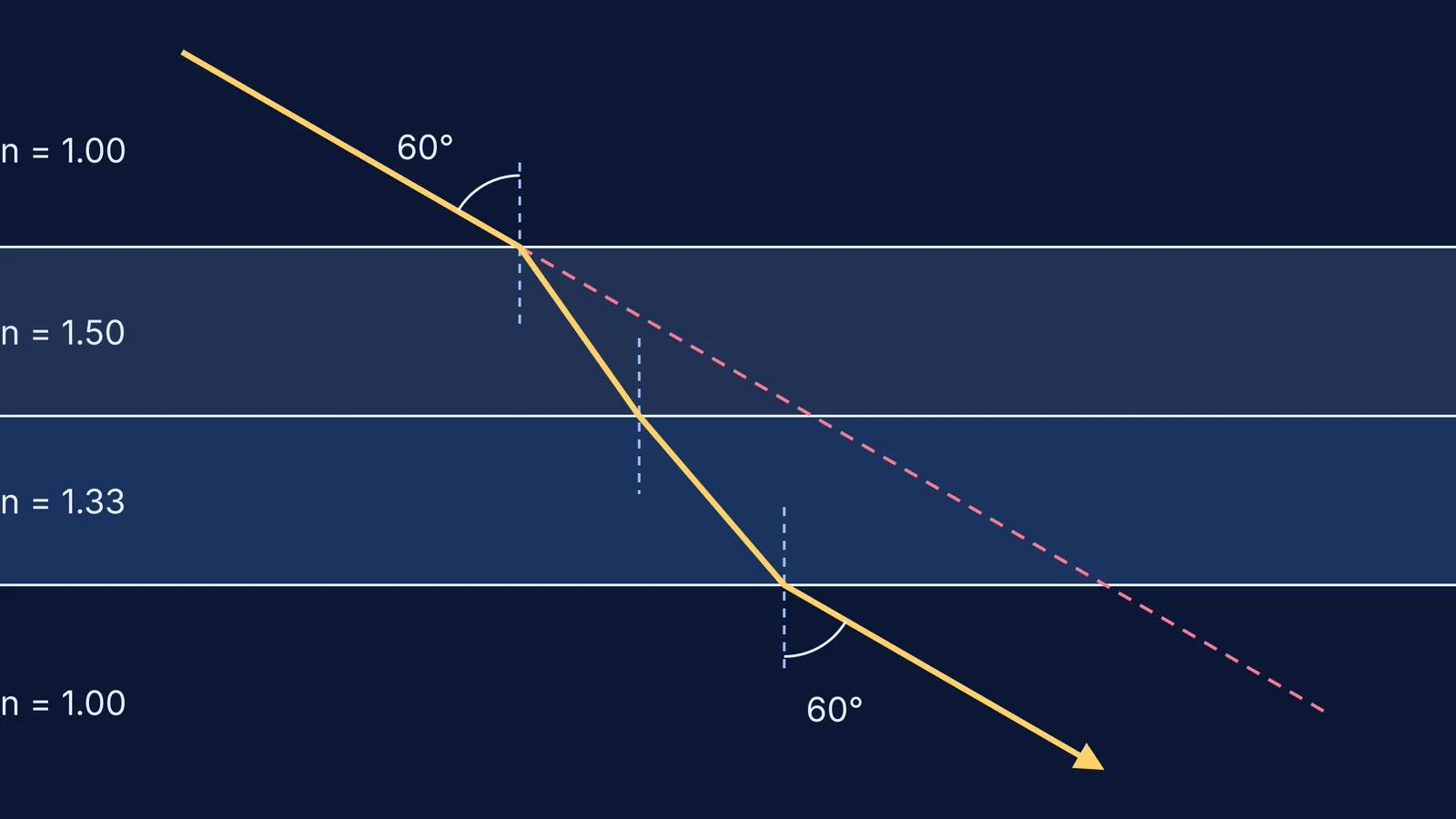
A ray in air meets a glass slab at 60°. Under the glass is water, then air again.
Invariant: 1.00 × sin 60° = 0.866.
In the glass: sin θ = 0.866 / 1.50 = 0.577, so θ ≈ 35.3°.
In the water: sin θ = 0.866 / 1.33 = 0.651, so θ ≈ 40.6°.
Back in air: sin θ = 0.866 / 1.00, so θ = 60°.
The ray leaves parallel to its entry path, shifted sideways. Had the stack ended in water, you could skip the glass and go straight to 40.6°. The sideways shift does depend on each layer's thickness; see our guide to lateral shift through a glass slab.
When does total internal reflection happen in a stack?
A ray enters a layer only if sin θ = (invariant) / n is at most 1, that is, only if the layer's n exceeds the invariant. Otherwise it is totally reflected at the face before that layer. This matches the critical angle θc = sin⁻¹(n₂/n₁), which exists only when n₁ > n₂ (OpenStax, total internal reflection).
Start inside the glass and aim at the water:
At 50°: invariant = 1.50 × sin 50° = 1.149. Water's 1.33 is larger, so the ray enters at about 59.8°. Air's 1.00 is smaller, so it is totally reflected at the water–air face.
At 60°: invariant = 1.299, still below 1.33. The ray enters the water at about 77.6°, then reflects at the water–air face.
At 65°: invariant = 1.359, above 1.33. The ray reflects at the glass–water face, whose critical angle is about 62.5°.
The glass–air critical angle is sin⁻¹(1/1.50) ≈ 41.8°, so the 50° ray would be trapped without the water too. The water only moved where the reflection happens.
More practice: total internal reflection and critical angle problems.
How do you find apparent depth through several layers?
For one flat surface, apparent depth is hᵢ = (n₂/n₁)h₀, so a fish seen from above appears at about 3/4 of its real depth (OpenStax, images formed by refraction). It assumes small angles, so it holds only for near-vertical viewing (same source).
For a stack viewed from air, each layer of thickness t and index n contributes t/n to the depth you see:
Apparent depth = t₁/n₁ + t₂/n₂ + t₃/n₃ + …
Example: a coin lies under a 3 cm glass slab in a tank, with 6 cm of water above. Apparent depth = 6/1.33 + 3/1.50 = 4.51 + 2.00 = 6.51 cm. The real depth is 9 cm, so the coin looks raised by about 2.49 cm. Swapping the layers gives the same sum. Our apparent depth and normal shift problems cover more cases.
How do you check a layered-refraction answer in an exam?
Confirm every face is parallel. In a prism the normals differ and the invariant does not carry over.
Measure angles from the normal, not the surface.
Find the invariant once, where you know the angle.
For each layer, check its n exceeds the invariant; if not, total internal reflection happens just before it.
For apparent depth, check the viewing is nearly normal, then add t/n.
If you set up the invariant and still land on a wrong angle, the Fermi Problem Library has worked problems with a step-by-step solver that explains the reasoning rather than printing an answer. To revisit Snell's law itself, the Fermi Concept Library gives each concept its own lesson.
Next time, compute n sin θ once and cross every layer with it.


