On this page
Send 50 Hz alternating current through a thin copper wire and it spreads evenly, just as direct current does. Send it through a copper bar 60 mm thick and something odd happens: most of the current runs in the outer centimetre, and the copper in the middle carries much less. This is the skin effect. It is why heavy busbars are flat strips or hollow tubes and not solid round rods, and why the coil under an induction cooktop is wound from many thin insulated strands.
Why does AC crowd towards the surface of a conductor?
The cause is the same induction you met in eddy currents in plates and cores, but here the conductor induces eddy currents in itself.
The current in the bar sets up a magnetic field that circles the bar's axis, inside the metal as well as outside.
With AC, that field keeps changing. By Faraday's law, a changing magnetic flux induces an emf in any loop of metal it passes through.
Inside the bar, the induced emf drives small loops of current. Near the axis they flow against the main current. Near the surface they flow with it.
The result is less current at the centre and more at the rim.
With DC nothing is induced, so the current density is uniform. A faster change induces a larger emf, so the effect grows with frequency.
What is skin depth, and how do you calculate it?
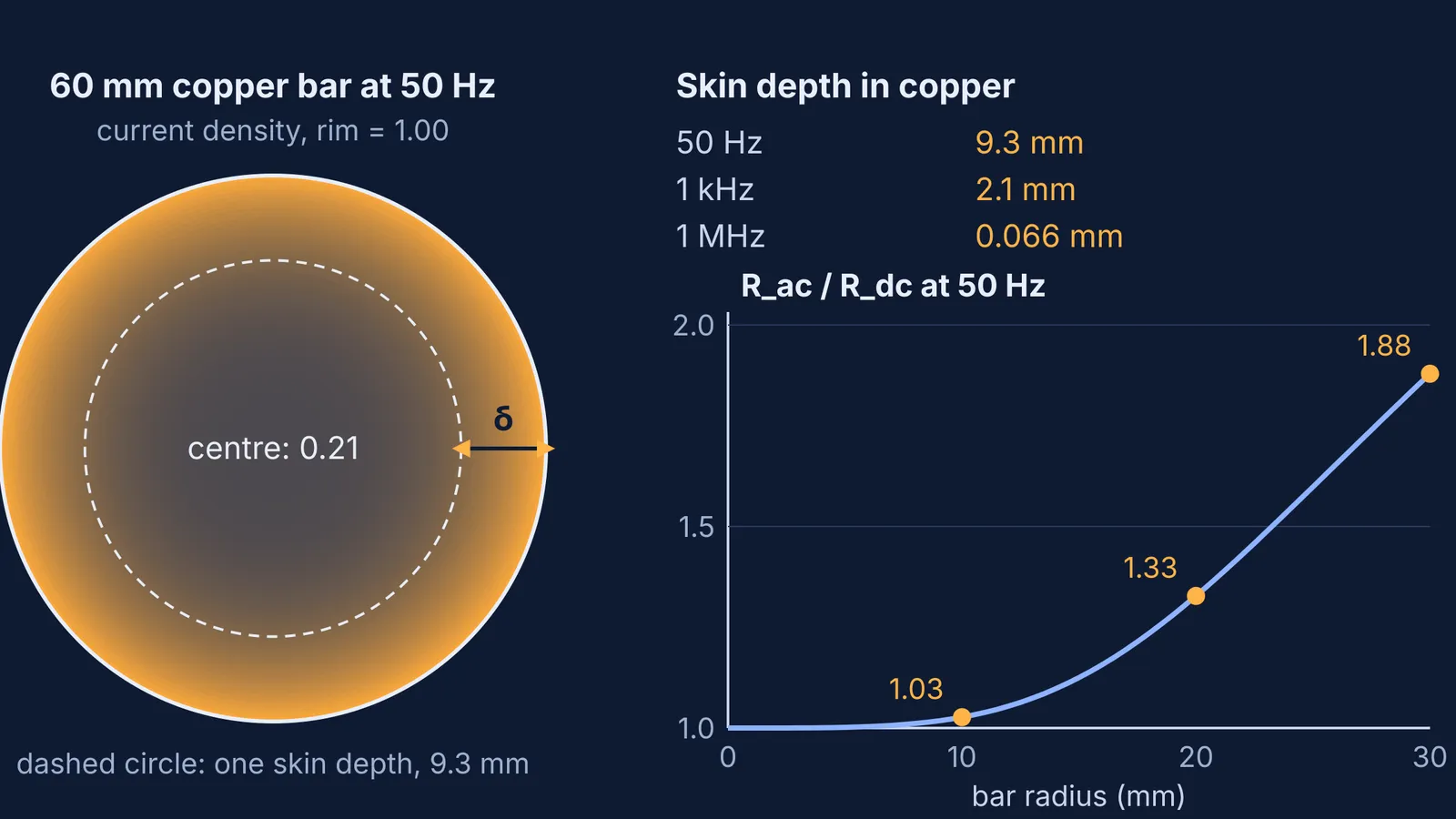
The skin depth δ is the depth below the surface at which the current density amplitude has fallen to 1/e (about 37%) of its value at the surface. For a non-magnetic metal such as copper or aluminium:
δ = √(2ρ / ωμ₀), where ω = 2πf
Here ρ is the resistivity, f the frequency and μ₀ = 4π × 10⁻⁷ H/m. Check the units: ρ/(ωμ₀) has units of (Ω m) / (s⁻¹ × Ω s m⁻¹) = m², so δ is a length. Good.
δ grows with resistivity, and shrinks as 1/√f: a hundredfold rise in frequency cuts δ tenfold.
The current does not stop at δ. It keeps falling inside, by another factor of e for every further δ in a flat slab. In a round bar the fall is not a simple exponential, which is why the worked numbers below use the exact solution.
How thick is the skin in copper at 50 Hz?
Use annealed copper at 20 °C, ρ = 1.72 × 10⁻⁸ Ω m, the value listed in the HyperPhysics resistivity table. The same table gives aluminium as 2.65 × 10⁻⁸ Ω m.
Step 1: angular frequency. ω = 2π × 50 = 314.2 rad/s.
Step 2: the product ωμ₀. 314.2 × 4π × 10⁻⁷ = 3.948 × 10⁻⁴ H m⁻¹ s⁻¹.
Step 3: divide. 2ρ / ωμ₀ = (3.44 × 10⁻⁸) / (3.948 × 10⁻⁴) = 8.71 × 10⁻⁵ m².
Step 4: square root. δ = 9.33 × 10⁻³ m, about 9.3 mm.
Repeat at other frequencies by dividing by √(f/50):
50 Hz: 9.3 mm (aluminium: about 11.6 mm)
1 kHz: 2.1 mm
1 MHz: 0.066 mm
Skin depth also changes with temperature. Copper's resistivity rises about 0.39% per °C near room temperature, so a busbar running at 70 °C has ρ ≈ 2.06 × 10⁻⁸ Ω m and δ ≈ 10.2 mm.
How much extra resistance does a thick copper bar have at 50 Hz?
A round copper bar has an exact solution, built from Bessel functions, for how the current density varies with radius. From it you get the ratio of AC resistance to DC resistance. The numbers below are computed from that solution for copper at 50 Hz:
radius 5 mm: R_ac/R_dc = 1.00
radius 10 mm: 1.03
radius 15 mm: 1.13
radius 20 mm: 1.33
radius 30 mm: 1.88
A shortcut treats the bar as a shell of thickness δ carrying uniform current. At 30 mm radius it gives 1.90, close enough, but at 15 mm it gives 1.17 against the exact 1.13. Use it only when the radius is many skin depths.
Worked example: heating in a 60 mm bar. Take a 60 mm diameter copper bar (radius 30 mm) carrying 2000 A rms.
Cross-section: A = π × (0.030)² = 2.83 × 10⁻³ m².
DC resistance per metre: R_dc = ρ/A = 1.72 × 10⁻⁸ / 2.83 × 10⁻³ = 6.08 × 10⁻⁶ Ω/m.
DC heating per metre: I²R_dc = (2000)² × 6.08 × 10⁻⁶ = 24.3 W/m.
At 50 Hz: R_ac = 1.88 × R_dc, so the heating is 1.88 × 24.3 = 45.7 W/m.
The same bar, carrying the same current, gets almost twice as hot as Ohm's law with the DC resistance predicts. The exact solution also shows the current density amplitude at the centre is only 0.21 of its value at the surface. The middle copper adds weight and cost but does little work.
Why are busbars flat and high-frequency coils made of Litz wire?
A flat strip a few skin depths thick, or a hollow tube, puts nearly all its copper close to a surface, so very little is wasted. That is why high-current busbars in substations and switchboards are strips or tubes. Why aluminium, not copper, is used for overhead lines is covered in why copper is used in wires and aluminium overhead.
At higher frequencies the skin gets thin enough to matter even for ordinary wire. Induction cooktops drive their coil at roughly 25 to 50 kHz, according to Wikipedia's article on induction cooking. The answer is Litz wire: many thin strands, each insulated, twisted so that every strand spends equal time at the outside and the inside of the bundle. Each strand is thinner than a skin depth, so the current uses the whole strand. Wikipedia's Litz wire article lists induction heating and the transmitter coils of inductive (Qi) chargers among its uses, and says it is most effective below about 500 kHz.
Transformer cores fight the same induced currents by being laminated, as explained in energy losses in a transformer. Skin effect is that problem moved into the winding itself.
To see induced currents in action, the Simulation Lab has interactive simulations for ideas that are easier to see than read.
What mistakes do students make with skin effect?
Thinking the current stops at δ. It falls to about 37% of the surface value there and keeps falling.
Using δ = √(2ρ/ωμ₀) for steel. Magnetic metals need μ₀μr, which makes δ far smaller.
Saying steel-cored aluminium lines use steel because of skin effect. The steel is there for mechanical strength.
Forgetting that ω is 2πf. Using f in place of ω makes δ too large by a factor of √(2π), about 2.5.
Quick checklist
Changing current, changing field, induced emf opposing current at the centre: current crowds to the surface.
δ = √(2ρ/ωμ₀) for non-magnetic metals; current amplitude falls to 1/e at δ.
Copper at 50 Hz: δ ≈ 9.3 mm; at 1 kHz ≈ 2.1 mm; at 1 MHz ≈ 0.066 mm.
A 60 mm copper bar has R_ac/R_dc ≈ 1.88 at 50 Hz.
Fixes: flat strips, hollow tubes, Litz wire.