

On this page
On paper, a transformer gives out all the power you put in. A real one gets warm, and that heat is wasted energy. The NCERT Class 12 Physics chapter on alternating current gives four reasons, each with its own design fix.
What are the four energy losses in a transformer?
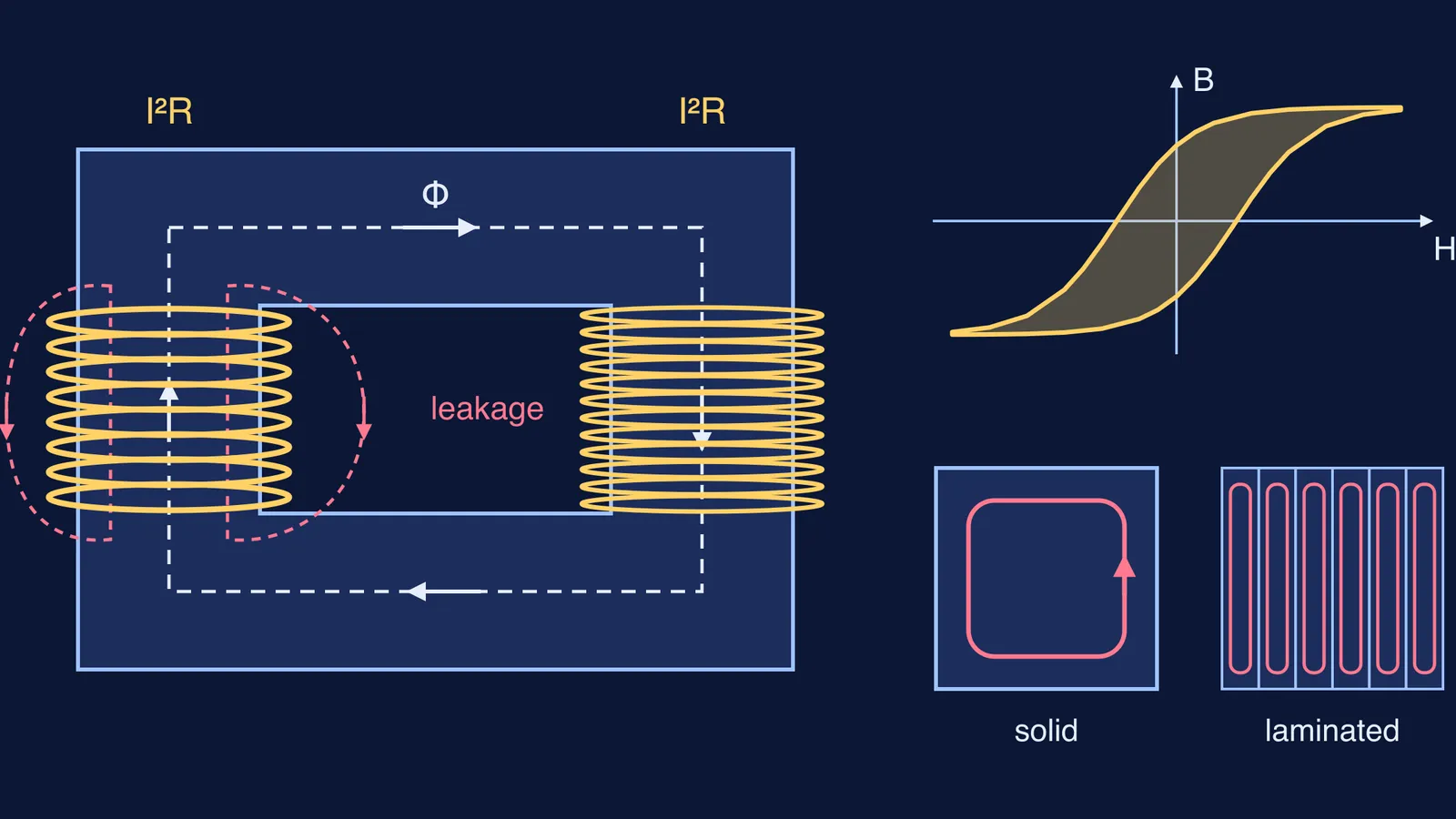
NCERT lists the four losses as flux leakage, resistance of the windings, eddy currents and hysteresis (NCERT, Alternating Current). It helps to sort them by where they happen.
Copper loss happens in the windings. The wire has resistance, so the current heats it at a rate of I²R.
Eddy current loss happens in the core. The alternating flux induces currents that swirl around inside the iron and heat it.
Hysteresis loss also happens in the core. The magnetisation of the iron is reversed again and again, and the energy spent on this appears as heat.
Flux leakage happens in the space around the coils. Some of the flux made by the primary never passes through the secondary.
Engineers have traditionally grouped hysteresis and eddy current loss together as core loss, as a 1965 NASA technical note on transformer laminations explains. Even with all four losses, NCERT says a well-designed transformer may have an efficiency of more than 95%.
How do you reduce each energy loss in a transformer?
Copper loss: use thick wire. A wire's resistance is R = ρL/A, so a thicker wire (larger A) has less resistance. NCERT says that in high-current, low-voltage windings, this loss is kept small by using thick wire (NCERT). Because the loss goes as the square of the current, the same idea explains why power companies send electricity at high voltage and low current. We work through those numbers in why electricity is transmitted at high voltage.
Eddy currents: laminate the core. NCERT says eddy current heating is reduced by building the core from thin sheets, called laminations, instead of one solid block. The NASA note by John Barranger shows why this works so well. At low frequencies such as mains power, where each sheet is much thinner than the skin depth, the eddy current loss per unit volume of a lamination is p = π²f²B²a²σ/6. Here a is the lamination thickness, f the frequency, B the peak flux density and σ the conductivity of the core metal.
The a² is the key: at the same B and f, halve the thickness of the sheets and the eddy loss per unit volume falls to a quarter. The σ in the formula tells you a less conductive core metal also helps. For the basic physics of these currents, see eddy currents explained: causes, damping and uses.
Hysteresis: choose a core material with a narrow loop. Barranger's note states that hysteresis loss is proportional to the area of the material's hysteresis loop (the B-H curve). The core goes round that loop once per cycle. NCERT's fix is to make the core from a magnetic material with low hysteresis loss, which means a narrow loop that encloses little area. The same back-and-forth magnetisation makes the core change size slightly, which is why transformers hum.
Flux leakage: wind the coils one over the other. NCERT says leakage comes from poor design of the core or air gaps in the core, and can be reduced by winding the primary and secondary coils one over the other.
How much does each fix save? A worked example
These numbers are made up for practice, but the scaling rules come from NCERT and the NASA lamination note. A step-down transformer delivers 960 W to its load. Its losses are 24 W copper, 10 W eddy current and 6 W hysteresis, so 40 W in total.
Efficiency now: output divided by input, 960 ÷ (960 + 40) = 0.96, or 96%.
Double the cross-sectional area of the winding wire. R halves, so at the same current the copper loss falls from 24 W to 12 W.
Halve the lamination thickness. Eddy loss goes as a², so 10 W becomes 10 × (1/2)² = 2.5 W.
Hysteresis stays at 6 W, because neither change touched the core material.
New total loss: 12 + 2.5 + 6 = 20.5 W. New efficiency: 960 ÷ 980.5 ≈ 97.9%.
Notice that the core-loss formulas contain B, f and the material but not the load current, so even a lightly loaded transformer loses energy in its core.
For more efficiency numericals, the Fermi Problem Library has worked problems with a step-by-step solver that explains the reasoning rather than printing an answer.
Which design choice tackles which loss?
For last-minute revision, here are the four pairs from NCERT:
Copper loss (winding resistance): thick wire.
Eddy current loss (currents induced in the core): a laminated core.
Hysteresis loss (repeated magnetisation reversal): a low-hysteresis core material.
Flux leakage (flux missing the secondary): coils wound one over the other.
If hysteresis loops still feel shaky, the Fermi Concept Library gives every physics concept its own lesson and its place in the map.


