

On this page
If you have ever stood near a large street transformer or a fluorescent light ballast, you have heard it: a constant, low-pitched drone that never seems to change. It is easy to assume that this hum is the sound of electricity arcing or a warning sign of a fault.
In reality, it is a mechanical sound. The transformer is humming because its solid iron core is physically changing size.
What is magnetostriction?
To understand the hum, you have to look at the metal inside. The core of a transformer is made of a ferromagnetic material, usually silicon steel. At the microscopic level, this steel is made of tiny regions called magnetic domains.
When a transformer operates, it generates a strong magnetic field. As HyperPhysics at Georgia State University notes, the external magnetic field forces these magnetic domains to align themselves. Because the crystal structures have slightly different lengths in different directions, forcing the domains to align causes the entire block of metal to stretch or shrink slightly.
This phenomenon is called magnetostriction. The change in length is minuscule—often less than one part in 100,000—but because the core is massive and rigid, even this microscopic stretching displaces the surrounding air, creating a sound wave.
Why is the transformer hum exactly 100 Hz?
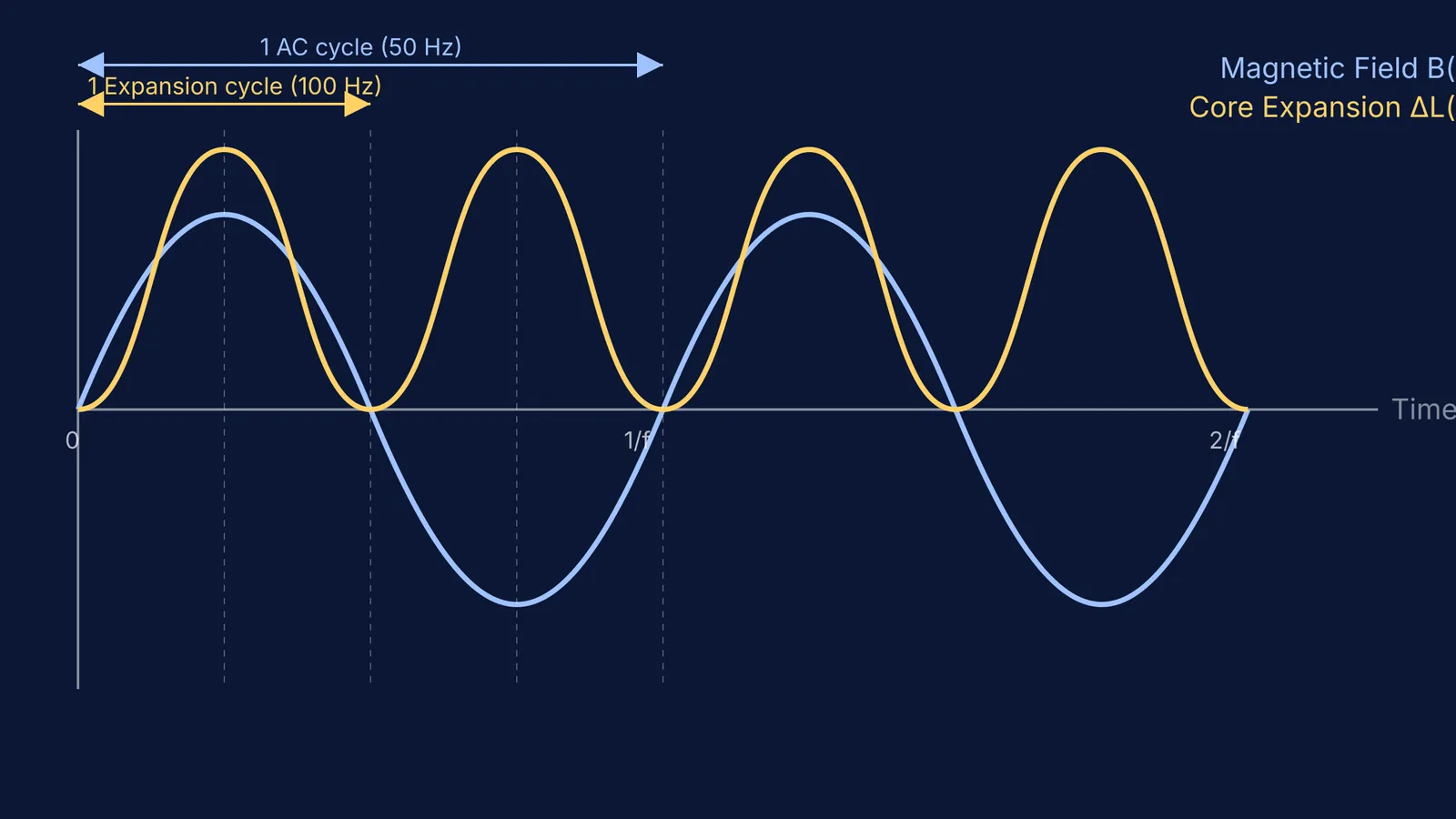
Power grids deliver alternating current (AC). In an AC circuit (the alternating current system developed by Nikola Tesla), the current and the magnetic field it creates are constantly reversing direction, following a sine wave.
If the electrical grid operates at a frequency of 50 Hz, the current completes 50 full cycles every second. However, magnetostriction depends only on the strength of the magnetic field, not its direction. The core stretches when the magnetic field peaks in the positive direction, relaxes when the field drops to zero, and stretches again when the field peaks in the negative direction.
Because the magnetic field peaks twice per AC cycle, the core completes two full expansion-contraction cycles for every electrical cycle.
This gives us a clear mathematical relationship. If the AC frequency is f, the core vibrates at 2f. For a 50 Hz supply, the core expands and contracts 100 times a second, vibrating the air to produce a 100 Hz acoustic hum (as noted by Wikipedia). In the United States, where the grid runs at 60 Hz, transformers hum at 120 Hz.
Proving the frequency mathematically
If you are preparing for JEE or NEET physics, you can prove this frequency doubling using trigonometry.
The alternating magnetic field B(t) varies with time according to B(t) = B₀ sin(2πft).
The physical expansion ΔL caused by magnetostriction is roughly proportional to the square of the magnetic field:
ΔL ∝ (B₀ sin(2πft))²
Using the trigonometric identity sin²θ = (1 − cos 2θ) / 2, we can rewrite the expansion as:
ΔL ∝ (B₀² / 2) (1 − cos 4πft)
The new cosine term has an angular frequency of 4πf, which corresponds to a standard frequency of 2f. This neat piece of mathematics is why the mechanical vibration is exactly twice the electrical frequency.
Seeing the invisible magnetic field reverse direction is often a sticking point for students. The Fermi Simulation Lab provides interactive simulations for the ideas that are easier to see than to read, letting you watch the AC cycle and the resulting forces unfold in slow motion.
Can the humming sound be stopped?
Because magnetostriction is a fundamental property of ferromagnetic materials (like those discussed in our guide to dia-, para- and ferromagnetism), the hum cannot be entirely eliminated. It happens even when the transformer has no electrical load attached, as long as it is plugged into a voltage source.
However, engineers can muffle the sound. They build transformer cores out of high-grade, grain-oriented steel that exhibits less magnetostriction. They also clamp the metal plates (laminations) tightly together so they cannot rattle against one another, and they submerge the core in heavy oil to dampen the vibrations before they reach the outside air.


