On this page
When you switch on a fan, the current reaches it through copper. Three properties put it there: low resistance, ductility and price. Aluminium wins one job copper does badly: hanging from towers.
Why is copper used in electric wires?
The resistance of a wire is R = ρL/A, so for a given length L and cross-section A, the metal with the smallest resistivity ρ wastes the least energy as heat.
Copper's resistivity at 20 °C is 1.68 × 10⁻⁸ Ω m, against 2.65 × 10⁻⁸ Ω m for aluminium and 9.71 × 10⁻⁸ Ω m for iron, according to the HyperPhysics resistivity table. Lower resistivity means less I²R heating in the wire and a smaller voltage drop before the current reaches your appliance. Why metals differ is worked out from electron collisions in our explainer on relaxation time and resistivity.
The second reason is ductility. Copper is ductile enough to be drawn down to diameters with very close tolerances, and it resists creep, so screw terminals do not slowly loosen, as summarised in this overview of copper conductors. The same overview notes that copper solders easily and that the oxides and sulphides that form on it are somewhat conductive, so a slightly tarnished joint keeps working.
The third reason is price. Copper averaged $9,142 per tonne in 2024, according to the World Bank's commodity price data.
Why not use silver, if it conducts better?
Silver is the one common metal that conducts better than copper: its conductivity is 106% of annealed copper's on the international standard scale, per the copper conductor overview. Its resistivity, 1.59 × 10⁻⁸ Ω m in the HyperPhysics table, is only about 5% lower than copper's.
The price gap is huge. Silver averaged $28.3 per troy ounce in 2024 in the World Bank Pink Sheet, which works out to about $910 per kilogram against copper's $9.14. Paying roughly 100 times more for 5% less resistance makes no sense for house wiring.
Why is aluminium used for overhead power lines?
Overhead conductors hang between towers, so every kilogram pulls on the towers. Aluminium's density is 2.70 g/cm³, according to PubChem's aluminium page, while copper's is 8.93 g/cm³ on PubChem's copper page.
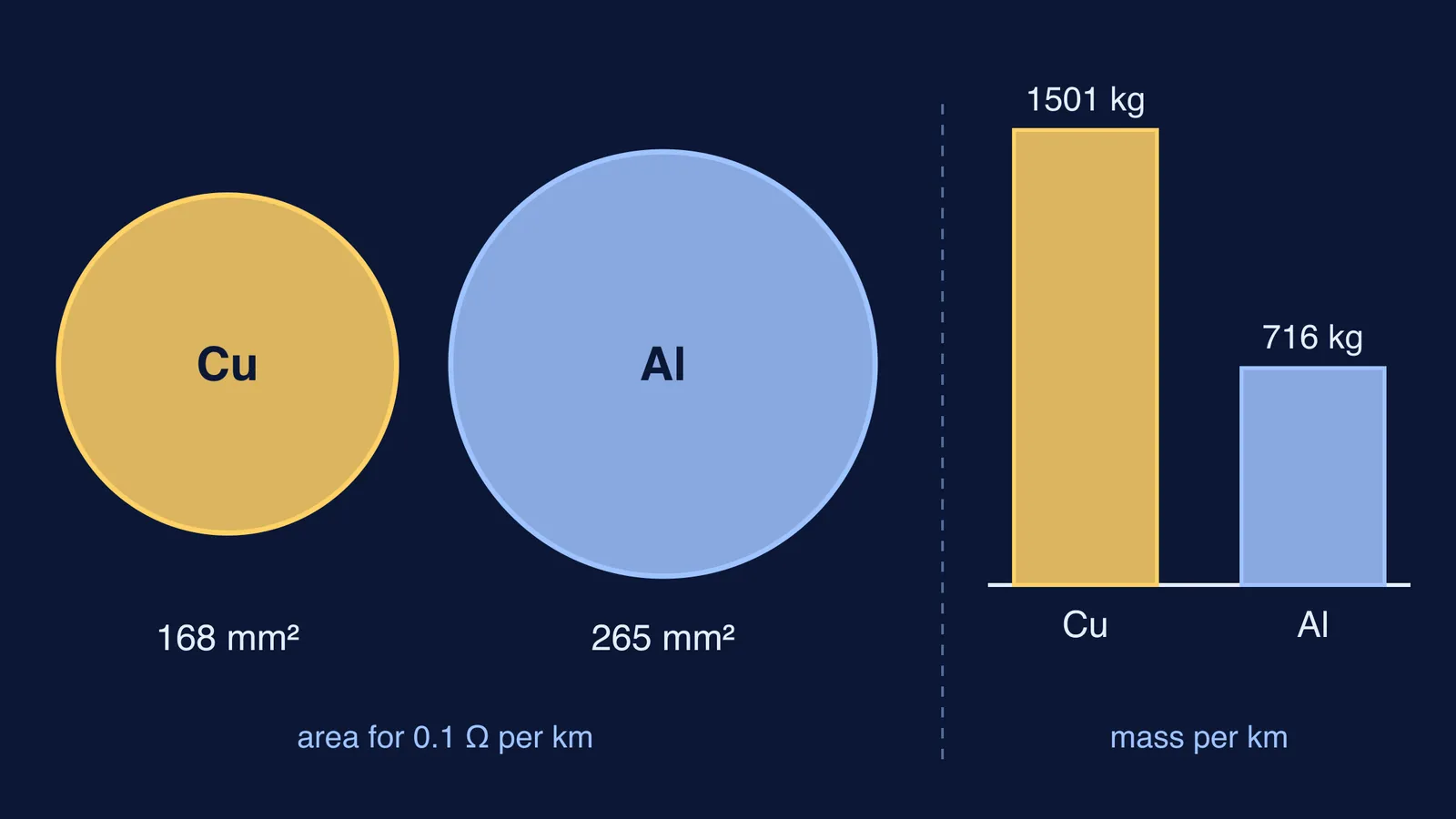
Worked example: 1 km of conductor that must have a resistance of 0.1 Ω.
Area needed, A = ρL/R. Copper: 1.68 × 10⁻⁸ × 1000 ÷ 0.1 = 1.68 × 10⁻⁴ m², or 168 mm². Aluminium: 265 mm².
Diameter ratio: √(265 ÷ 168) ≈ 1.26, so the aluminium wire is about a quarter thicker.
Mass = density × A × L. Copper: 8,933 kg/m³ × 1.68 × 10⁻⁴ m² × 1000 m ≈ 1,501 kg. Aluminium: 2,700 × 2.65 × 10⁻⁴ × 1000 ≈ 716 kg.
Metal cost at the 2024 World Bank annual averages ($9,142 per tonne for copper, $2,419 per tonne for aluminium): copper about $13,700, aluminium about $1,730.
So the aluminium line carries current just as well, weighs less than half as much, and its raw metal costs roughly one-eighth. These are metal prices only, not finished cable. A thicker wire is no problem in open air. Real lines usually use aluminium strands wound around a steel core, because the stronger steel lets engineers pull the conductor tighter between towers, as explained in this description of ACSR cable. Why these lines run at hundreds of kilovolts is worked out in our post on high-voltage power transmission.
Why do homes still use copper wiring, not aluminium?
Inside walls, space is tight and every switch and socket is a joint. The US Consumer Product Safety Commission's guide on repairing aluminium wiring explains that a copper shortage in the mid-1960s led US builders to use more aluminium in ordinary household circuits. A national survey for the CPSC found that homes built before 1972 and wired with aluminium were 55 times more likely to have one or more outlet connections reach "Fire Hazard Conditions" than homes wired with copper. The trouble was at the joints, where slow deterioration raised the resistance and the extra resistance caused overheating.
If a switch plate at home feels warm or you smell burning plastic, have a qualified electrician find the cause. The CPSC guide says not to try it yourself.
How do you write this answer in an exam?
For a three-mark "Why is copper used for electric wires?", give four points:
Low resistivity (1.68 × 10⁻⁸ Ω m in the HyperPhysics table), so little energy is lost as heat.
Ductile, so it can be drawn into thin wires.
Joints stay tight and it solders easily.
Far cheaper than silver, which conducts only slightly better.
For "Why is aluminium used for overhead lines?", add: low density, so it is lighter for the same resistance; cheaper; and a steel core supplies the strength.
Try it yourself: repeat step 1 of the worked example for iron. You should get 971 mm², nearly six times copper's area. If R = ρL/A numericals still trip you up, the Fermi Problem Library has worked problems with a step-by-step solver that explains the reasoning rather than printing an answer.
Next, see how the same formula sets the voltage drop in a long extension wire.