On this page
A tower crane holds a load far out over the road and looks as if it should tip. It does not, because it is built around one idea from Class 11 physics: the principle of moments.
How do tower cranes not fall over?
A moment, or torque, is a force multiplied by its perpendicular distance from a pivot. A rigid body stays at rest only when the net force and the net torque on it are both zero (OpenStax University Physics).
Think of the top of the mast as the pivot. The load hangs from a trolley on the long arm, the jib, and tries to turn the crane forwards. A concrete counterweight on the short arm, the counter-jib, tries to turn it backwards. OSHA defines a counterweight as "a weight used to supplement the weight of equipment in providing stability for lifting loads by counterbalancing those loads" (OSHA 1926.1401).
The counterweight cannot match every load, so whatever moment is left over travels down the mast into the foundation. The same OpenStax section shows the failure with a tipping truck: once the combined centre of mass of truck and load sits outside its wheels, it tips over. That is why US rules say a tower crane must not be erected, dismantled or operated without counterweight in the amount and position "specified by the manufacturer or a registered professional engineer familiar with the equipment" (OSHA 1926.1435).
Why can a crane lift less at the end of its jib?
What tips a crane is the load moment, load times radius, not the load alone. Double the radius and the turning effect doubles.
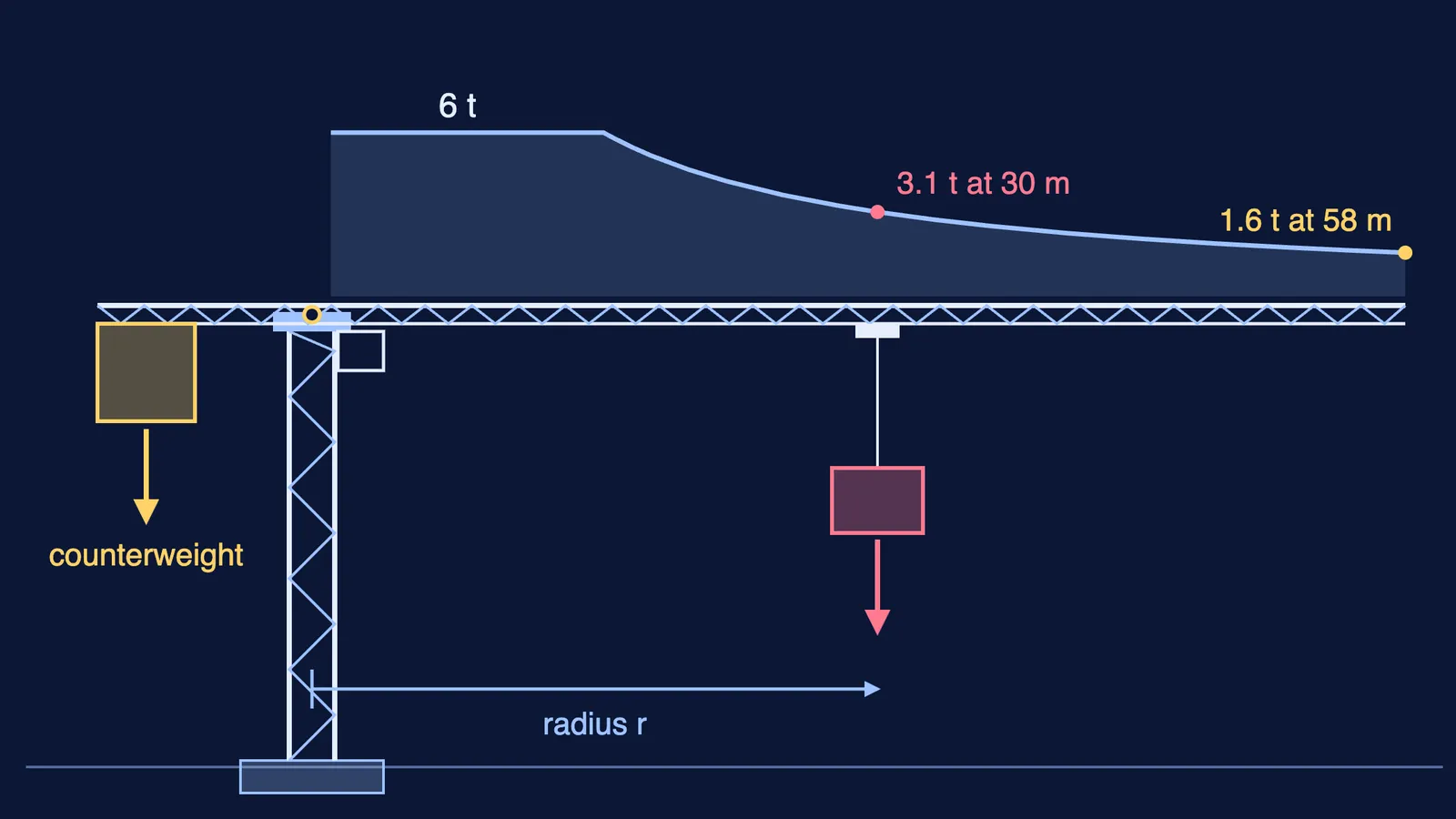
Liebherr lists its 125 EC-B 6 flat-top crane with a maximum lifting capacity of 6,000 kg, a maximum radius of 58 m, and 1,600 kg at that radius (Liebherr flat-top cranes).
Moment at the tip: 1,600 kg × 58 m = 92,800 kg·m. Times g = 9.8 m/s², that is about 909 kN·m.
If that same moment were allowed at every radius, the load at 30 m could be 92,800 ÷ 30 ≈ 3,090 kg.
The 6,000 kg maximum would take over at 92,800 ÷ 6,000 ≈ 15.5 m. Closer in, that cap decides, not the moment.
That is the shape in the diagram above: flat near the mast, then falling as 1/r. Real charts combine several limits, so operators use the manufacturer's chart, not sums like ours. Comansa's 21LC335 shows the same pattern: up to 20 t in its heavier version, but 2,700 kg at its 74 m reach (Comansa 21LC335).
More in our guide to SI units of torque and moment of inertia.
What is a crane load chart, and who checks it?
A load chart lists rated capacity: "the maximum working load permitted by the manufacturer under specified working conditions", such as radius (OSHA 1926.1401). US rules require load charts to be "readily available in the cab at all times" and say the equipment "must not be operated in excess of its rated capacity" (OSHA 1926.1417).
A load moment limiter senses the overturning moment and, at rated capacity, shuts off power to motions that would make it worse, such as hoisting. For tower cranes the rule is blunt: "The tower crane must have a device that prevents moment overloading" (OSHA 1926.1435).
How does a tower crane build itself taller?
Cranes grow by climbing, which OSHA defines as "the process in which a tower crane is raised to a new working height" (OSHA 1926.1401).
In top climbing, a top climbing guide fits around the mast and a hydraulic ram raises the entire structure of the crane, opening a gap for a single mast section (WorkSafeBC). The guide's rollers travel smoothly "when the system is weight-balanced". Moments again: riding on the ram, the crane's top must balance about the mast.
WorkSafeBC recalls a tower crane that collapsed while being dismantled in Kelowna, Canada, in July 2021, killing five people, and warns that not following the manufacturer's instructions may cause structural failure.
Try it: build a ruler crane
Rest a 30 cm ruler on a round pencil at the 10 cm mark. The short side is your counter-jib.
Stack 4 identical coins at the 0 cm end: 4 coins × 10 cm = 40 coin-cm.
Predict the coins that balance at the 30 cm mark, 20 cm out: 40 ÷ 20 = 2.
Test it. You need fewer, perhaps none, because the ruler's own weight acts at its 15 cm mark, on the jib side.
Step 4 is the real lesson: the crane's own steel counts, as when you find the centre of gravity of a non-uniform rod. A wide base helps for the same reason dahi handi pyramids need a wide base.
To watch a balance shift as a load slides out, the Fermi Simulation Lab has interactive simulations for ideas easier to see than to read. If torque questions cost you marks, Fermi's AI tutor works out what you already know and builds a plan for the session.
Next time you pass a crane, find the trolley and guess its radius: you are reading half of its load chart.