On this page
Every year at Janmashtami, govinda teams in Maharashtra build human pyramids to reach and break a pot of curd hung high above the street. The shape is always the same: the most people, preferably sturdy, at the bottom, and usually a single child at the top, as the Dahi Handi entry on Wikipedia describes. That shape is Class 11 physics.
What keeps a human pyramid from tipping over?
The centre of gravity is the point where the pyramid's whole weight can be taken to act. The base of support is the area enclosed by the bottom layer's feet.
OpenStax College Physics states the rule: "The critical point is reached when the cg is no longer above the base of support." Before that point, gravity swings it back; after it, gravity pulls it over.
The Body Physics text on LibreTexts/05%3A_Maintaining_Balance/5.08%3A_Human_Stability) gives the corollary: "a high center of gravity or a small support base makes a structure less stable." A dahi handi pyramid tackles both.
For a pyramid a few metres tall, the centre of gravity and centre of mass are the same point; our explainer covers when centre of gravity and centre of mass differ.
Why do the heaviest people stand at the bottom?
The height of the combined centre of gravity is a weighted average: h = (m1h1 + m2h2 + ...) / (m1 + m2 + ...). Mass near the ground pulls the average down, so the heavy, strong people go where they lower it most and can carry the load.
Take a five-tier pyramid with illustrative numbers we chose, not measurements. Each tier stands 1.4 m above the one below, and each person's own centre of gravity is 0.9 m above their feet (0.6 m for the child).
Tier 1: 8 people of 70 kg = 560 kg, centre of gravity at 0.9 m
Tier 2: 6 people of 65 kg = 390 kg, at 2.3 m
Tier 3: 4 people of 55 kg = 220 kg, at 3.7 m
Tier 4: 2 people of 45 kg = 90 kg, at 5.1 m
Tier 5: 1 child of 25 kg, at 6.2 m
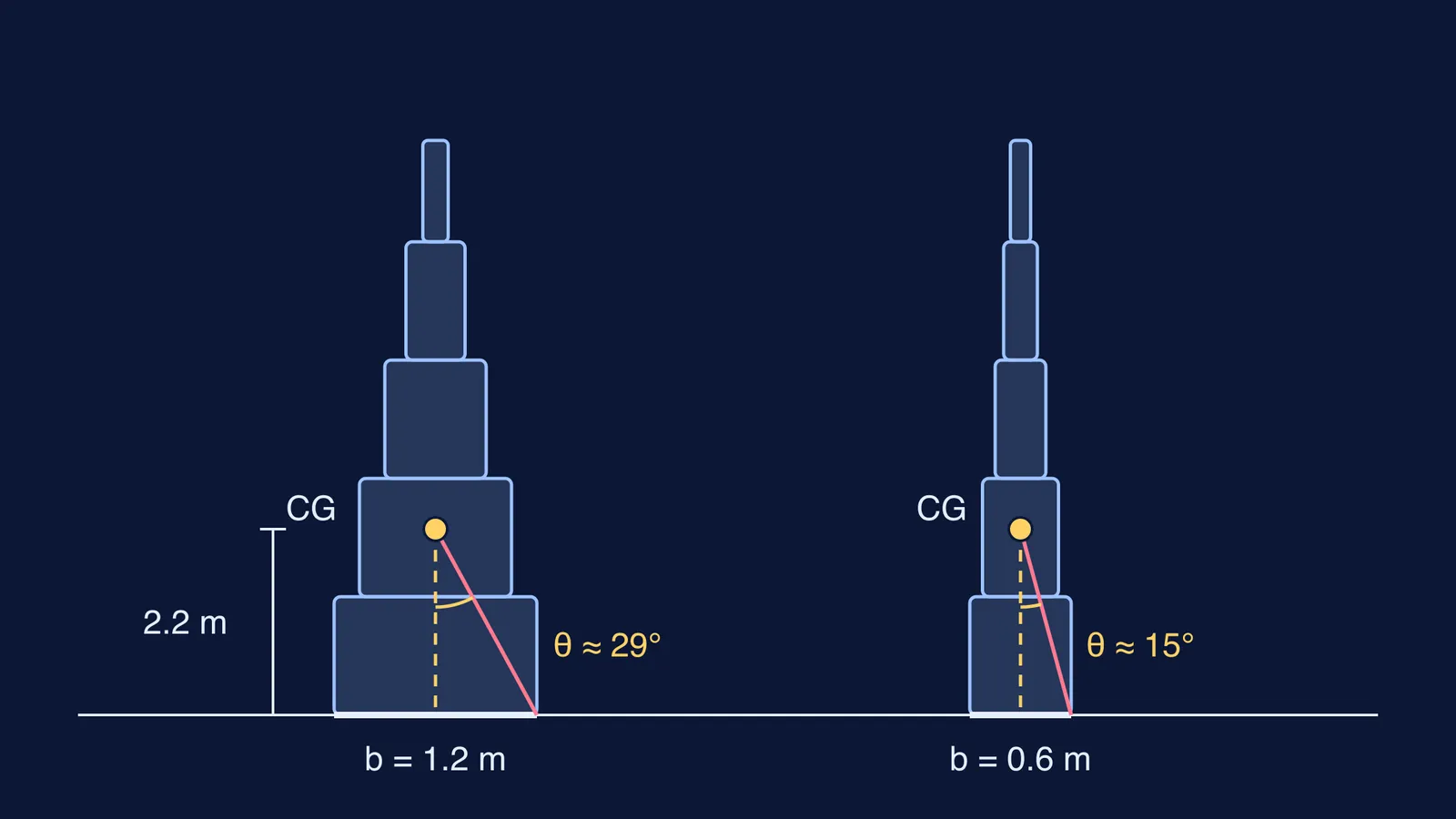
Total mass is 1,285 kg; the sum of mass times height is 504 + 897 + 814 + 459 + 155 = 2,829 kg m. So the combined centre of gravity sits at about 2.2 m, though the child is over 6 m up.
How far can a pyramid lean before it falls?
Treat the example pyramid as one rigid block. With b the distance from the middle of the base to its edge, it topples once the line from the centre of gravity to that edge passes vertical: θ = tan⁻¹(b / h).
Wide base, b = 1.2 m, h = 2.2 m: θ ≈ 29°
Narrow base, b = 0.6 m, h = 2.2 m: θ ≈ 15°
Wide base, but every climber weighs 70 kg (1,470 kg in total, h ≈ 2.5 m): θ ≈ 26°
Halving the base nearly halves the safe lean. Heavy climbers cost a few degrees, and they also put more load on the people below.
Why is the base so crowded?
More people at the bottom spread more feet over a bigger area, widening the base of support. But a real pyramid is not a rigid block. Researchers who modelled the simplest Catalan human tower, or castell, treated it as an N-link pendulum, a chain of hinged links, with the people's response as a control problem (Antunes and colleagues, arXiv, 2020). It never balances once and for all.
When do dahi handi injuries happen?
Mostly on the way down. A study of 124 pyramid participants treated at one hospital after the 2010 festival found 37.1% had major injuries; 81.5% were hurt during the descent, and the main mechanism was a participant from an upper layer falling on them (Nemade and colleagues, Journal of Postgraduate Medicine, 2012). The study does not say why; one physics guess is that as layers break up, the base shrinks, so a smaller wobble can tip it. Rules have changed since the Supreme Court upheld a 20-foot cap and barred under-18s in 2016: check the current local rules, and insist on helmets, mats and a practised team.
How can you test the wide-base rule at home?
Stand feet together while a friend gently pushes your shoulder. Repeat with feet apart, then knees bent.
Stack five books as a pyramid, then with the biggest on top. Tilt a board under each and note the tipping angle.
Measure b, estimate h, and compare tan⁻¹(b / h) with what you saw.
The same rule explains why three-wheelers topple on sharp turns and whether a pushed block slides or topples. A shifting centre of gravity is easier to see than to read about, and the Fermi Simulation Lab has interactive simulations for ideas like this. Stuck on the algebra? The Fermi Problem Library has a step-by-step solver that explains the reasoning.