

On this page
Stand a thick book upright on a table and push it sideways with one finger. Push near the top and it tips over. Push near the bottom and it slides. Somewhere in between, the behaviour switches. Predict first: for a book 4 cm thick, is that height near the top, the middle or the bottom?
Will a block topple or slide when pushed?
It does whichever needs the smaller push. The open textbook Engineering Statics: Open and Interactive describes the two outcomes: as you push harder, either static friction reaches its maximum and the box slides, or the push and the friction force form a couple that tips it onto its corner. So work out the limiting force for each and compare.
Call the block's width (in the push direction) b, its height h, its mass m, and your horizontal push F, applied at height y.
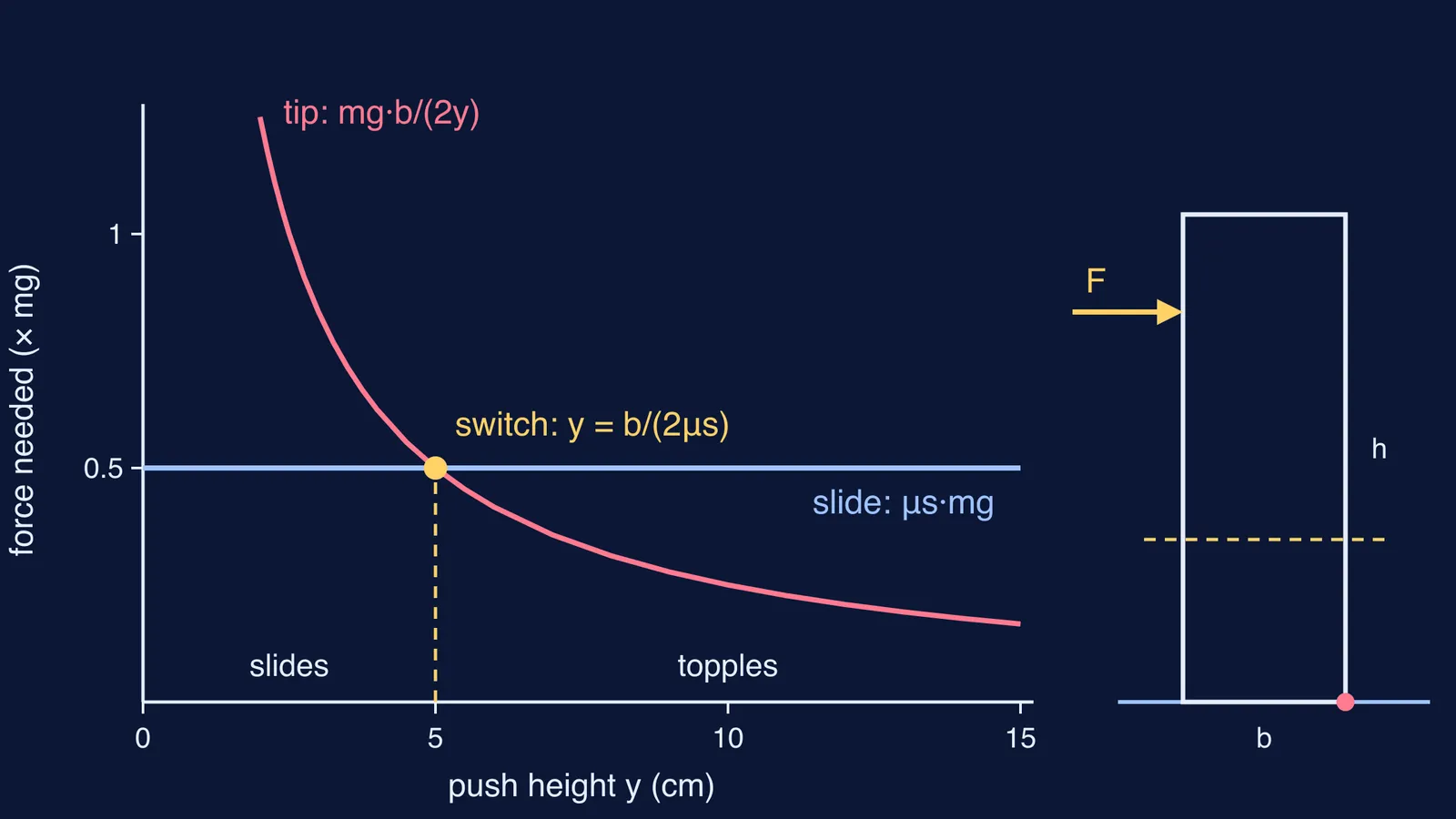
Sliding: static friction can be at most μs times the normal force, according to OpenStax University Physics, section 6.2. On a flat table the normal force is mg, so the block slides once F is bigger than μs·mg, at any push height.
Toppling: at the point of tipping, the normal force acts at the front bottom corner, as the University of Alberta statics notes explain. Take moments about that edge, where friction and the normal force drop out. Your push turns the block forward with F·y; the weight, acting at the centre, turns it back with mg·b/2. The block tips once F is bigger than mg·b/(2y).
At what height does a block switch from sliding to toppling?
Set the two limits equal: μs·mg = mg·b/(2y). Mass and g cancel, leaving the switch height y = b/(2μs).
Push below this height and the block slides.
Push above it and the block topples.
If b/(2μs) is taller than the block, a horizontal push can never tip it. That happens when μs is less than b/(2h).
Worked example: a wooden block on a wooden table
Take a block 5 cm wide and 15 cm tall with mass 0.2 kg, so mg = 0.2 × 9.8 = 1.96 N. OpenStax's Table 6.1 gives a static friction coefficient of about 0.5 for wood on wood.
Force to slide, at any height: 0.5 × 1.96 = 0.98 N.
Force to tip when you push at the top (y = 15 cm): 1.96 × 5/(2 × 15) = 0.33 N. That is less than 0.98 N, so the block topples.
Force to tip when you push at y = 2 cm: 1.96 × 5/(2 × 2) = 2.45 N. Now sliding needs less force, so the block slides.
Switch height: 5/(2 × 0.5) = 5 cm, exactly one block-width above the table.
For a slippery surface, take the same table's 0.1 for ice on ice. The switch height becomes 5/(2 × 0.1) = 25 cm, taller than the 15 cm block, so it slides wherever you push.
How do you test it at home?
You need a tall, rigid object with a flat base (a thick book stood upright, or a narrow box packed full), a ruler and a pencil.
Measure b (the thickness in the push direction) and h. Mark heights every centimetre on a paper strip beside it.
Predict tip or slide at the top, the middle and 1 cm up. Estimate the switch height with μs = 0.5, the OpenStax wood-on-wood value, as a first guess.
Push slowly and level with the blunt end of the pencil, at the centre of the face, starting at the top.
Move down 1 cm at a time and record tip or slide at each height.
The height where the answer changes is your measured switch height. Repeat three times and take the middle value.
Work backwards to the friction coefficient: μs = b/(2y). A book 4 cm thick that switches at 5 cm gives μs = 4/(2 × 5) = 0.4.
Change the surface (a sheet of paper, a cloth, a steel plate) and predict whether the switch will rise or fall before you try it.
Step 6 turns a toppling test into a way to measure friction.
Where does this idea show up next?
The same moment balance about an edge decides the condition for a car to topple on a circular road. For what friction does once the block moves, read the static vs kinetic friction graph as you pull a block, and for more practice with moments, try three torque predictions with a simulation.
The Fermi Simulation Lab has interactive simulations for ideas that are easier to see than to read; predict before you press play, as you did with the book. If your moment equation keeps coming out wrong, the Fermi Problem Library has worked problems with a step-by-step solver that explains the reasoning rather than printing an answer.


