

On this page
When a car turns on an unbanked road, it usually holds its lane. But take a corner too fast, and it faces two dangerous failure modes: skidding outward or rolling over. In rigid-body mechanics, knowing which occurs first depends on a direct comparison between tyre friction and vehicle geometry.
Why does a turning car experience an overturning torque?
To turn along a curve of radius r at speed v, a vehicle requires centripetal acceleration a = v² / r toward the curve's centre. On an unbanked road, this force comes entirely from static friction between tyres and asphalt, as explained in OpenStax *University Physics*.
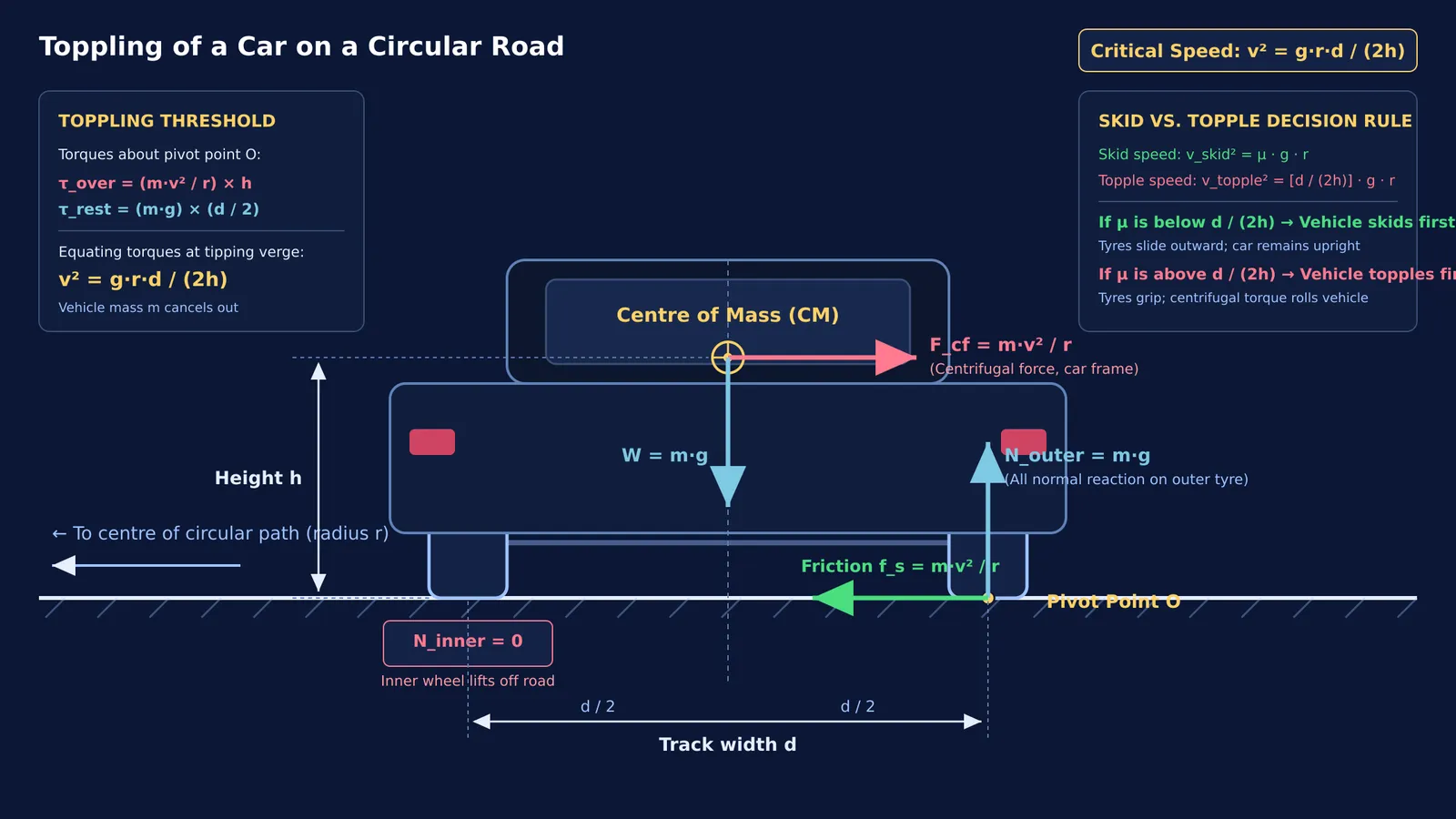
Friction acts at the road surface, but vehicle inertia acts through the centre of mass (CM) at height h. In the car's rotating frame, an outward centrifugal force m v² / r acts at height h. Separated vertically from ground friction, this creates an overturning torque: τ_over = (m v² / r) × h. This torque tilts the car outward. Our guide explains why the friction in a turning car is static, not kinetic.
Why does the inner wheel lift off before the outer wheel?
To prevent overturning, the road exerts a restoring torque by redistributing normal forces between the wheels. Let d be the track width and m g be the total weight.
Vertical equilibrium gives: N_inner + N_outer = m g
Balancing torques about the centre of mass gives: N_outer × (d / 2) - N_inner × (d / 2) = (m v² / r) × h
Solving these yields the normal force on each wheel:
N_inner = (m / 2) × [g - 2 v² h / (r d)]
N_outer = (m / 2) × [g + 2 v² h / (r d)]
As speed v rises, N_outer increases while N_inner falls. Assuming normal forces stay equal is a classic error; see our guide to common rotational motion mistakes. When reviewing rigid-body equilibrium, the Fermi Concept Library maps every concept in physics, each with its own lesson and its place in the map.
How do you derive the critical toppling speed v² = grd / (2h)?
Overturning begins when inner wheels lose contact with the road, meaning N_inner = 0.
Setting N_inner = 0 gives: g - 2 v² h / (r d) = 0
Rearranging gives the toppling speed condition: v² = g r d / (2 h)
Taking the square root: v_topple = √(g r d / (2 h))
You can also take torques about outer contact point O at the verge of tipping. Friction and N_outer pass through O, producing zero torque. Equating overturning and restoring torques: (m v² / r) × h = m g × (d / 2)
Cancelling mass m confirms v² = g r d / (2 h). Because mass cancels, vehicle weight does not affect toppling speed.
Does a car skid or topple first on a sharp curve?
Whether a car skids or rolls depends on friction coefficient μ relative to vehicle geometry. As explained in our guide on the maximum safe speed for a car turning on a flat road, skidding begins when required centripetal acceleration exceeds friction: v_skid = √(μ g r).
Comparing squared threshold speeds:
Skidding: v_skid² = μ g r
Toppling: v_topple² = [d / (2 h)] × g r
Dividing both by g r gives the decision rule:
If μ < d / (2 h), then v_skid < v_topple: the car skids outward safely on all four wheels.
If μ > d / (2 h), then v_topple < v_skid: tyre grip holds, but the car rolls over before skidding.
How do automotive safety engineers evaluate rollover risk?
Automotive engineers define this geometric ratio as the Static Stability Factor: SSF = T / (2 H), where T is track width d and H is centre of gravity height h. In TRB Special Report 265, published by the Transportation Research Board of the National Academies, engineers show that SSF represents the lateral acceleration in g units needed to overturn a rigid vehicle. Under the National Highway Traffic Safety Administration vehicle ratings program, passenger cars typically achieve SSF values between 1.30 and 1.50. Because dry asphalt has μ around 0.80, sedans skid rather than roll. Taller SUVs often register SSF values near 1.05 to 1.15, leaving them closer to rollover risk.
Consider a worked example:
An SUV has track width d = 1.6 m, centre of mass height h = 0.8 m, on a curve of radius r = 40 m with μ = 0.85 and g = 9.8 m/s².
Stability ratio: d / (2 h) = 1.6 / (2 × 0.8) = 1.00.
Because μ = 0.85 < 1.00, the SUV skids before it topples.
Skidding speed: v_skid = √(0.85 × 9.8 × 40) = √333.2 ≈ 18.25 m/s (65.7 km/h).
Toppling speed: v_topple = √(9.8 × 40 × 1.00) = √392 ≈ 19.80 m/s (71.3 km/h).
For guided practice on rotational dynamics and mechanics numericals, the Fermi Problem Library provides worked problems with a step-by-step solver that explains the reasoning rather than printing an answer.


