

On this page
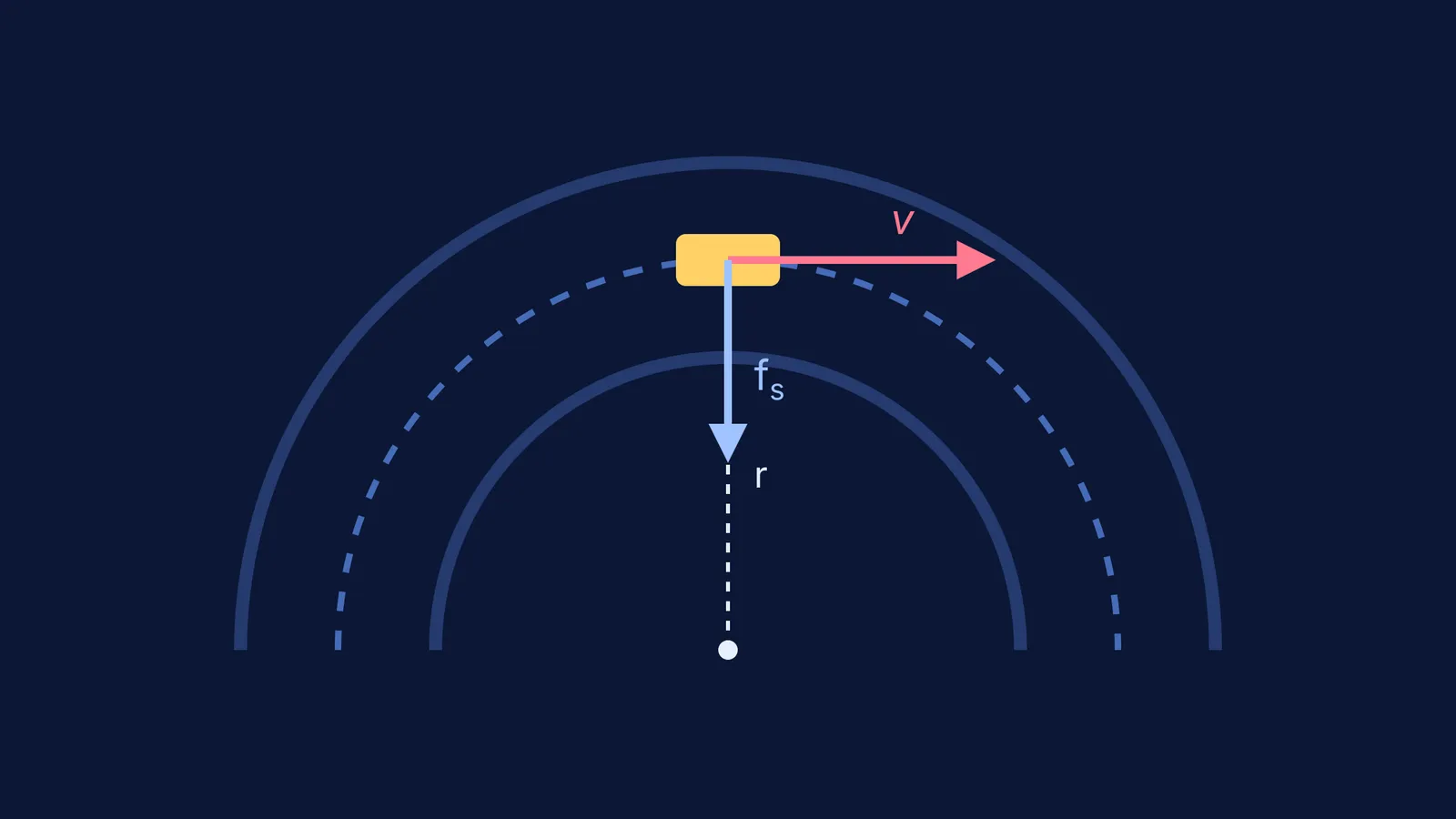
On an unbanked road, static friction between the tires and the surface is the only force pushing a vehicle toward the centre of its circular path. This friction provides the centripetal force—similar to the mv²/r term seen in pendulum string tension—necessary for any circular motion. When a car drives straight, friction merely overcomes air resistance and rolling resistance. However, entering a curve forces the tires to push sideways against the asphalt. If the required sideways force exceeds the maximum grip the tires can provide, the car will break traction and skid outward.
Understanding this delicate balance of forces is essential not just for physics students, but for anyone who sits behind the wheel of a car. The physics of circular motion explains why we must slow down for tight corners and why adverse weather changes everything.
What is the maximum speed for a car turning on a flat road?
The maximum velocity (v) before slipping begins is found by setting the required centripetal force equal to the maximum available static friction, as shown in the standard derivation. It is important to note that we use static friction, not kinetic friction, because the contact patch of a rolling tire is momentarily stationary relative to the ground.
The required centripetal force is given by (m × v²) / r. On a level surface, the normal force equals the vehicle's weight (m × g), so the maximum static friction is μs × m × g, where:
μs is the coefficient of static friction (related to the angle of friction).
m is the mass of the vehicle.
g is the acceleration due to gravity (9.8 m/s²).
Equating the required centripetal force to the maximum frictional force gives the full balance of forces for the moving vehicle: (m × v²) / r = μs × m × g
Because the mass (m) appears on both sides of the equation, it cancels out, yielding the final mathematical formula: v = √(μs × r × g)
How does friction affect the maximum safe speed?
The speed you can safely carry through a corner scales with the square root of the available friction. This square-root relationship means that improving your tire grip yields diminishing returns for your cornering speed, while losing grip can be surprisingly dangerous. In a textbook example, an open-access physics manual notes that taking a gentle 500-metre curve at 25 m/s (90 km/h) requires a minimum static friction coefficient of 0.13. Standard dry asphalt typically offers a coefficient between 0.7 and 0.9, giving drivers a very comfortable safety margin under normal conditions.
However, rain, ice, or severely worn tires dramatically lower the static friction. If a downpour causes your friction coefficient to drop by half, your maximum safe speed drops by a factor of the square root of a half. Since the square root of a half is roughly 0.7, your new limit is considerably lower, though not entirely halved. If the car starts to slide, the wheels transition from static friction to kinetic friction. Because the kinetic coefficient is always lower than the static coefficient, the car suddenly has even less grip, making it extremely difficult to regain control until the vehicle significantly slows down.
How to test and visualise turning limits?
Predicting where a car loses grip is a classic mechanics problem, but visualising the balance of forces in real time can make the abstract mathematics much clearer. You can set up the physical variables for yourself in the Simulation Lab.
By adjusting the curve's radius and the tire friction coefficient, you can test where the car starts to skid and see exactly when the required centripetal force breaks the limit of static adhesion. This hands-on experimentation builds a deeper physical intuition than memorising the square-root formula alone.
It also sets the stage for understanding why highway engineers bank tight corners. When friction alone is not enough to keep a car on the road at highway speeds, a banked road tilts inward. This tilt recruits a horizontal component of the normal force to help push the car through the turn, reducing the reliance on tire friction and keeping passengers safe even on wet or icy days.


