On this page
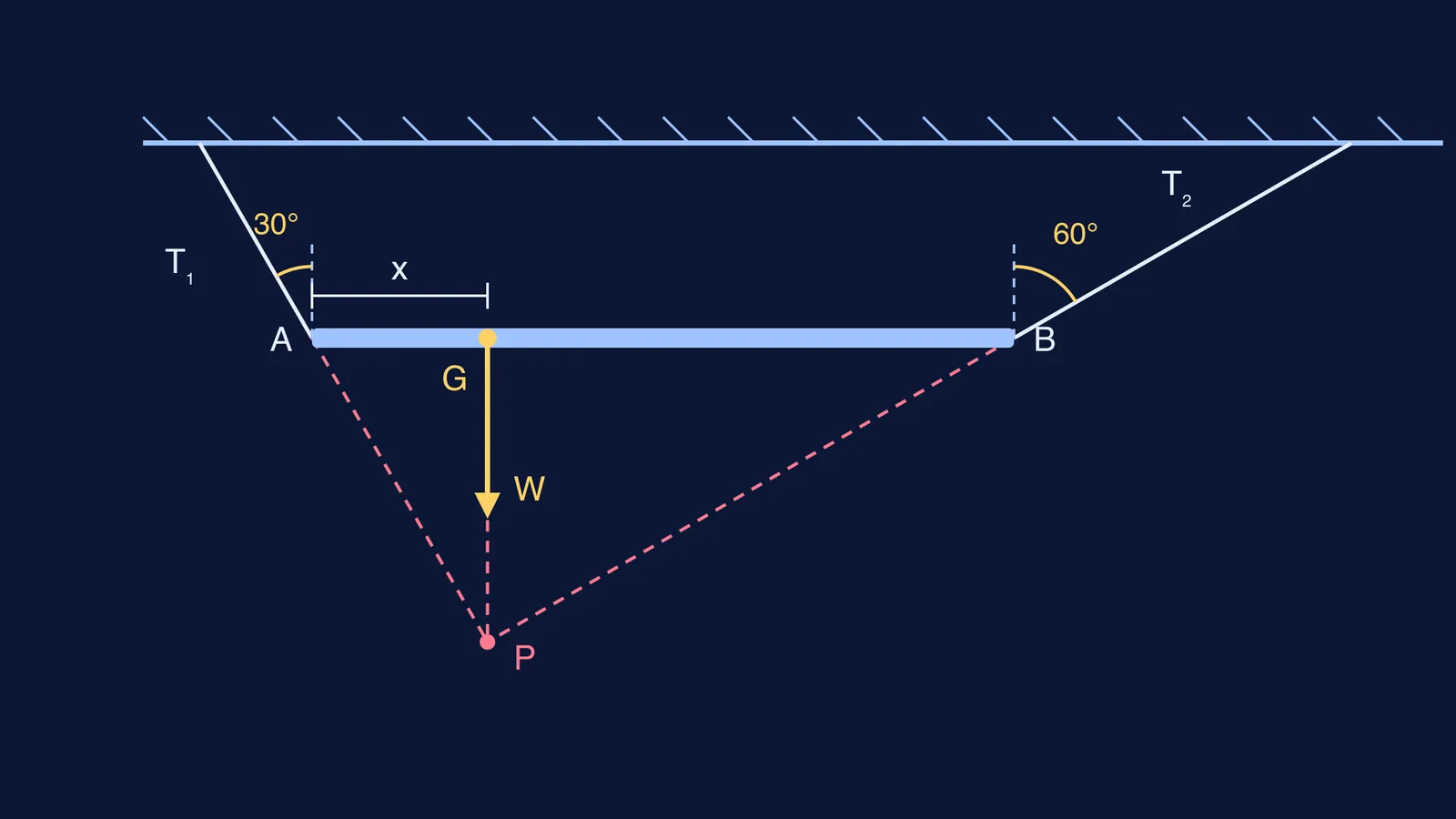
A rod that is not uniform hangs level from two light strings tied to its ends. The strings make different angles with the vertical, and the question asks where the rod's centre of gravity is. The midpoint is no use, because the mass is not spread evenly. You need the equilibrium conditions, a good point to take torques about, and a shortcut that checks the answer.
What does centre of gravity mean for a rod?
NCERT's Class 11 Physics textbook defines the centre of gravity as the point where the total gravitational torque on the body is zero (NCERT Physics Part I, Chapter 6, section 6.8.2). That is why you can replace the weight of every bit of the rod with one arrow, W, acting at a single point G.
The same section notes that G coincides with the centre of mass when g is the same across the body, as it is for any rod small enough that g does not vary along it. If you are given a density formula instead of strings, you integrate, as in our post on finding the centre of mass of a rod with variable density.
What equations hold when the rod hangs at rest?
When all the forces lie in one plane, NCERT lists three conditions for mechanical equilibrium: the force components along two perpendicular axes each add to zero, and the torques about any axis perpendicular to that plane add to zero (NCERT, section 6.8).
Call the tensions T₁ at end A and T₂ at end B, with angles θ₁ and θ₂ measured from the vertical:
Horizontal: T₁ sinθ₁ = T₂ sinθ₂
Vertical: T₁ cosθ₁ + T₂ cosθ₂ = W
Torques about any point add to zero
Once the forces balance, any point works for torques, so pick end A, where T₁ has no torque. Our guide on which point to take torque about in equilibrium problems explains why.
How do you find the centre of gravity step by step?
Worked example: a non-uniform rod AB, 1.20 m long and weighing 40 N, hangs level. The string at A is at 30° to the vertical and the string at B at 60°. Find x, the distance of G from A, and both tensions.
Torques about A. T₁ passes through A, so its torque is zero. The horizontal part of T₂ lies along the rod, so its torque about A is zero too. What remains is T₂ cos60° × 1.20 = 40 × x.
Horizontal balance. T₁ sin30° = T₂ sin60°, so T₁ = √3 T₂.
Vertical balance. √3 T₂ × (√3/2) + T₂ × (1/2) = 40, which gives 2T₂ = 40, so T₂ = 20 N and T₁ = 20√3 ≈ 34.6 N.
Solve for x. 20 × 0.5 × 1.20 = 40x, so x = 0.30 m from A.
Check about G: the vertical pulls are 30 N at A and 10 N at B, and 30 × 0.30 = 10 × 0.90 = 9 N m.
In symbols: x = L sinθ₁ cosθ₂ / sin(θ₁ + θ₂), which is the same as x = L tanθ₁ / (tanθ₁ + tanθ₂).
Is there a faster way using the three-force rule?
Only three forces act on the rod: T₁, T₂ and W. A body held in equilibrium by three forces needs them to be either parallel or concurrent, meaning their lines of action pass through one point (Mississippi State University statics notes on three-force members). The strings are not parallel, so if you extend both string lines past the rod, they meet at a point P. The weight's line has to pass through P too, which puts G directly above P.
If P is a depth h below the rod, then x = h tanθ₁ and L − x = h tanθ₂. Divide one by the other: x/(L − x) = tanθ₁/tanθ₂. In the example, tan30°/tan60° = 1/3, so x is one quarter of 1.20 m, or 0.30 m. That matches the torque method, and you can do it in your head. For the tensions, see our post on Lami's theorem for three forces on strings and knots.
What mistakes cost marks here?
Putting G at the midpoint, which only works for a uniform rod.
Using the angle with the rod as if it were from the vertical. Subtract it from 90° first.
Swapping sin and cos. With θ measured from the vertical, the vertical component is T cosθ.
Taking torques about a point off the rod and forgetting that the horizontal components then have torque.
If your numbers don't come out, the Fermi Problem Library has worked problems with a step-by-step solver that explains the reasoning rather than printing an answer. If torque itself feels shaky, the Fermi Concept Library gives each concept its own lesson.
Try one now: the same 1.20 m rod with strings at 45° and 60° to the vertical. You should get x ≈ 0.44 m from the 45° end.