

On this page
Look at a washing line, a suspension bridge cable, or a tightrope. No matter how tightly they are pulled, they always sag in the middle. It turns out this is not a failure of the material or the winch, but a fundamental law of mechanics. Even an unloaded wire sags under its own weight, but the physics is clearest when we consider a string pulled taut with a single weight hanging in the middle.
Why a taut horizontal string cannot be perfectly straight?
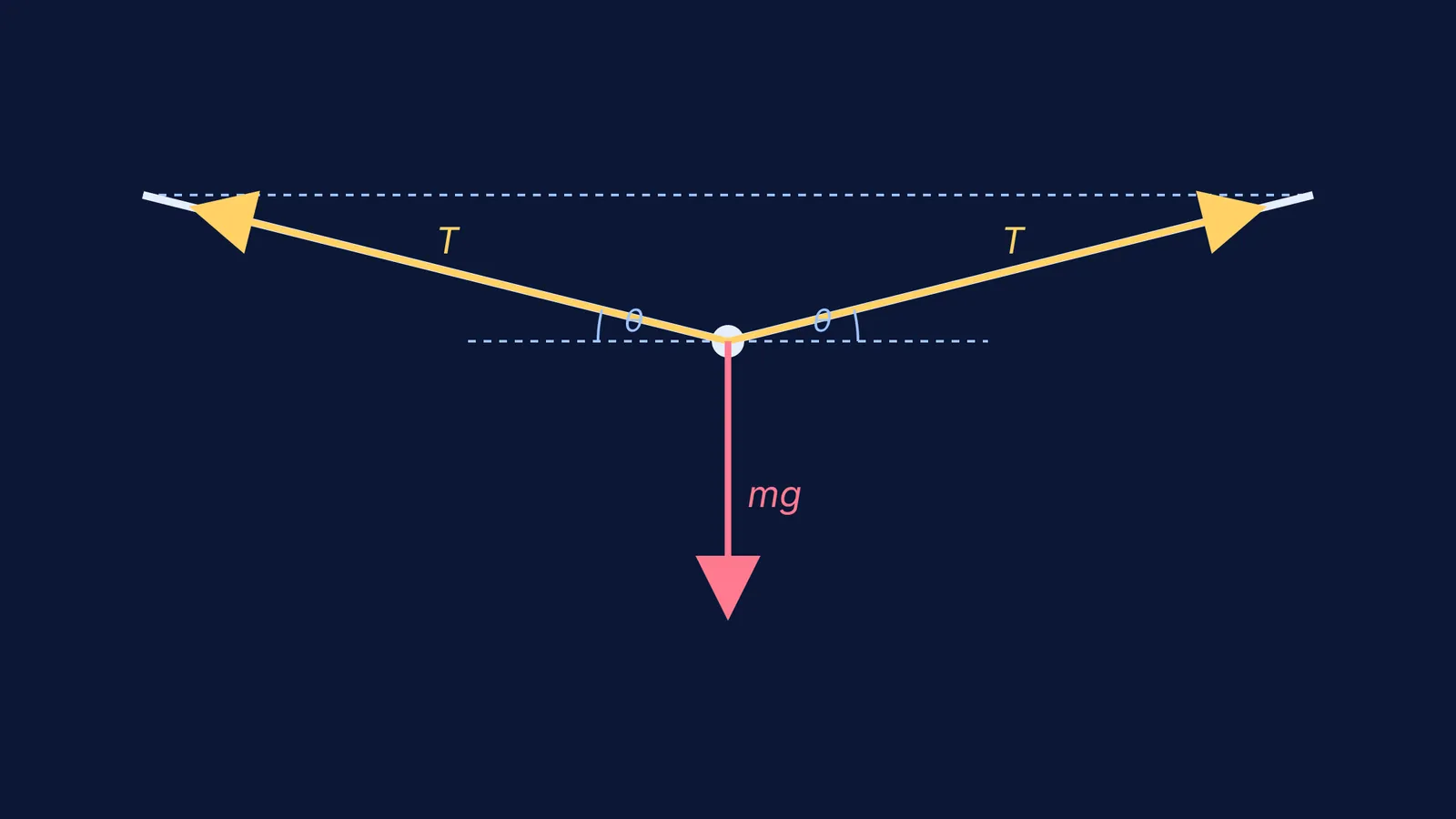
If you hang a small weight at the centre of a flexible string, gravity pulls it downwards with a force equal to mg, where m is the mass and g is the acceleration due to gravity.
For the weight to stay still and not fall, Newton's second law dictates that there must be an equal upward force. The string provides this upward force through its tension, denoted as T. If the string were perfectly horizontal, the tension would only pull horizontally towards the two support points. It would have no vertical component to counteract gravity, and the weight would instantly pull the string downwards.
To create an upward force, the string must yield and sag by some angle θ below the horizontal. The tension T then acts along this angle. By breaking the tension vector into components, we find that it has a horizontal component of T cos θ and a vertical component of T sin θ. Since there are two sides of the string pulling up and outwards on the weight, the horizontal components cancel each other out, while the vertical components add together. The total upward force is therefore 2T sin θ.
Balancing the vertical forces gives the fundamental equation for equilibrium in this system: 2T sin θ = mg
How high is the tension for a tiny sag angle?
Rearranging the equilibrium equation to solve for tension gives us a clear view of the relationship between the sag and the force: T = mg / (2 sin θ)
This formula shows exactly why a perfectly straight string is impossible. As explained by OpenStax University Physics, making the wire more horizontal decreases the angle of sag θ, which requires the tension to increase significantly. As the angle θ gets closer and closer to zero, the value of sin θ also approaches zero. Mathematically, dividing the constant weight by a number that approaches zero means the required tension T approaches infinity.
Since no physical material can withstand infinite tension, the string or wire will always stretch, sag, or eventually snap long before it ever becomes perfectly horizontal.
What happens in real-world power lines and cables?
Engineers who design power lines, suspension bridges, and zip lines must carefully account for this relationship between sag and tension. They can never winch a cable perfectly straight. In fact, if they pull a cable too tight during installation in the summer, they risk catastrophic failure in the winter.
When the temperature drops, metal cables undergo thermal contraction and shrink in length. This shortening decreases the sag angle θ. As we know from our equilibrium equation, even a small decrease in θ when the angle is already small causes a massive spike in tension. If the tension exceeds the breaking strength of the metal, the power line snaps. To prevent this, engineers intentionally leave enough slack in the line to ensure the tension remains safe even on the coldest days.
A worked example: A small weight at the centre
To see how aggressively tension scales up when the angle is small, consider a hypothetical 100-gram (0.1 kg) mass hung from the centre of a string, following the principles from OpenStax University Physics. Its downward weight is roughly 0.1 × 9.8 = 0.98 N.
If the string is pulled taut so that it sags by just 1°, the tension required to support it is: T = 0.98 / (2 sin 1°)
Using a calculator, we find that sin 1° ≈ 0.01745: T = 0.98 / (2 × 0.01745) ≈ 28 N
Because the angle is so tiny, a mere 100-gram mass has created a tension of 28 Newtons — the equivalent of holding nearly 3 kilograms vertically. The tension in the string is roughly 28 times the weight it is supporting.
Getting help with mechanics problems
Setting up free-body diagrams, resolving vectors into components, and balancing forces is the core of classical mechanics. If you have concept gaps around pulleys, strings and tension (like finding the tension when a monkey climbing a rope accelerates, or calculating a simple pendulum's string tension at its lowest point), the Fermi Concept Library has every concept in physics, chemistry, biology, mathematics and computing, each with its own lesson and its place in the map.
If you do not know where to start on a tough homework question, the Fermi Problem Library has worked problems with a step-by-step solver that explains the reasoning rather than printing an answer.


