

On this page
Every autumn, songbirds and falcons fly thousands of kilometres, many songbirds alone and at night. Henrik Mouritsen of the University of Oldenburg argues in a 2018 review in Nature that no single cue lets an animal navigate with pinpoint accuracy over such distances; the brain has to combine many. A 2018 study in Movement Ecology lists the compass cues birds use: the stars, the Sun, polarised skylight and Earth's magnetic field.
How does a bird use the Sun as a compass?
The Sun moves, so a bird's body clock corrects its Sun compass through the day, as an Oxford study of homing pigeons explains. Scientists test this by shifting the birds' day and night six hours early or late in special lofts; the heading then goes wrong predictably.
A worked example. The Sun goes round the sky once in 24 hours, so its direction changes by 360 ÷ 24 = 15 degrees per hour on average. Say it is really 6 a.m. in Delhi in autumn, with the Sun rising in the east. A bird whose clock runs six hours ahead thinks it is noon, when the Sun stands roughly due south. To fly south it flies towards the Sun, which is actually east: an error of 6 × 15 = 90 degrees.
In the Oxford study, 24 clock-shifted pigeons turned only partly off course, even within sight of their loft, which suggests they combined the Sun compass with familiar landmarks.
How do birds navigate by the stars at night?
Stephen Emlen tested young indigo buntings under a planetarium sky (Science, 1970). Birds raised without seeing the night sky could not choose the normal migration direction. Birds shown a normal rotating sky headed south. Birds shown a false sky turning around a different star oriented "correctly" relative to that false axis.
So the star compass is learned: a young bird finds the point of the sky that stays still while the rest turns, and treats it as north. In the real sky that point sits close to Polaris, as our explainer on why the pole star does not move shows.
How do birds sense Earth's magnetic field?
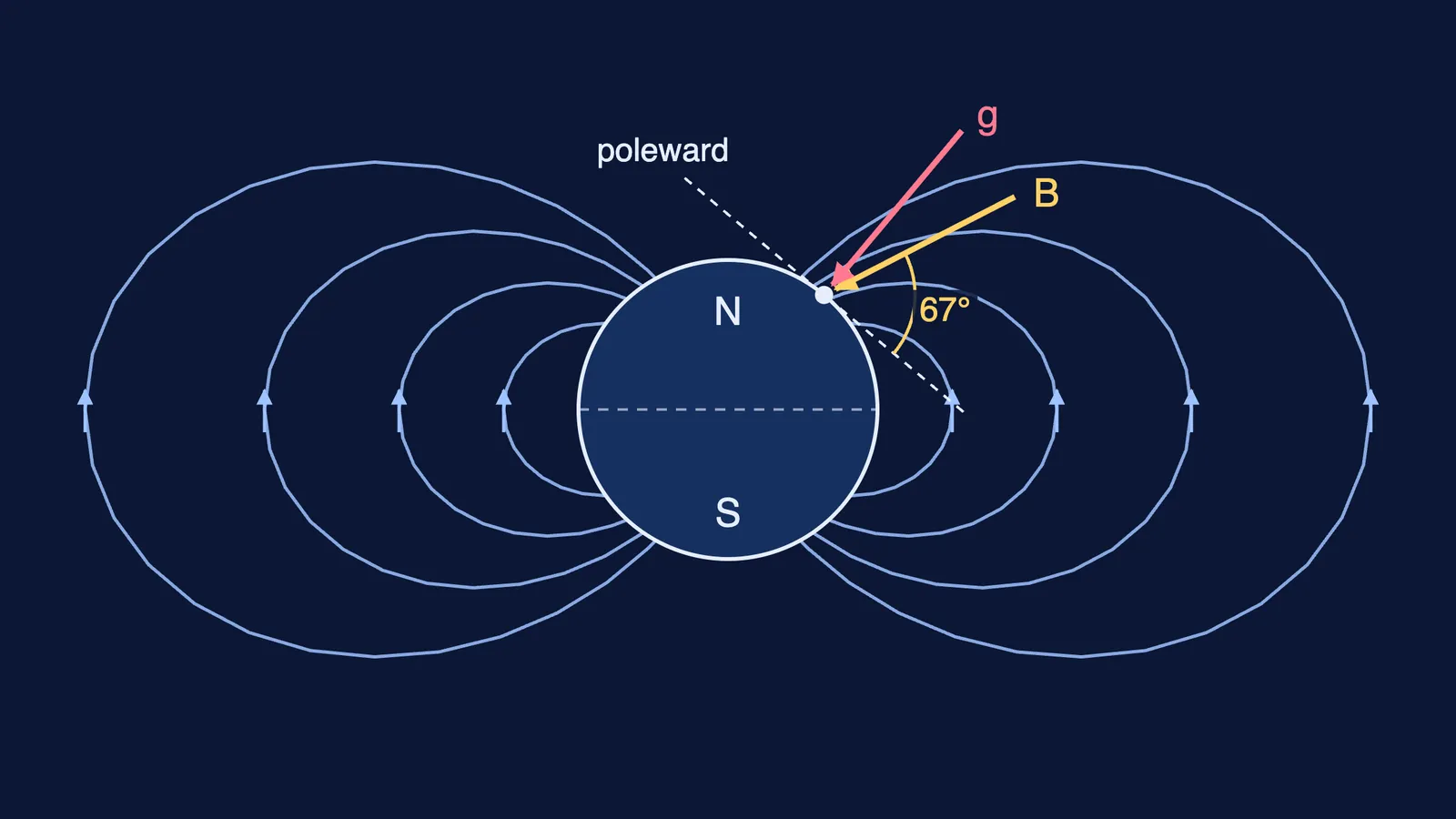
In 1972, Wolfgang and Roswitha Wiltschko showed in Science that the magnetic compass of European robins ignores the field's polarity. A robin reads the tilt of the field lines instead, and takes the poleward side as the one where field lines and gravity make the smaller angle. That tilt is the angle of dip, covered in our guide to dip, declination and Earth's field.
One idea for how birds feel the field is a light-sensitive protein in the eye. A 2021 study in Nature found that cryptochrome 4 from the European robin is magnetically sensitive in the test tube, more so than the same protein from chickens and pigeons, which do not migrate. That supports the idea, but it is not yet proof inside a living bird.
How do Amur falcons cross the Arabian Sea?
Amur falcons breed mainly in north-east China and winter mainly in southern Africa, about 14,600 km apart along the tracked birds' paths, says a summary of satellite tracking by Bernd Meyburg and partners. The monsoon gives them tailwinds both ways, the same winds traders once rode, as our piece on how monsoon winds were used to cross the Indian Ocean explains.
The team's 2026 paper in Ibis says the falcons cross about 2,800 km of open ocean without stopping. They tracked seven birds on spring migration in 2010, three of them in both directions. Spring crossings took about 60 hours and autumn ones about 78 hours. In spring the birds set off when tailwinds were strong and corrected for sideways drift. The authors warn that relying on these wind corridors may leave the route exposed to climate change.
India tracks them too. Chiuluan 2, a male tagged in November 2024 in Tamenglong, Manipur, by the Manipur Forest Department, the Wildlife Institute of India and local communities, flew about 3,800 km non-stop over the Arabian Sea in 93 hours, Outlook Traveller reported.
How can you test each bird compass yourself?
Sun: mark a stick's shadow tip at 10 a.m. and 11 a.m. and measure the angle between the marks. Expect more or less than 15 degrees: the Sun's direction changes unevenly.
Stars: note a bright star low in the northern sky at 8 p.m., then look again at 10 p.m. It will have swung about 30 degrees around the pole star: two hours at 15 degrees an hour.
Magnetism: for an ideal bar-magnet Earth, the dip angle I at magnetic latitude λ follows tan I = 2 tan λ. At 50 degrees that gives 67 degrees, as in the diagram at the top of this post. At 20 degrees, tan I = 2 × 0.364 = 0.728, so I is about 36 degrees. The real field is lumpier, so compare your estimate with the inclination for your city from NOAA's magnetic field calculators.
If dip and field lines are hard to picture, the Fermi Simulation Lab has interactive simulations for ideas easier to see than to read, and the Fermi Concept Library gives each concept in physics and biology its own lesson.
Next clear night, find the pole star and watch the sky turn around it, as a young bunting does.


