On this page
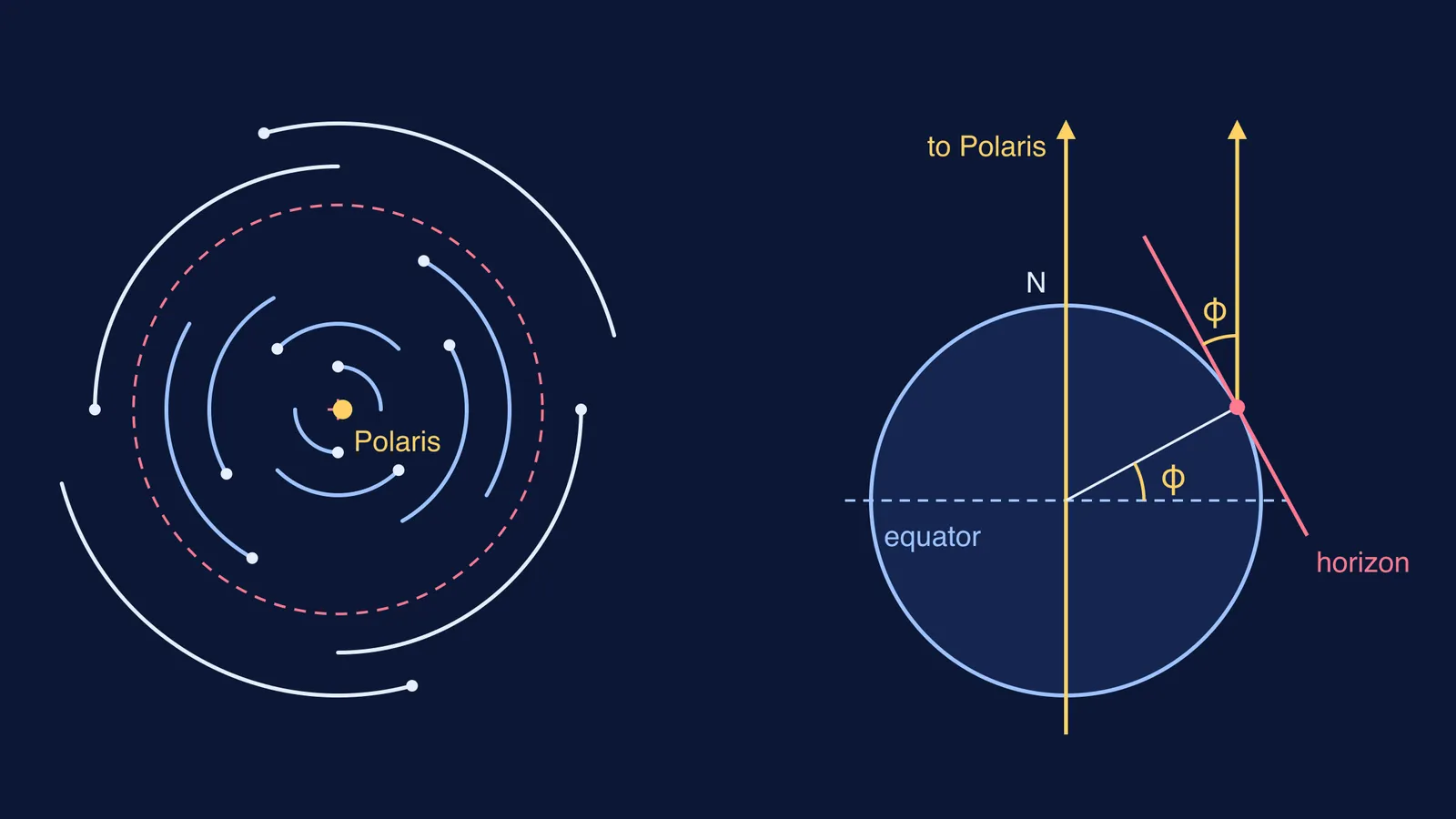
Leave a camera pointed at the northern sky for an hour and the stars smear into curved streaks, all bending around one point. Right next to that point sits a star that hardly moves at all: Polaris, the pole star. The reason is geometry, and the same geometry lets you find your latitude with your fist.
Why does the pole star not move in the sky?
Earth spins about an axis through its North and South Poles. Extend that axis into space above the North Pole and it points at a spot called the north celestial pole. As Earth turns, every star seems to swing around that spot, and the closer a star is to the axis of rotation, the slower it moves in the sky, as physicist Christopher Baird of West Texas A&M University explains (Science Questions with Surprising Answers). A star exactly on the axis would not move at all.
Polaris is almost on it. Royal Museums Greenwich, which runs the Royal Observatory, describes Polaris as "almost directly above the North Pole" (Royal Museums Greenwich). So while the rest of the sky wheels around it, Polaris stays put to the eye.
One full turn of the stars takes a sidereal day of 23 hours 56 minutes 4 seconds, about four minutes shorter than a 24-hour solar day (NASA Glenn Research Center). That is about 15 degrees of sky every hour. Why the turning goes unnoticed underfoot is its own question: why we don't feel the Earth spinning.
How far is Polaris from the true pole?
Polaris is offset about 0.65 degrees from the north celestial pole, so it makes a circle about 1.3 degrees across each day (EarthSky). For scale, the width of your fist held at arm's length covers about 10 degrees (EarthSky). Polaris's daily circle is a small fraction of one fist, too small to notice by eye; a long-exposure photo shows it.
Why does the pole star's height equal your latitude?
Start with two extreme cases. At the North Pole, Earth's axis runs straight up through you, so Polaris is overhead, 90 degrees up. At the equator the axis lies parallel to the ground, so Polaris sits on the northern horizon, 0 degrees up. PBS NOVA's classroom guide uses exactly these two cases, and notes that Polaris is not visible below the Equator (PBS NOVA).
For everywhere in between, follow the right-hand drawing at the top of this post:
Polaris is so far away that its light reaches every part of Earth along lines that are parallel to one another and almost exactly parallel to the axis.
Your latitude is the angle at Earth's centre between the equator and the line out to where you stand.
The equator is at 90 degrees to the axis; your horizon is at 90 degrees to that line from the centre.
Turn both lines through 90 degrees and the angle between them does not change, so the angle from your horizon up to Polaris equals your latitude.
EarthSky states the result plainly: the North Star's height in the northern sky matches your latitude on Earth (EarthSky).
How can you measure your latitude with the pole star?
Find Polaris by following a line through Dubhe and Merak, the two end stars in the bowl of the Great Bear, Ursa Major (Royal Museums Greenwich).
Go somewhere dark. City light washes out fainter stars; why city skies show few stars explains what skyglow does.
Hold your fist at arm's length with its bottom edge on the horizon, then stack fists until you reach Polaris. Each fist is about 10 degrees (EarthSky).
Multiply the number of fists by 10. That is your latitude, give or take a few degrees.
Check it against your town's latitude in a map app.
A worked example: in New Delhi, at 28.6 degrees north (Wikipedia), you should count just under three fists. In Kanyakumari, at about 8.1 degrees north (Wikipedia), Polaris sits less than one fist up, low enough that buildings or haze can hide it.
Will Polaris always be the pole star?
No. A slow wobble of Earth called precession makes the axis trace an imaginary circle on the sky about every 26,000 years (EarthSky). Royal Museums Greenwich notes that Thuban was the pole star about 5,000 years ago and that Alderamin will be nearest the pole in about 5,000 years (Royal Museums Greenwich).
Much of physics is easier to see than to read. The Fermi Simulation Lab has interactive simulations for those ideas, and the Fermi Concept Library gives each physics concept its own lesson.
To share the fist trick, see how to run a science show or sky-watching night in your town.