On this page
Right now you are moving east at hundreds of metres per second, and you can sit, read and pour a glass of water without spilling it. It is one of the first ideas in physics: motion at a steady speed cannot be felt, only changes in it can.
How fast is the Earth spinning?
The NASA Earth fact sheet gives an equatorial radius of 6,378 km and a sidereal rotation period of 23.9345 hours, the time for one full turn against the stars. Divide the length of the equator by that time and you get the speed of the ground there:
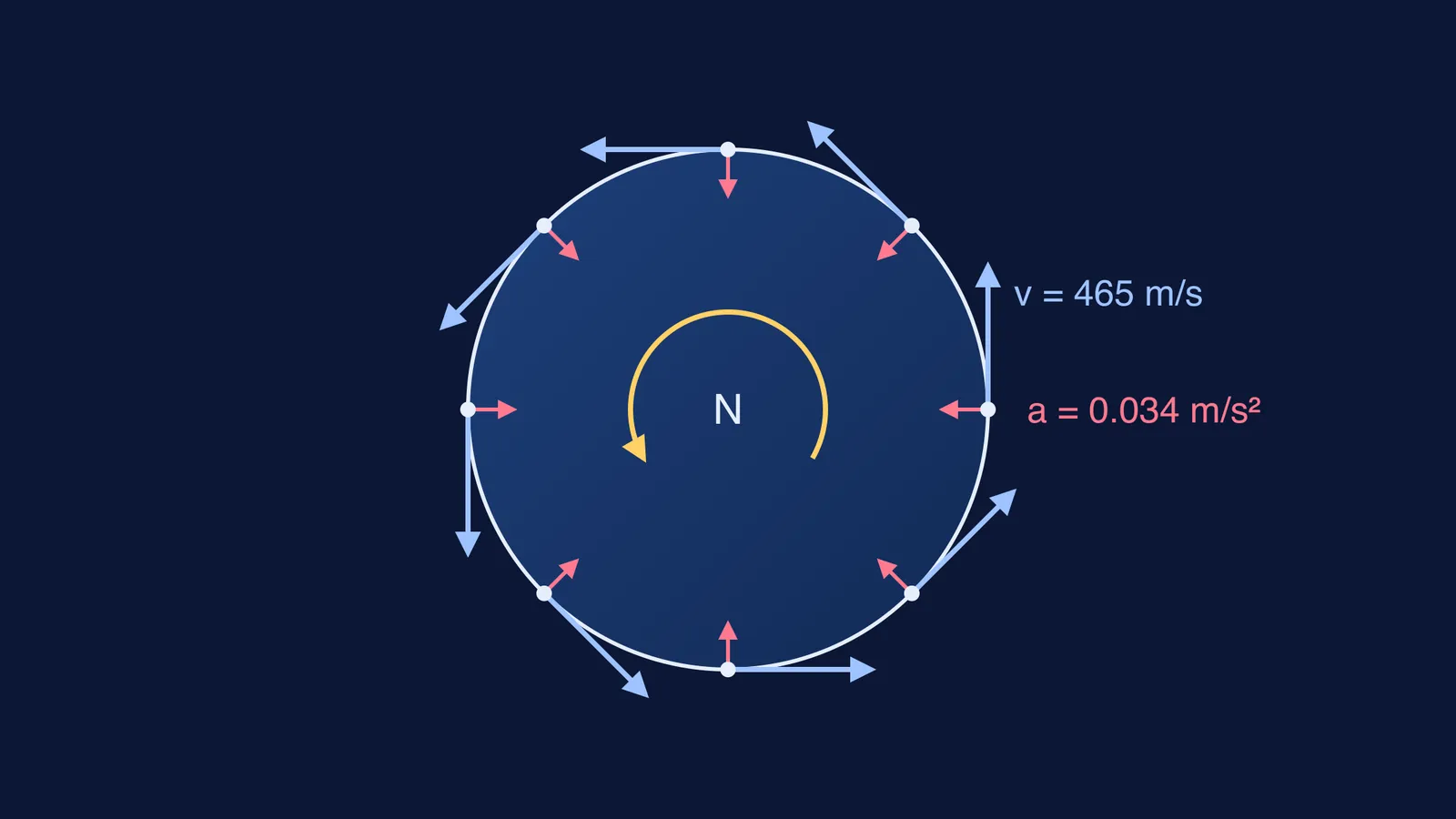
At the equator: about 465 m/s, or 1,674 km/h.
At latitude 30°: about 1,450 km/h, because the circle you ride on is smaller by a factor of cos 30°.
At latitude 60°: about 837 km/h.
At the poles: almost zero; you just turn on the spot.
Every point turns through the same angle, about 15° an hour, but points farther from the axis cover more ground. That is the rule v = ωr, worked through in our post on why the same angular velocity gives different speeds.
The same fact sheet gives Earth's mean orbital velocity around the Sun as 29.78 km/s, which is over 1 lakh km/h. You don't feel that either.
Why do we not feel the Earth spinning?
Newton's first law, in NASA Glenn Research Center's wording, says "an object in motion remains in motion at constant speed and in a straight line unless acted on by an unbalanced force." You, the floor, the air in the room and the water in your glass are already moving together. Nothing has to push you to keep up, so nothing presses on you.
Your body's motion sensors work the same way. In the inner ear, the utricle and saccule measure linear acceleration and the semicircular canals measure angular acceleration, as Steven LaValle's textbook on virtual reality sets out. They respond when motion changes. A steady speed gives them nothing to report.
Nilakshi Veerabathina, a professor of instruction in physics at the University of Texas at Arlington, compares it to flying: "Just as passengers don't feel the plane's speed while smoothly cruising, we don't feel Earth's movement because we're traveling at the same speed as our planet." You feel the take-off and the landing, not the cruise.
But isn't spinning a change in direction?
Yes, and this is where a sharp student pushes back. Moving in a circle means your velocity keeps turning, so there is an acceleration towards the Earth's axis. Here is how big it is, using the NASA figures from above.
Angular speed: ω = 2π ÷ (23.9345 × 3,600 s) ≈ 7.29 × 10⁻⁵ rad/s.
Centripetal acceleration at the equator: a = ω²R ≈ (7.29 × 10⁻⁵)² × 6.378 × 10⁶ m ≈ 0.034 m/s².
Compare it with gravity at the equator, 9.780 m/s² on the same fact sheet: 0.034 ÷ 9.78 ≈ 0.35%.
For scale, a car that goes from rest to 36 km/h in 5 seconds accelerates at 2 m/s², about sixty times more, and you feel that in your back. The Earth's 0.034 m/s² also never switches on or off. It has been there your whole life, taken out of the pull of gravity, so a bathroom scale at the equator reads slightly less than it would on an Earth that did not spin.
The orbit is gentler still: 29.78 km/s around a circle of radius 149.6 million km, the semimajor axis on the same NASA sheet, gives about 0.006 m/s². And because you and the Earth fall around the Sun together, even that does not press you into the ground.
How can you test this yourself?
You can't step off the Earth, but you can check the rule in places where the speed does change.
In a train or metro, close your eyes on a smooth stretch at steady speed. Try to say whether you are moving. Then notice the moment the brakes come on.
Hang a key on a thread inside the coach. It hangs straight at steady speed and leans back or forward only while the train speeds up or slows down; our post on the angle of a hanging bob in an accelerating train works out the tilt, tan θ = a/g.
In a lift, you feel heavier only as it starts going up and lighter only as it stops. The middle of the ride feels like standing still. The same idea decides how long a dropped coin takes to fall in an accelerating lift.
If the arrows of circular motion are hard to picture, the Fermi Simulation Lab has interactive simulations for the ideas that are easier to see than to read.
Next time someone asks why the ground isn't rushing past, the answer fits in one sentence: you are moving with it, and steady motion feels like rest.