On this page
Spin a ceiling fan and watch one blade. The tip blurs while the part near the hub looks almost still, yet the whole blade turns as one piece. That is the idea behind a standard Class 11 rotation question: every point on the blade has the same angular velocity, but not the same linear speed.
Why do all points on a rotating body have the same angular velocity?
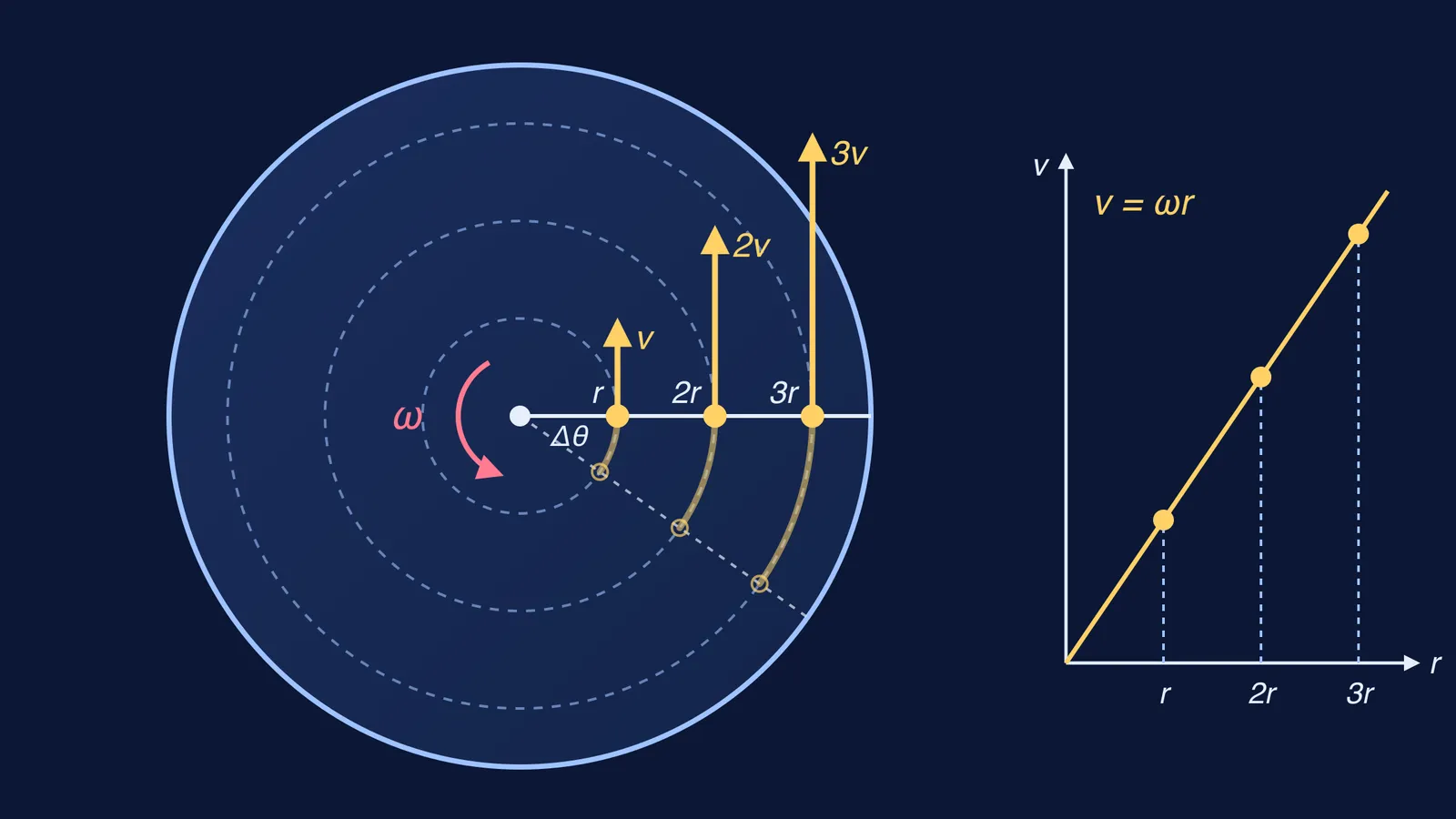
Angular velocity ω is the rate at which angle is swept out, measured in radians per second. In a rigid body the distances between points never change, so if one point turns through 30°, every other point must turn through 30° in the same time, or the body would bend or tear. OpenStax's University Physics, section 10.1 makes this explicit for two particles on a rotating disc: the disc has one angular velocity, so ω₁ = ω₂.
So ω belongs to the body, not to any one point. When a question says a disc rotates at some number of rad/s, that number applies to the rim, the region near the axis and everything in between.
Why does linear speed increase with distance from the axis?
Because each point travels round a circle of a different size in the same time. In one turn, a point at radius r covers 2πr, so a point at 3r covers three times the distance. Arc length is s = rθ, and dividing by time gives the key relation.
Tangential speed is angular velocity times radius, v = ωr, so for constant ω it increases with distance from the axis (OpenStax, section 10.1). In OpenStax's own example, a flywheel spinning at 45.0 rad/s gives a point 10 cm from the axis a speed of 4.5 m/s.
The same factor of r shows up in acceleration. Centripetal acceleration is a = v²/r (OpenStax, section 10.3); substituting v = ωr gives a = ω²r, so outer points also have a larger centripetal acceleration. Tangential acceleration follows the same pattern: a_t = rα.
Worked example: how fast do two points on a fan blade move?
Suppose a fan turns at 300 rpm and its blade tip is 0.6 m from the axis. Compare a point 0.15 m from the axis with the tip.
Convert to rad/s: ω = 300 × 2π / 60 = 10π ≈ 31.4 rad/s. This ω is the same for both points.
Inner point: v = 31.4 × 0.15 ≈ 4.7 m/s.
Tip: v = 31.4 × 0.6 ≈ 18.8 m/s, four times faster because it is four times farther out.
Centripetal acceleration: a = ω²r gives about 148 m/s² at the inner point and about 592 m/s² at the tip.
The ratio check is the habit worth building. Speeds and centripetal accelerations must scale exactly with r, so if your two answers are not in the ratio 1 : 4, something went wrong. If the unit conversion is where you trip, our guide to converting rpm to radians per second walks through it.
How fast are you moving because Earth spins?
Earth is close enough to a rigid body for this. NASA's Earth fact sheet lists an equatorial radius of 6,378.137 km and a sidereal rotation period of 23.9345 hours. That gives ω = 2π / (23.9345 × 3600 s) ≈ 7.29 × 10⁻⁵ rad/s, shared by every place on the planet.
At the equator, v = ωR ≈ 465 m/s. At 60° latitude your distance from the axis is R cos 60°, half as much if you treat Earth as a sphere, so your speed is about 233 m/s. At a pole you sit on the axis, so v is zero even though you still turn once a day. We work through the equator figure step by step in how fast Earth's equator moves.
Which mistakes cost marks in rotation problems?
Giving different points different ω. On a rigid body rotating about a fixed axis, ω is one number.
Putting rpm or degrees into v = ωr. The formula needs ω in rad/s.
Measuring r from the wrong place. In v = ωr, r is the perpendicular distance from the axis of rotation, not from the edge or the ground.
Forgetting that rolling changes the axis. For a wheel rolling without slipping, speeds relative to the ground are measured about the contact point, so the bottom is momentarily at rest and the top moves fastest. Our explainer on rolling without slipping works it through.
It helps to see the spin before you calculate it. The Fermi Simulation Lab has interactive simulations for ideas that are easier to see than to read. When you are ready to practise, the Fermi Problem Library has worked problems with a step-by-step solver that explains the reasoning rather than printing an answer, so you can find the exact step where an r went missing.