

On this page
When we talk about spinning objects in everyday life, we usually measure their speed in revolutions per minute (RPM). It is easy to picture a ceiling fan turning 200 times a minute or a car engine spinning rapidly on the highway as you accelerate. But in physics and mathematics, equations almost always require angular velocity to be measured in radians per second (rad/s). To use standard formulas for rotational kinetic energy, centripetal force or torque, you must convert your values between these two units first.
How do you convert RPM to radians per second?
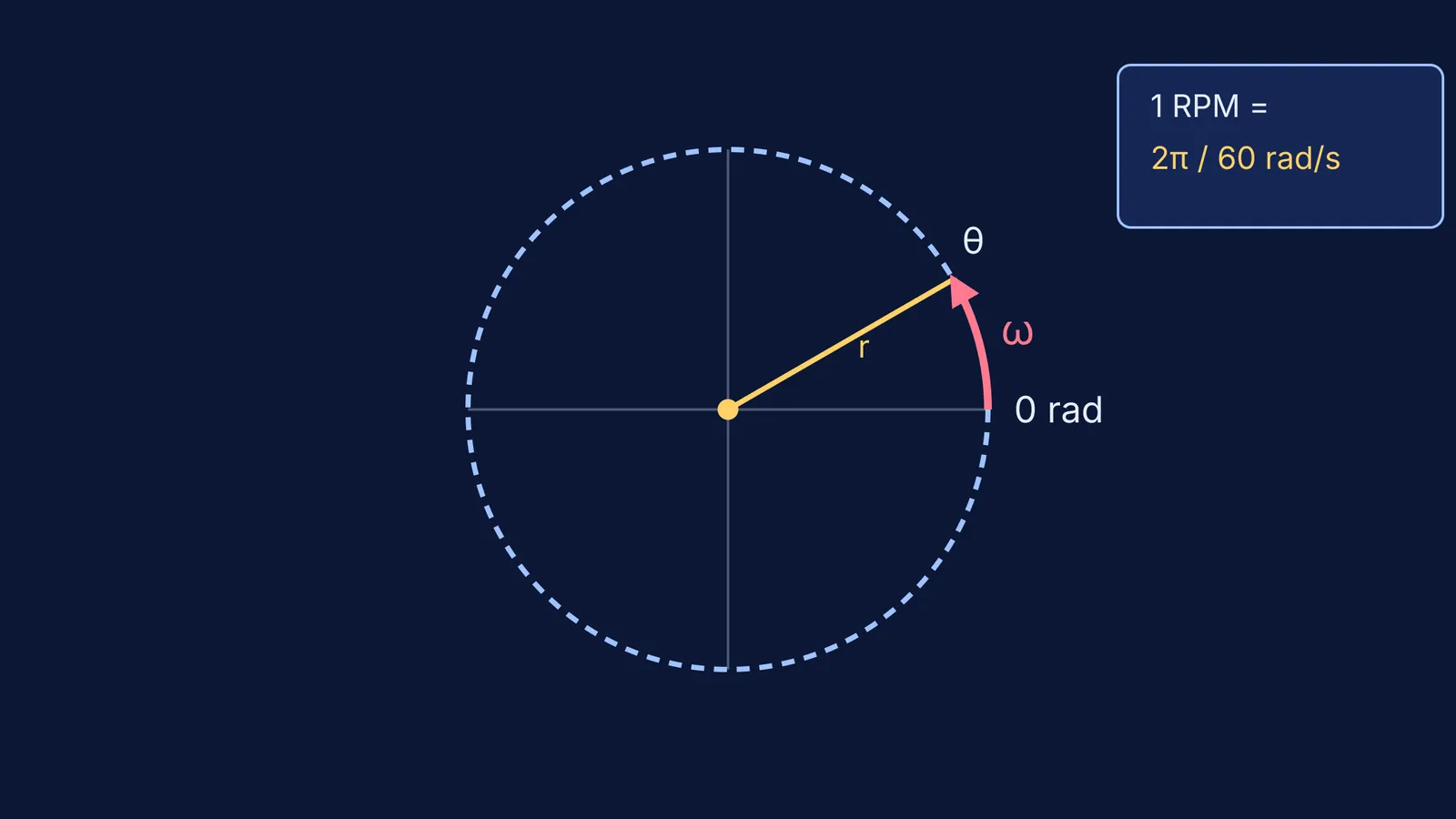
To convert revolutions per minute to radians per second, you multiply the RPM by 2π and divide by 60 (rpmtoradianspersecond.com).
This calculation works because one full revolution of a circle is exactly 2π radians. If a wheel makes one complete revolution per minute, it covers 2π radians in 60 seconds. Dividing the 2π radians by 60 gives the standard conversion factor of π/30.
Let us look at how this mathematical conversion works in practice, using familiar examples from everyday life and engineering to show the formula in action.
How fast does a ceiling fan spin in rad/s?
A standard high-speed ceiling fan typically runs at 200 RPM (rpmtoradianspersecond.com). If we take this steady 200 RPM as an example, we can calculate its precise angular velocity in rad/s.
Start with 200 RPM.
Multiply by π/30.
200 × (π/30) = 6.67π rad/s.
This means the fan blades are sweeping through roughly 20.9 radians every single second. When calculating the mechanical power delivered by the fan's motor or its rotational kinetic energy, 20.9 rad/s is the exact number you plug into the equations. This mathematical approach connects directly to concepts like Torque as r × F, which depends on rotational forces and angular acceleration to understand how objects begin to spin in the first place.
How fast does a washing machine spin in rad/s?
During its final spin cycle, a front-loading washing machine can operate at speeds of 1,200 RPM (rpmtoradianspersecond.com). Let us convert this starting speed of 1,200 RPM to see the rotational forces involved.
Start with 1,200 RPM.
Multiply by 2π to find the total radians per minute: 1,200 × 2π = 2,400π.
Divide by 60 to find the radians per second: 2,400π / 60 = 40π rad/s.
At 40π rad/s (about 125.7 rad/s), you can calculate the massive centripetal acceleration acting on the wet clothes inside the spinning drum. Because centripetal acceleration scales with the square of the angular velocity, having the speed in rad/s is the crucial first step in designing such equipment. If you are tracking the path of a water droplet in a spinning machine, you would use Motion in a plane from r(t) to find its velocity and acceleration vectors accurately.
How do you convert rad/s back to RPM?
Sometimes a physics problem gives you the angular velocity in rad/s and asks for the frequency in revolutions per minute instead. To convert back, you simply flip the fraction: multiply the rad/s by 60 and divide by 2π (which is mathematically identical to multiplying by 30/π).
Imagine a car engine on the highway spinning at an angular velocity of 262 rad/s (rpmtoradianspersecond.com). You want to know the RPM.
Multiply by 60 to get radians per minute: 262 × 60 = 15,720 rad/min.
Divide by 2π to get revolutions: 15,720 / 2π = 7,860 / π.
This evaluates to approximately 2,502 RPM.
By flipping the conversion factor upside down, you can easily switch between how engineers think about engine speed (RPM) and how physicists calculate rotational dynamics (rad/s).
How should you handle RPM in exam questions?
When you face rotational mechanics problems in an exam setting, checking and converting your units early is the easiest way to prevent a cascading mistake.
Check the given values: If the question states the speed of a motor, a wheel, or a pulley in RPM, underline it immediately so you remember it needs adjustment before you begin calculating.
Convert immediately: Do not wait until the final step of the problem. Multiply the given RPM value by π/30 right away and write down the rad/s figure.
Keep π exact: Until you reach the final numeric answer on your calculator, leave π as a mathematical symbol. It very often cancels out with another π in the equation, saving you from premature rounding errors.
If you struggle with setting up these conversions, the Fermi Concept Library maps out exactly how angular velocity links to centripetal force and torque. You can see how the units flow from one step to the next. When you are ready to test yourself, you can try problems in the Fermi Problem Library. The step-by-step solver will catch if you forget to convert RPM to rad/s, explaining the reasoning rather than just printing an answer.


