

On this page
What is the speed of Earth's rotation at the equator?
To calculate how fast the Earth turns at the equator, physics students start from the definition of uniform circular motion: speed equals distance divided by time, or v = 2πR / T.
According to the NASA Earth Fact Sheet, Earth has an equatorial radius R of 6,378.137 km, yielding an equatorial circumference of 2πR ≈ 40,075 km.
The crucial detail lies in choosing the time period T. While a solar day lasts 24.0000 hours (86,400 seconds), Earth completes a full 360-degree rotation relative to the distant stars in one sidereal day. As listed in the NASA Earth Fact Sheet, this sidereal rotation period is 23.9345 hours, or 86,164.2 seconds. Dividing the equatorial circumference by this period gives:
v = 40,075,017 m / 86,164.2 s ≈ 465.1 m/s
In everyday units, that is 1,674.4 km/h—faster than the speed of sound in air (roughly 343 m/s at sea level). Rounding R to 6,400 km and using a 24-hour solar day of 86,400 seconds yields 465.4 m/s. Catching this period distinction is one of the classic rotational motion mistakes in JEE physics.
How does rotational speed change with latitude?
Because the Earth is a rigid body rotating about its polar axis, every point shares the identical angular velocity, derived from the NASA Earth Fact Sheet rotation period:
ω = 2π / T ≈ 7.292 × 10⁻⁵ rad/s
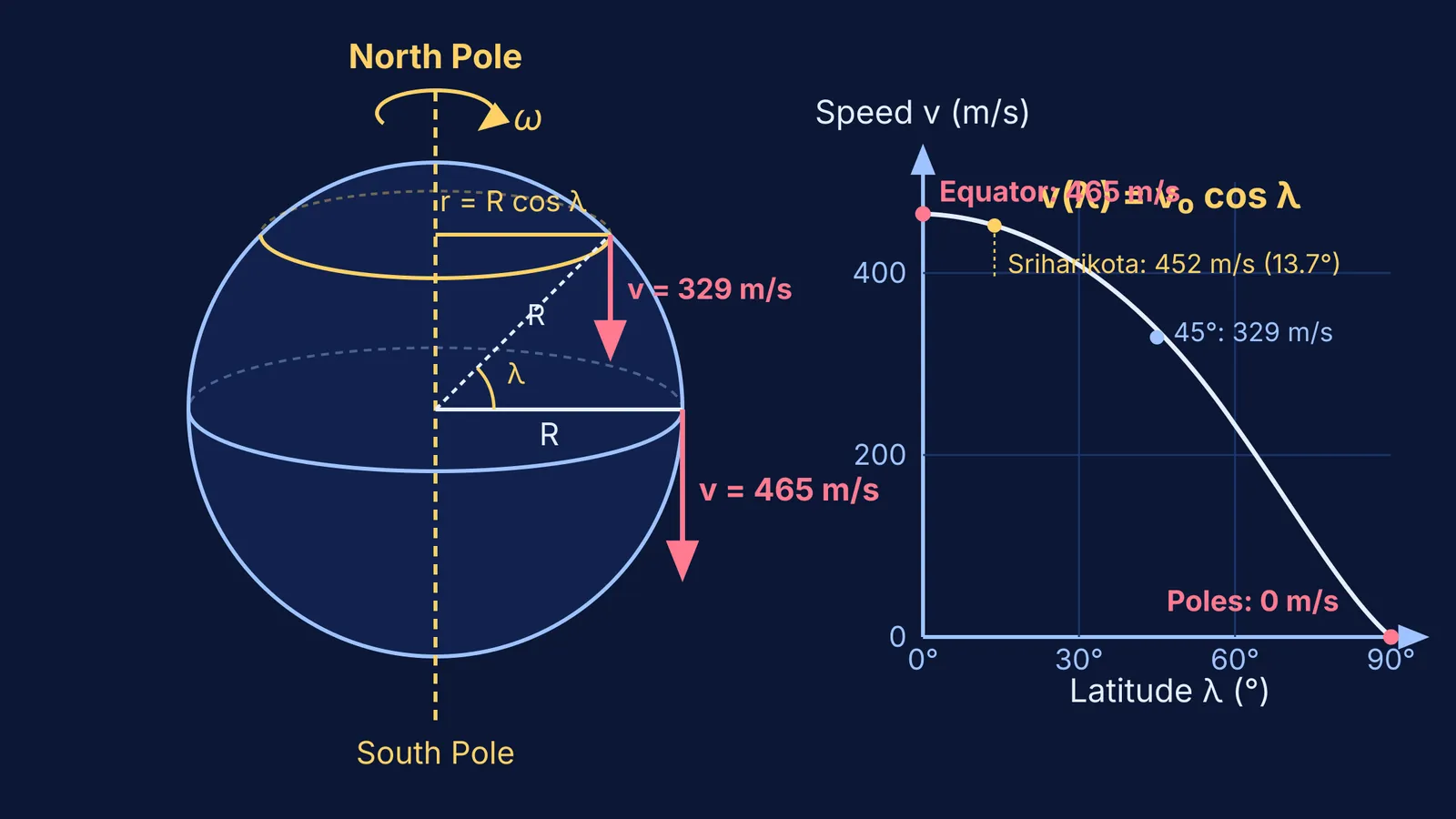
Linear speed v depends directly on the perpendicular distance r from the rotation axis: v = ω r. At latitude λ, that radius narrows to:
r = R cos λ
This yields the universal latitude speed formula:
v(λ) = ω R cos λ = v_equator cos λ
Across the globe, this geometric relationship leads to three clear cases:
At the equator (λ = 0°): cos 0° = 1, so linear speed reaches its peak of 465 m/s.
At 45° latitude: cos 45° = √2 / 2 ≈ 0.7071, reducing speed to 329 m/s.
At the geographic poles (λ = 90°): cos 90° = 0, so linear speed drops to 0 m/s as observers merely turn in place.
In New Delhi (roughly 28.6° N), cos(28.6°) ≈ 0.878, so residents travel eastward at about 408 m/s—roughly 57 m/s slower than someone at the equator.
Why do space agencies launch rockets towards the east?
This 465 m/s equatorial velocity is a vital asset in aerospace engineering. Reaching Low Earth Orbit requires an orbital velocity of roughly 7.8 km/s (7,800 m/s). Launching eastward harnesses the planet's existing linear momentum.
The Indian Space Research Organisation (ISRO) operates its primary spaceport, the Satish Dhawan Space Centre SHAR, on Sriharikota island at approximately 13.7° N latitude:
v = 465.1 m/s × cos(13.7°) ≈ 452 m/s
Launching east over the Bay of Bengal imparts an immediate 452 m/s head start toward orbit. Under Tsiolkovsky's rocket equation, every extra metre per second of required velocity demands exponential propellant mass. That 452 m/s boost saves tonnes of fuel. Launching westward would impose a 900 m/s penalty compared to an eastward ascent.
How does Earth's rotation affect apparent gravity?
Circular motion on a rotating planet requires centripetal acceleration toward the axis: a_c = ω² r = ω² R cos λ. In the ground reference frame, outward centrifugal inertia opposes gravity.
As outlined in the NCERT Class 11 Physics curriculum and our guide to the variation of g with height, depth and Earth's rotation, effective gravity g' at latitude λ is:
g' = g - ω² R cos² λ
At the equator, centrifugal acceleration reaches 0.034 m/s², reducing apparent weight by roughly 0.35%. Because rotation also caused Earth's equatorial radius to bulge 21 km beyond its polar radius according to the NASA Earth Fact Sheet, total surface gravity increases from roughly 9.780 m/s² at the equator to 9.832 m/s² at the poles. This planetary rotation was demonstrated directly on the ground by Leon Foucault's pendulum demonstrating Earth's rotation.
How to solve Earth rotation problems in JEE and NEET?
When tackling rotational mechanics numericals in the NCERT Class 11 Physics curriculum and competitive exams, watch for three frequent stumbling blocks:
Never confuse angular velocity ω with linear velocity v. Angular velocity remains 7.29 × 10⁻⁵ rad/s everywhere on Earth, while linear velocity scales with cos λ.
Remember that centrifugal force points perpendicular to the rotation axis, not outward from the Earth's center. This is why the radial subtraction term carries a factor of cos² λ rather than cos λ.
Check whether a problem specifies a sidereal day (86,164 s) or a solar day (86,400 s) when high precision is requested.
Mastering these derivations requires connecting spatial geometry with rotational dynamics. The Fermi Problem Library offers worked problems with a step-by-step solver that explains the reasoning rather than just printing an answer. If visualizing circular paths across different latitudes feels challenging, the Fermi Simulation Lab provides interactive simulations for ideas that are easier to see than to read. You can review all underlying rotational principles and gravitational laws in the Fermi Concept Library.


