On this page
A science show in your colony hall or a sky-watching night on the school terrace needs no budget or stage. It needs three or four friends, one teacher willing to stand behind you, and a plan. Here is ours, with a script for asking permission and a checklist for the night.
Why run a science event as a student?
It is fun, and it is one of the better ways to learn science yourself.
A 2019 meta-analysis by Keiichi Kobayashi pooled 28 studies of learning by teaching and found an average effect size of 0.35 for preparing to teach and 0.56 for preparing and then actually teaching, compared with studying without expecting to teach. The same paper found that interactive teaching gave larger gains than teaching without interaction.
In a review chapter on learning by teaching, psychologist Logan Fiorella describes a study in which college students who explained a lesson while drawing it did better on tests a week later than those who only explained or only drew. Those students recorded a video lesson rather than facing a live crowd, but a science show uses the same mix: you explain, you point, and people can ask questions.
You also have a ready-made date. National Science Day falls on 28 February, marking C. V. Raman's 1928 discovery of the Raman effect, and the National Council of Science Museums lists observation of the night sky and student demonstrations among the ways it is celebrated.
How do you organise a science outreach event, step by step?
Here is a six-week plan for a one-hour event for a few dozen neighbours.
Week 1: Choose one format, either a demo show (four to six table-top experiments) or a sky night. Do not mix both the first time.
Week 1: Ask a teacher to be the adult host, for permission, safety and the questions you cannot answer.
Week 2: Book the space: a school courtyard, community hall, society clubhouse or terrace. For a sky night, pick a spot away from street lights.
Week 3: Give each friend one station. Each person owns one demo or one sky object, start to finish.
Weeks 3 to 5: Each presenter writes a 90-second explanation, then practises it on a younger sibling or a parent, who must be allowed to interrupt.
Week 5: Run a full rehearsal with the teacher. Cut any demo that fails twice.
Week 6: Put up a notice in the society WhatsApp group and on the school board. Keep it to date, time, place and "free, all ages".
When a presenter gets stuck on the why behind their demo, the Fermi Concept Library covers every concept in physics, chemistry, biology, mathematics and computing, each with its own lesson, so they can check the idea before explaining it to a room.
What should a sky-watching night include?
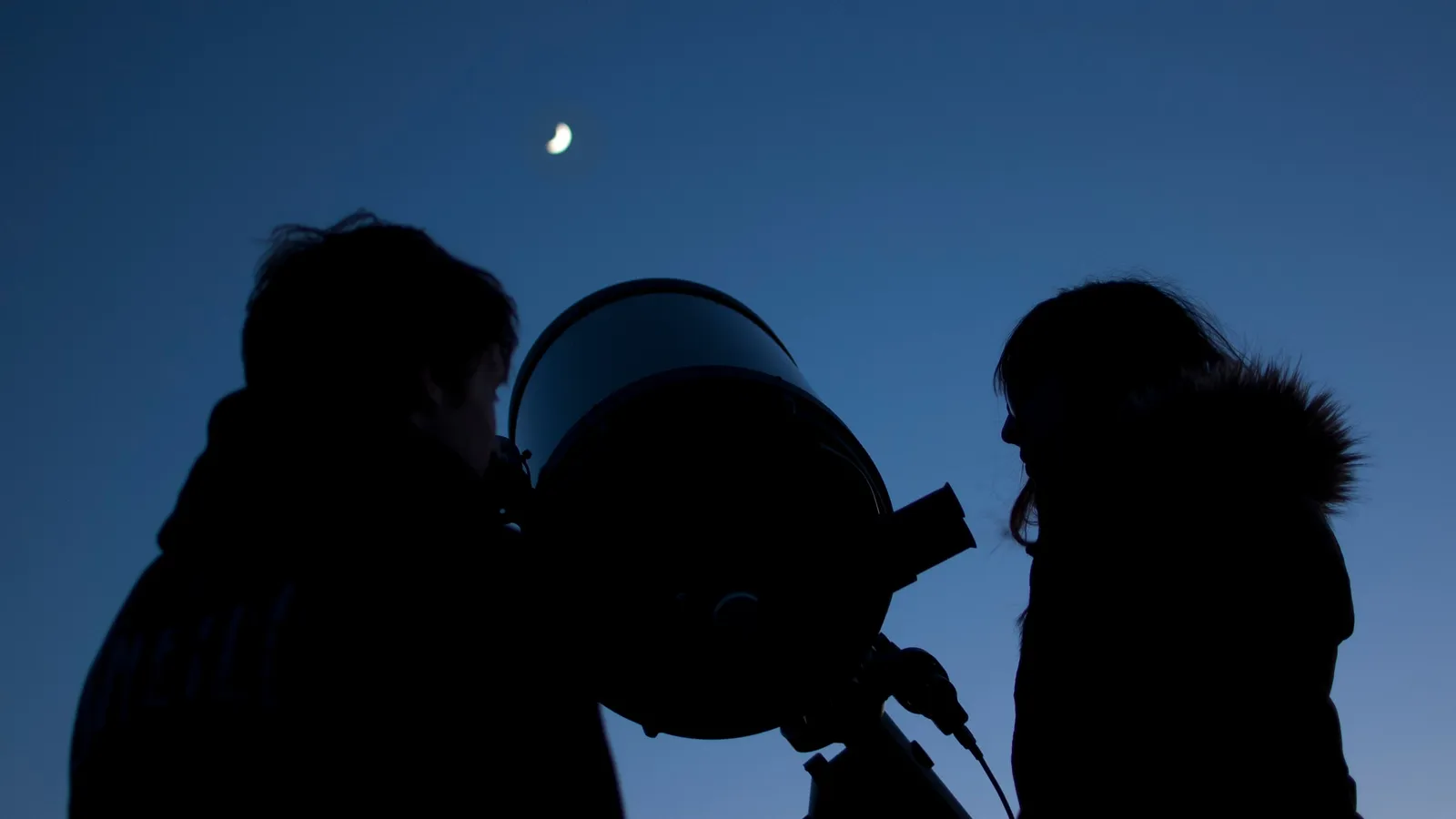
Start with the Moon, which shows well through binoculars even from a city terrace. You will need that: the world atlas of artificial night sky brightness found that more than 80% of the world's population lives under light-polluted skies, and that the Milky Way is hidden from more than one-third of humanity.
So plan for the Moon, a bright planet and one constellation. Our guide to starting an astronomy club at school covers equipment, and what meteor showers are helps if you want to time your night to one.
One rule is not negotiable: no one looks at the Sun. NASA warns that looking at the bright Sun through binoculars or a telescope without a proper solar filter will instantly cause severe eye injury. If you run a daytime event, read how to watch a solar eclipse safely first, and let your teacher handle any solar viewing.
Moon phases are hard to explain by hand-waving. The Fermi Simulation Lab has interactive simulations for ideas that are easier to see than read, so you can find the words before a ten-year-old asks.
What should you say to the principal or society secretary?
Ask in person, with the teacher beside you, and bring a one-page plan. A script that works:
"Ma'am, four of us from Class 11 want to run a free one-hour science evening for families on the 28th. [Teacher's name] from physics has agreed to supervise. We need the courtyard from 6 to 8 pm and two tables. Nothing involves fire or anything beyond kitchen items, and we will clean up. May we go ahead?"
Name the supervising teacher, the date, the space and what you will not do: the four things an adult will worry about.
What does the checklist for the night look like?
One adult in charge, with a first-aid kit and a torch with a red cover
A sign-in sheet with no phone numbers on display
Each station labelled with one question, such as "Why does the Moon change shape?"
A backup indoor demo in case of clouds
Water, a dustbin and a plan for packing up
A notebook at each station to write down questions you could not answer
The questions you could not answer are your reading list for next week. Pick your date, find your teacher and write your 90 seconds this week.