On this page
Every midsummer, merchant ships left Egypt's Red Sea coast for India. They were waiting for a wind that changes direction with the seasons, and they planned a whole year of trade around it.
What is a monsoon wind, and why does it reverse?
In a monsoon, the winds reverse with the seasons. India's NCERT Class 11 geography textbook says the word monsoon “connotes the climate associated with seasonal reversal in the direction of winds”. The same chapter gives the cause: water heats up and cools down more slowly than land, and this differential heating creates different air pressure zones in different seasons, which reverses the winds.
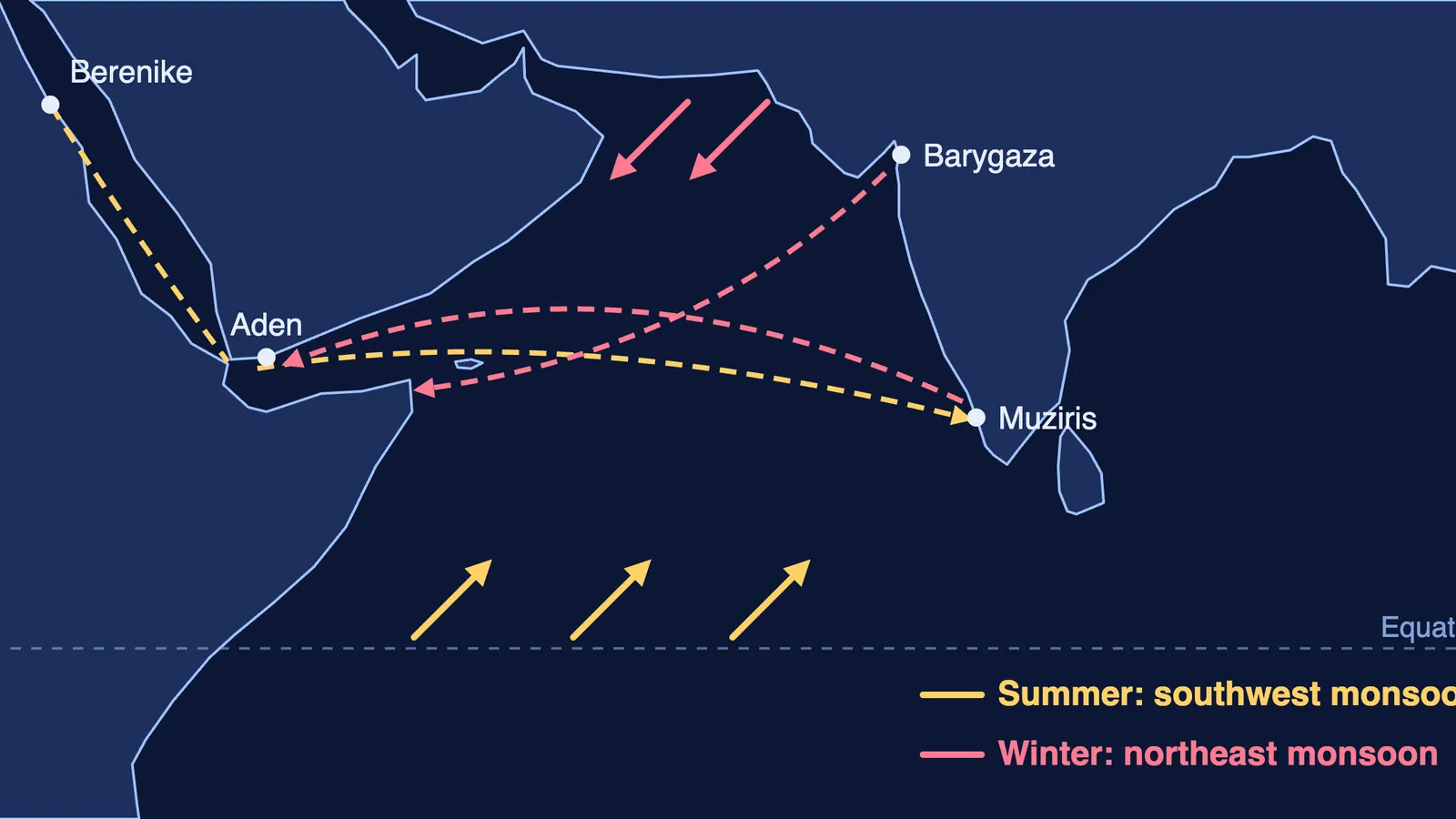
In summer, intense low pressure forms over north-west India while the cooler ocean keeps higher pressure. Southern-hemisphere trade winds then cross the equator between 40° E and 60° E and are turned by the Coriolis force to blow from the southwest. This southwest monsoon sets in over the Kerala coast by 1 June. In winter the low-pressure zone moves south and the winds reverse to blow from the northeast.
For the daily version, read why the sea breeze blows towards land during the day.
How did traders use monsoon winds to cross the sea?
They treated the wind as a timetable. Pliny the Elder set out the route in his Natural History, Book 6. Goods went overland from Keft on the Nile to Berenike on the Red Sea, a 12-day journey. Sailing began at midsummer, and it took about 30 days to reach the ports of southern Arabia. From there, Pliny writes, it was “a 40 days' voyage, if the Hippalus is blowing”, to the first trading station in India, Muziris (Cranganore in this translation).
The return waited for the season to turn. Travellers left India at the start of the Egyptian month Tybis, which Pliny equates with December, or at the latest before 13 January, “so making it possible to return home in the same year.”
The same winds tied India to East Africa. The Periplus of the Erythraean Sea, a Greek merchant's guide (here in J. W. McCrindle's 1879 translation), says the African market towns beyond the Red Sea straits, around the Horn, were regularly supplied from Ariake and Barygaza, today's Bharuch in Gujarat, with grain, rice and ghee among other goods. It also gives about the month of July as the season to sail from Egypt for India.
Who discovered the monsoon route?
The Periplus says these voyages were once made in small vessels that hugged the shore, until a pilot named Hippalos “discovered the direct course across the ocean”. The south-west wind of that season came to be called Hippalos.
That is the Greek side of the story. McCrindle's notes summarise the scholar Vincent's view that Arabian sailors used a direct monsoon passage before the Greeks adopted it, and that Hippalus learned from Indian or Arabian traders he met.
Science caught up much later. In 1686 Edmond Halley published An historical account of the trade winds, and monsoons in the Philosophical Transactions of the Royal Society, with what its title calls “an attempt to assign the physical cause of the said winds”.
Plan the voyage yourself: a worked timeline
Build the merchant's calendar from Pliny's numbers, assuming you sail from Berenike on 15 July, our stand-in for “midsummer”.
Keft to Berenike overland, 12 days: leave the Nile on 3 July.
Berenike to southern Arabia, about 30 days: arrive around 14 August.
Open sea with the Hippalus, the southwest wind, 40 days: reach Muziris around 23 September.
Trade on the Indian coast for about ten weeks while the season turns.
Sail home in December, and before 13 January at the latest.
The outward trip from Keft is 12 + 30 + 40 = 82 days. Pliny's 13 January deadline is what made it possible “to return home in the same year”. The monsoon's strength also varies from year to year; see the Indian Ocean Dipole and its effect on the monsoon.
How can you read the wind like a navigator?
Ask three questions, in order:
Which is warmer now, land or sea? Air over the warmer surface rises and pressure falls.
Where is the low pressure? Surface air flows from high pressure towards low.
How does the Earth's rotation turn that flow? The NCERT climate chapter credits the Coriolis force with turning the cross-equator trade winds into southwesterlies. For the sailors' rule linking wind and low pressure, see Buys Ballot's law.
Try it on January: the land is colder than the sea, pressure is higher over India, and the wind blows off the land from the northeast, pushing a ship from India's west coast back towards Arabia and Africa.
If pressure-driven winds are easier to see than to read, the Fermi Simulation Lab has interactive simulations for that kind of idea, and the Fermi Concept Library gives every concept in physics its own lesson.
When the monsoon reaches Kerala next June, it is the same wind that once set the calendar of the Indian Ocean trade.