On this page
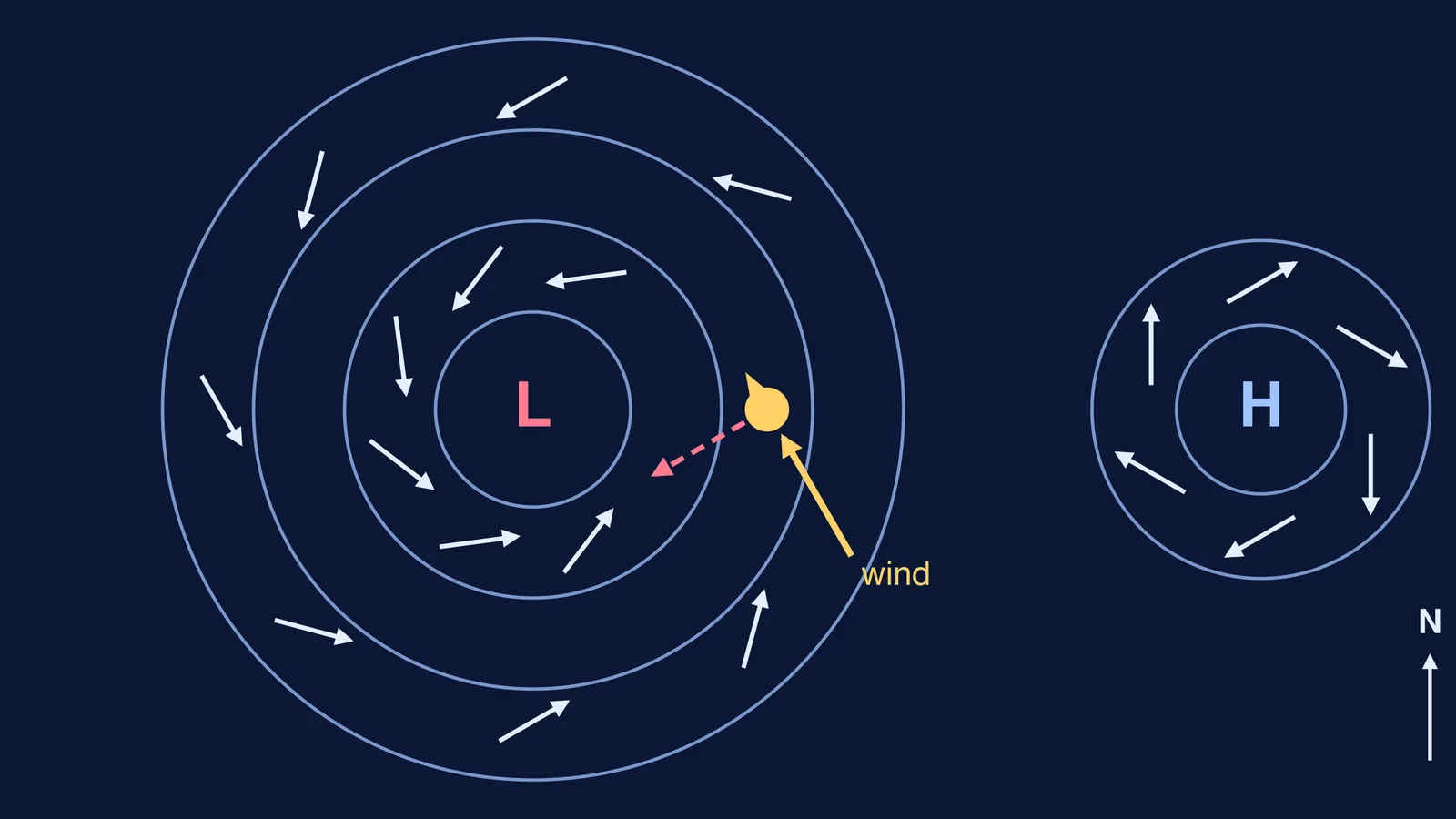
Stand outside on a windy day with the wind on your back and stretch out your left arm. In the Northern Hemisphere, including most of India, that arm points roughly towards the nearest low pressure. That is Buys Ballot's law.
What is Buys Ballot's law in geography?
The 1911 Encyclopaedia Britannica puts it in one line: "Stand with your back to the wind; the low-pressure area will be on your left-hand" (1911 Britannica entry). The same entry says the rule is reversed in the Southern Hemisphere and that Buys Ballot published it in the Comptes rendus in November 1857.
The Royal Netherlands Meteorological Institute (KNMI) gives the full version: with the wind at your back, low pressure lies to the left and higher pressure to the right (KNMI on Buys Ballot). KNMI also notes that Christophorus Henricus Diedericus Buys Ballot (1817-1890) founded the institute in 1854.
He was not the first to notice it. The 1911 Britannica says American meteorologists J. H. Coffin and William Ferrel recognised the rule first, and calls it a direct consequence of Ferrel's law (more in our post on William Ferrel and the Ferrel cell). Buys Ballot's name stuck anyway.
Why does the wind keep low pressure on your left?
Two forces do almost all the work.
The pressure gradient force pushes air from high pressure towards low pressure. NOAA describes it as a force that tries to equalise pressure differences (NOAA JetStream: origin of wind).
The Coriolis force, which comes from Earth's rotation, turns moving objects to the right in the Northern Hemisphere and to the left in the Southern Hemisphere, according to the same NOAA page. Our post on Gustave Coriolis and the sideways force explains where it comes from.
Air heading for the low is turned right until the two forces balance. The result is a geostrophic wind, which the US National Weather Service defines as a wind that blows parallel to the isobars, with a strength set by how closely the isobars are spaced (NWS glossary). Air flowing along the isobars with a rightward pull balancing an inward push must have the low on its left. That is the whole law.
The same reasoning explains why the wind circles a low anticlockwise in the Northern Hemisphere, which NOAA's diagram shows, and why cyclones in the Bay of Bengal spin that way (see why cyclones spin anticlockwise).
The Coriolis turn is hard to picture from a textbook diagram. The Fermi Simulation Lab has interactive simulations for ideas that are easier to see than to read, so you can watch an idea play out instead of taking it on trust.
Why is the low slightly in front of you near the ground?
Near the surface, friction slows the wind. A slower wind feels a weaker Coriolis force, so the push towards low pressure wins a little and the wind cuts across the isobars. A National Weather Service comparison of weather charts says surface friction turns the wind about 30 degrees towards low pressure (NWS chart comparison).
So, at ground level, point your left arm out and then swing it about 30 degrees forward. The low is in that direction.
How do you use Buys Ballot's law on a weather map?
Here is a worked example you can repeat with any map. Suppose a station on a Northern Hemisphere map shows wind blowing from the east.
Put your back to the wind. Wind from the east means you face west.
Your left hand now points south. That is where low pressure would lie if the air were blowing along the isobars.
Correct for friction, which the NWS chart comparison puts at about 30 degrees on surface charts. Swing about 30 degrees forward, towards west. The low is roughly to the south-south-west.
Check the map. The isobar values should fall as you move in that direction.
Now run it backwards, which is how many school map questions are set. You are given isobars around an L and asked to draw the wind.
Draw arrows going anticlockwise around the L.
Tilt each arrow slightly inwards, so it crosses the isobars towards the L.
Around an H, draw arrows clockwise and tilted slightly outwards.
Make the arrows longer where the isobars are closer together, since the geostrophic wind gets stronger as the spacing shrinks.
For the Southern Hemisphere, reverse every direction: back to the wind, low on your right, clockwise around the L.
If you are unsure why the Coriolis force points right, go back one step: the Fermi Concept Library gives every physics concept its own lesson, so you can close that gap before the next map question.
Next time the wind picks up, try it outside, then check a weather map.