

On this page
Why does air curve to the right in the Northern Hemisphere?
As explained in the NOAA National Ocean Service tutorial, Earth's eastward rotation deflects moving air to the right across the Northern Hemisphere and to the left across the Southern Hemisphere. A point on the equator moves at roughly 1,674 km/h to complete one turn every 86,164 seconds, whereas a point at 20° N moves at about 1,573 km/h. While George Hadley suggested that poleward air simply carries higher eastward speed ahead of the slower surface, this momentum view accounts for only half the actual deflection and fails for east-west winds.
The complete explanation requires rotating coordinate frames. An air parcel moving with velocity v in a frame rotating with angular velocity vector Ω experiences Coriolis acceleration:
a_cor = -2(Ω × v)
As detailed in Anders Persson's rotating frame study079<1373:HDWUTC>2.0.CO;2), Earth rotates at an angular speed Ω = 7.2921 × 10⁻⁵ rad/s. For horizontal surface winds, the acceleration magnitude simplifies to a_cor = f × v, where f = 2 Ω sin φ is the Coriolis parameter at latitude φ. Because φ is positive across the Northern Hemisphere, this acceleration acts 90° to the right of horizontal motion. For how rotating frames were formulated historically, explore Gustave Coriolis and the sideways deflection in rotating systems.
How does rightward deflection create an anticlockwise spiral?
If the Coriolis force pushes winds to the right, why do Northern Hemisphere cyclones rotate anticlockwise?
The answer lies in the pressure gradient. A cyclone is an intense low-pressure centre, not an isolated projectile. Air flows inward from surrounding high pressure down the pressure gradient. As converging streams approach the low, rightward deflection steers them aside:
Air from the south turns east, passing east of the centre heading north.
Air from the east turns north, passing north of the centre heading west.
Air from the north turns west, passing west of the centre heading south.
Air from the west turns south, passing south of the centre heading east.
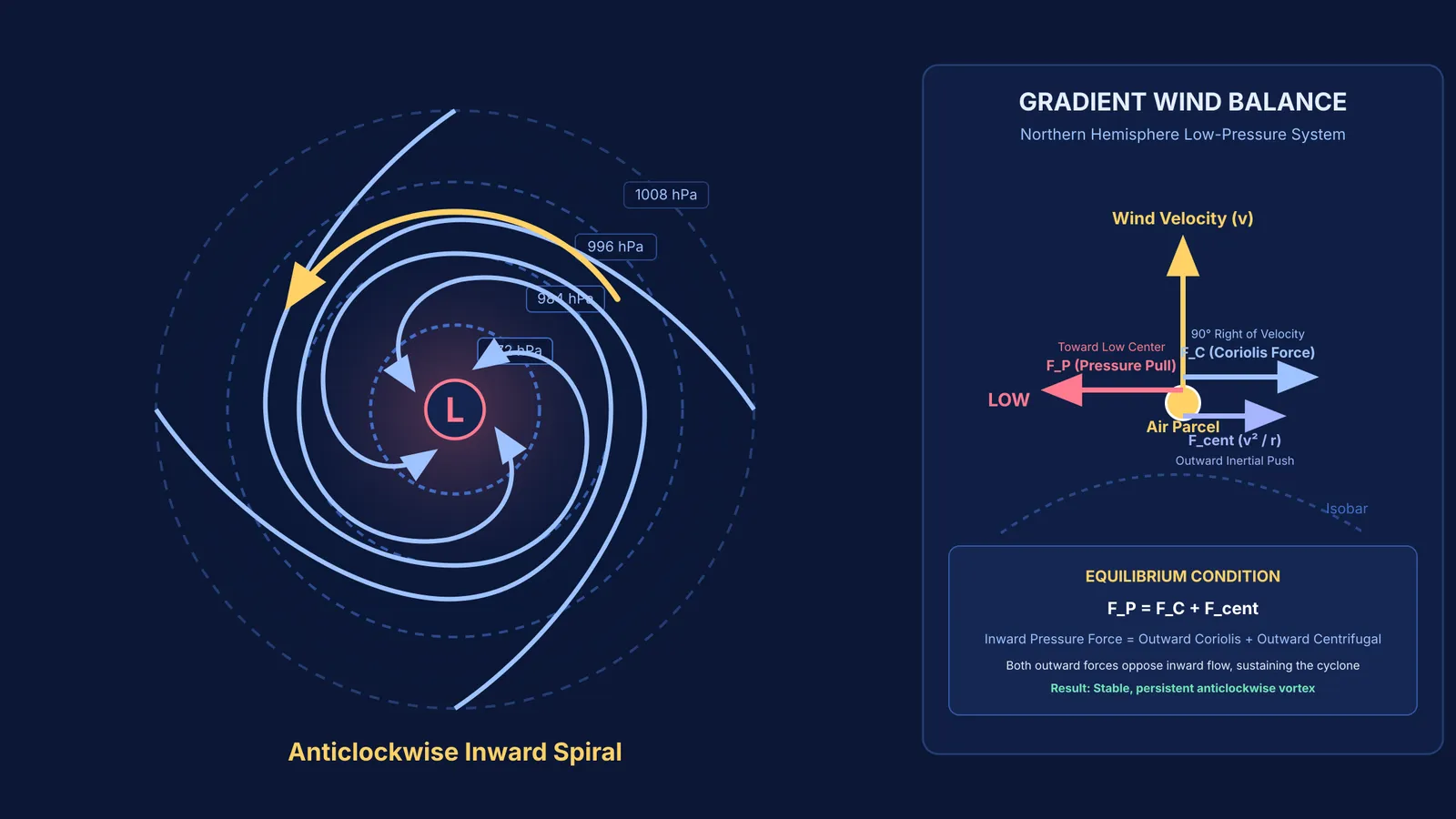
Instead of meeting head-on at the centre, these streams form an anticlockwise loop around the eye. In the NOAA National Hurricane Center glossary, a cyclone is formalised as a closed circulation rotating counter-clockwise in the Northern Hemisphere and clockwise in the Southern Hemisphere. Conversely, in high-pressure anticyclones, air flows outward; rightward deflection of outward air drives clockwise circulation.
How do forces balance inside a mature tropical cyclone?
In a mature tropical cyclone tracked by the Regional Specialised Meteorological Centre New Delhi, winds do not spiral straight into the eye. Instead, the flow achieves gradient wind balance among three horizontal forces per unit mass:
Inward Pressure Gradient Force: (1/ρ)(dp/dr), pulling air toward low pressure.
Outward Coriolis Force: f × v, acting 90° to the right of motion.
Outward Centrifugal Force: v² / r, the inertial resistance along curved isobars of radius r.
The radial equation of motion balances inward pull against outward forces:
(1/ρ)(dp/dr) = f v + v² / r
Because both the Coriolis and centrifugal forces point radially outward, they resist the inward pressure drop. For an air parcel moving at 20 m/s (72 km/h) at 20° N, f ≈ 4.99 × 10⁻⁵ s⁻¹, yielding Coriolis acceleration a_cor = f × v ≈ 1.0 × 10⁻³ m/s². Over 1 hour (3,600 s), this 1 mm/s² push deflects the parcel sideways by roughly 6.5 km, curving radial inflow into a closed vortex.
To see how pressure differences drive winds across landscapes, read how atmospheric pressure gradients drive winds. Distinguishing pseudo-forces from physical forces in rotating frames is an essential physics skill; explore common mistakes in rotational motion problems for key traps. In the Fermi Simulation Lab, interactive simulations let you explore these rotating-frame deflections and see how gradient wind balance emerges. For guided practice, the Fermi Problem Library has worked problems with a step-by-step solver that explains the reasoning rather than printing an answer.
Why can tropical cyclones never form at the equator?
Although severe cyclonic storms regularly develop over the Bay of Bengal and Arabian Sea, they never originate along the equator. The physical constraint follows directly from the Coriolis parameter formula f = 2 Ω sin φ.
At the equator (φ = 0°), sin(0°) = 0, so the Coriolis parameter vanishes. Without sideways deflection, air rushes straight down the pressure gradient, quickly equalising pressure and preventing vortex formation. In William M. Gray's 1968 global study096<0669:GVOTOO>2.0.CO;2), fewer than 1% of all tropical cyclones formed within 5° of the equator, with none recorded at 0° latitude. Gray demonstrated that tropical cyclogenesis requires a minimum planetary vorticity threshold, typically reached poleward of 5° where f exceeds roughly 10⁻⁵ s⁻¹ (reaching 1.3 × 10⁻⁵ s⁻¹ at 5° latitude).
Does the Coriolis effect make water swirl in bathroom sinks?
A persistent myth claims that water drains clockwise in Australia and anticlockwise in India due to Earth's rotation. Atmospheric fluid dynamics tests this claim using the dimensionless Rossby number:
Ro = U / (f × L)
where U is velocity, L is length scale, and f is the Coriolis parameter. When Ro is near or below 1, Coriolis forces govern the flow; when Ro is much greater than 1, inertia dominates.
As documented in Anders Persson's meteorological review079<1373:HDWUTC>2.0.CO;2), a 500-kilometre cyclone with 20 m/s winds at 20° N has Ro ≈ 0.8, confirming that the Coriolis force shapes the storm. In contrast, a 30-centimetre bathroom basin draining at 0.2 m/s has Ro ≈ 13,300. Because this inertial ratio exceeds 10,000, the Coriolis force in a sink is thousands of times weaker than container shape and residual water movement. Earth's rotation steers massive ocean cyclones, but bathroom sinks obey plumbing.


