On this page
Put copper(I) ions in water and they don't stay copper(I) for long. They react with each other: one Cu⁺ gives up an electron and becomes Cu²⁺, the other takes it and becomes copper metal. A reaction where one species is both oxidised and reduced is called disproportionation. Here is why, first with electrode potentials and then with energies.
What happens to Cu⁺ in water?
The reaction is 2Cu⁺(aq) → Cu²⁺(aq) + Cu(s). LibreTexts' chapter on copper chemistry/04%3A_Biological_and_Synthetic_Dioxygen_Carriers/4.06%3A_General_Aspects_of_the_Chemistry_of_Copper) states it plainly: in aqueous solution the Cu⁺ ion is unstable with respect to disproportionation to Cu metal and Cu²⁺.
You can see it in a test tube. Chemguide describes adding copper(I) oxide to hot dilute sulphuric acid: instead of a copper(I) sulphate solution, you get a brown precipitate of copper and a blue solution of copper(II) sulphate.
How do E° values prove 2Cu⁺ → Cu²⁺ + Cu is spontaneous?
You need two standard reduction potentials from the Wikipedia table of standard electrode potentials):
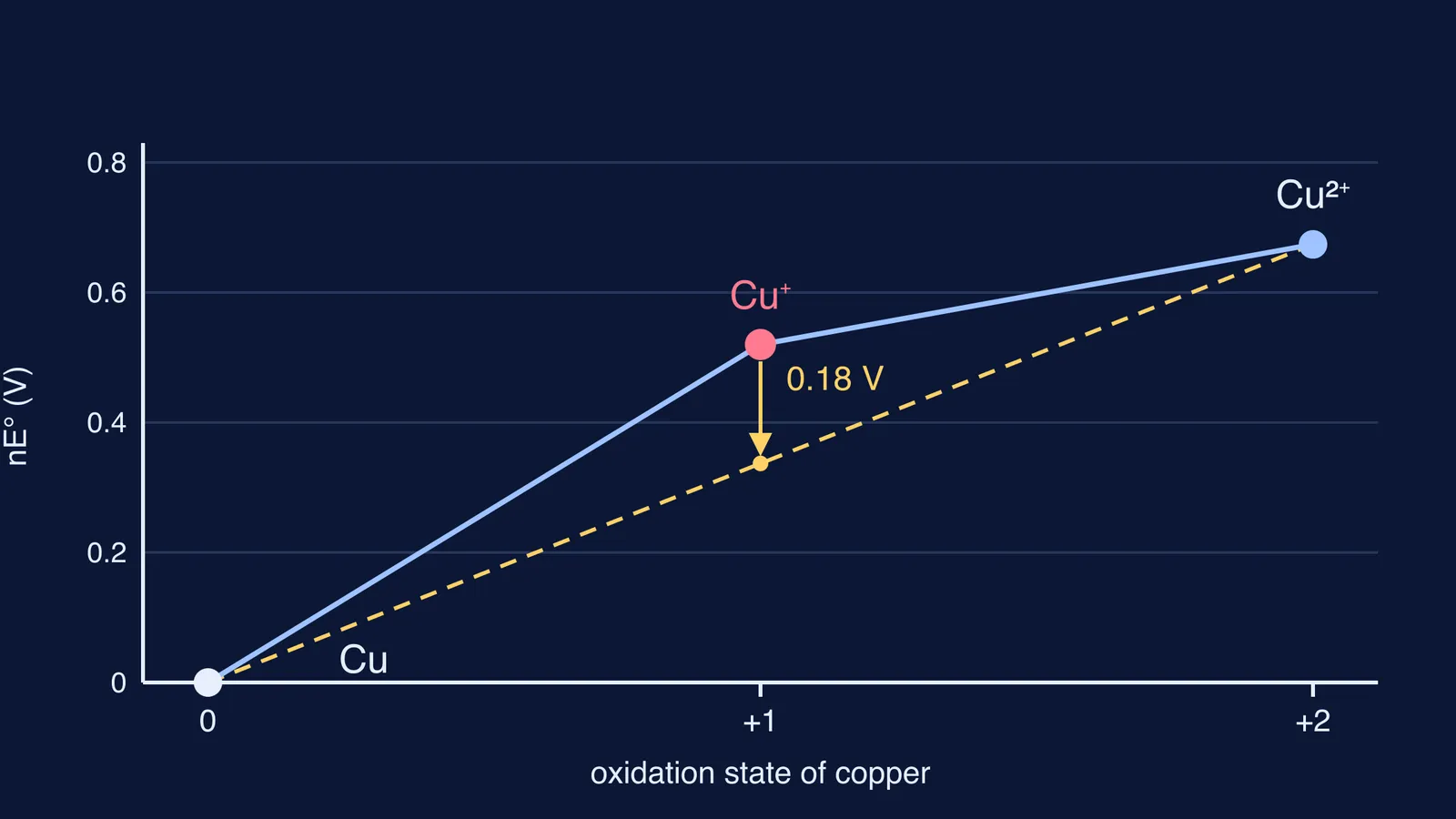
Cu⁺ + e⁻ → Cu, E° = +0.52 V
Cu²⁺ + e⁻ → Cu⁺, E° = +0.159 V
Now work it through.
Split the reaction into two halves. Reduction: Cu⁺ + e⁻ → Cu. Oxidation: Cu⁺ → Cu²⁺ + e⁻. One electron moves, so n = 1.
E°cell = E°(reduction) − E°(couple being oxidised) = 0.52 − 0.159 = +0.361 V.
ΔG° = −nFE°. With the Faraday constant F = 96,485 C/mol (NIST CODATA), ΔG° = −1 × 96,485 × 0.361 ≈ −34.8 kJ/mol.
K = e^(−ΔG°/RT). With R = 8.314 J/(mol K) (NIST CODATA) and T = 298.15 K, −ΔG°/RT ≈ 14.05, so K ≈ 1.3 × 10⁶.
Read the answer: K = [Cu²⁺]/[Cu⁺]² ≈ 1.3 × 10⁶. If the solution ends up with 0.1 mol/L of Cu²⁺, only about 2.8 × 10⁻⁴ mol/L of Cu⁺ can remain.
A positive E°, a negative ΔG° and a K far above 1 all say the reaction goes. Our post on getting ΔG° and K from cell EMF walks through the general method, and Latimer diagrams for predicting disproportionation give you a shortcut: if the potential to the right of an ion is higher than the one to its left, that ion disproportionates. For Cu⁺, 0.52 V is greater than 0.159 V.
If the n in step 3 is where you slip, the Fermi Problem Library has worked problems with a step-by-step solver that explains the reasoning rather than printing an answer.
Why is Cu²⁺ more stable than Cu⁺ in water if Cu⁺ is 3d¹⁰?
This is the part that confuses students. Cu⁺ has a full 3d¹⁰ shell, which sounds stable, and removing a second electron from copper is expensive. The table of molar ionisation energies lists 745.5 kJ/mol for copper's first electron and 1957.9 kJ/mol for the second.
In the gas phase, that cost wins and Cu⁺ is the comfortable ion. Water changes the accounts. When a gaseous ion meets water, the water molecules cluster around it and release energy, called the hydration enthalpy. The LibreTexts hydration enthalpy table/Thermodynamics/Energies_and_Potentials/Enthalpy/Hydration) gives −2100 kJ/mol for Cu²⁺.
A +1 ion is hydrated far less strongly: the same course table lists Na⁺ at −406 kJ/mol, because a small, doubly charged ion pulls on water dipoles much harder than a singly charged one. "2100 beats 1958" is only a shorthand: the starting Cu⁺ ions were hydrated too, and one copper ends up as metal, so large terms nearly cancel. The much stronger hydration of Cu²⁺ is what tips the total below zero, and the E° values above are that balance written in volts. Our post on why hydration enthalpies of 3d ions show a double hump shows where Cu²⁺ sits among its neighbours.
When does Cu⁺ survive?
Take away the water and the argument changes. LibreTexts/04%3A_Biological_and_Synthetic_Dioxygen_Carriers/4.06%3A_General_Aspects_of_the_Chemistry_of_Copper) notes that Cu⁺ can be stabilised by ligands, especially sulphur-containing ones, inside a protein, or in non-aqueous solvents such as acetonitrile when oxygen is kept out. Insoluble copper(I) compounds also escape, because the ion is locked in a solid rather than hydrated. That is why your textbook can list stable Cu₂O and CuI while saying Cu⁺(aq) is unstable.
How to write this answer in an exam
Use this checklist for a three- or five-mark answer:
Write the balanced equation with states: 2Cu⁺(aq) → Cu²⁺(aq) + Cu(s).
Quote the two E° values from the standard electrode potential table) and show E° = +0.36 V is positive.
Convert to ΔG° (about −35 kJ/mol) if marks allow.
Give the reason: Cu²⁺ is hydrated much more strongly than Cu⁺ (about −2100 kJ/mol for Cu²⁺/Thermodynamics/Energies_and_Potentials/Enthalpy/Hydration)), which more than compensates for the second ionisation energy (about 1958 kJ/mol).
Add the exception: Cu⁺ is stable in insoluble solids or with suitable ligands.
If hydration enthalpy or electrode potential still feels shaky, the Fermi Concept Library has every concept in chemistry, each with its own lesson and its place in the map, so you can fix the idea before the next problem set.