

On this page
What is a Latimer diagram?
In inorganic chemistry, tracking redox transformations across multiple oxidation states can quickly become overwhelming. A Latimer diagram solves this by condensing standard electrode potential data into a compact linear chain. Named after American chemist Wendell Mitchell Latimer, the diagram arranges chemical species of an element from left to right in order of decreasing oxidation state. Horizontal arrows connect adjacent species, with the standard reduction potential (E°) in volts written directly above each arrow for that half-reaction under standard conditions (such as pH 0 with 1 M H⁺). The IUPAC Gold Book defines disproportionation as any reaction where a substance reacts to form separate products in higher and lower oxidation states. Reviewing assigning oxidation numbers from chemical structure helps ensure species are properly ordered before checking potentials.
By organizing these sequential redox couples, a Latimer diagram lets you determine whether an intermediate species will spontaneously disproportionate in a fraction of a second.
Why does a species disproportionate when E°_right > E°_left?
Consider an intermediate species B flanked by species A on the left and C on the right: A → B → C. Species A has a higher oxidation state than B, while C has a lower oxidation state. The reduction potential to the left is E°_left (for reducing A to B), and the potential to the right is E°_right (for reducing B to C).
When B disproportionates, one portion of B is reduced to C (cathode, potential E°_right) while another is oxidized to A (anode, potential −E°_left). The standard cell potential for the disproportionation reaction is:
E°_cell = E°_cathode − E°_anode = E°_right − E°_left
A redox process is thermodynamically spontaneous when its standard Gibbs energy change is negative (ΔG° < 0). As analyzed in redox curriculum research in the World Journal of Chemical Education, the relation ΔG° = −nFE°_cell ensures that ΔG° is negative whenever E°_cell is positive. Therefore, disproportionation is spontaneous if:
E°_right > E°_left
When multi-step redox chains feel difficult to balance under exam pressure, the Fermi Problem Library provides worked problems with a step-by-step solver that explains the reasoning rather than printing an answer.
How do you calculate non-adjacent standard potentials?
A frequent pitfall in competitive exams like JEE Advanced is adding reduction potentials directly across multiple steps. Standard potentials are intensive properties and cannot be summed. However, Gibbs free energy is extensive and additive.
In a classic 1951 paper in the Journal of the American Chemical Society, Arthur A. Frost demonstrated that multi-step potentials must be calculated by summing intermediate free energies (ΔG° = −nFE°). For two sequential steps with electron transfers n₁ and n₂:
E°_total = (n₁ E°₁ + n₂ E°₂) / (n₁ + n₂)
To find the potential across any skipped step, take the electron-weighted average of the intermediate potentials. For additional practice with these conversions, see our guide on converting cell EMF to Gibbs energy and equilibrium constants.
Worked examples: how to test Cu⁺, H₂O₂ and Mn intermediate states?
To apply the rule during exam problem-solving:
Locate the intermediate species and read E°_left and E°_right.
Check if E°_right > E°_left. If true, the species spontaneously disproportionates.
Calculate E°_cell = E°_right − E°_left to verify the driving force.
As compiled in the World Journal of Chemical Education, standard reduction potentials illustrate how this test functions across three classic systems:
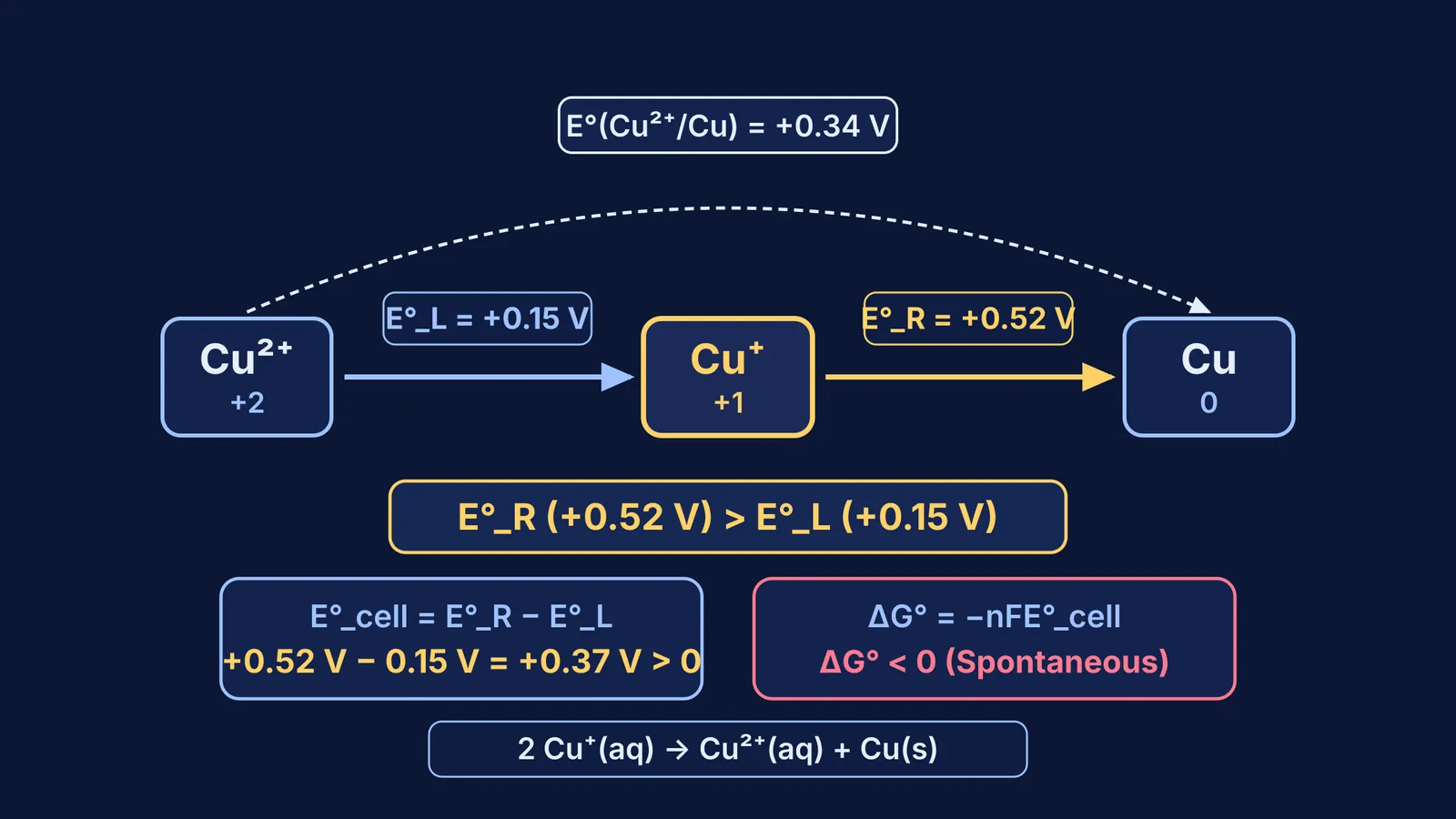
Copper in acid: Cu²⁺ (+0.15 V) → Cu⁺ (+0.52 V) → Cu. For Cu⁺, E°_right (+0.52 V) > E°_left (+0.15 V). Thus, aqueous Cu⁺ spontaneously disproportionates: 2 Cu⁺(aq) → Cu²⁺(aq) + Cu(s), with E°_cell = +0.37 V. Using the weighted average formula, the overall potential for Cu²⁺ to Cu (n = 2) is (1 × 0.15 V + 1 × 0.52 V) / 2 = +0.34 V, matching data for standard electrode potentials of 3d transition metals.
Hydrogen peroxide in acid: O₂ (+0.70 V) → H₂O₂ (+1.76 V) → H₂O. For H₂O₂, E°_right (+1.76 V) > E°_left (+0.70 V). Disproportionation is spontaneous: 2 H₂O₂(aq) → 2 H₂O(l) + O₂(g), with E°_cell = +1.06 V. As noted by chemical educators in the Journal of Chemical Education, pure solutions decompose slowly without catalysts due to a large activation barrier.
Manganese in acid: MnO₄⁻ (+0.56 V) → MnO₄²⁻ (+2.26 V) → MnO₂ (+0.95 V) → Mn³⁺ (+1.51 V) → Mn²⁺. For MnO₄²⁻ (+6), +2.26 V > +0.56 V, so it rapidly disproportionates to MnO₄⁻ and MnO₂. Conversely, for MnO₂ (+4), E°_right (+0.95 V) < E°_left (+2.26 V), making MnO₂ stable against disproportionation. For Mn³⁺ (+3), +1.51 V > +0.95 V, so Mn³⁺ disproportionates to MnO₂ and Mn²⁺.
If you are reviewing redox couples across different reaction conditions, the Fermi Concept Library covers every concept in chemistry, each with its own lesson and its place in the map.