

On this page
When India transitioned to the Bharat Stage VI (BS-VI) emission norms on April 1, 2020, the country leaped past an entire generation of fuel standards, according to the Press Information Bureau. The headline change was the dramatic reduction of sulphur in both petrol and diesel. By skipping the BS-V stage entirely, regulators aimed to rapidly clean up urban air and bring Indian vehicular emissions in line with the strictest global standards.
What changed with BS6 fuel and why low sulphur matters?
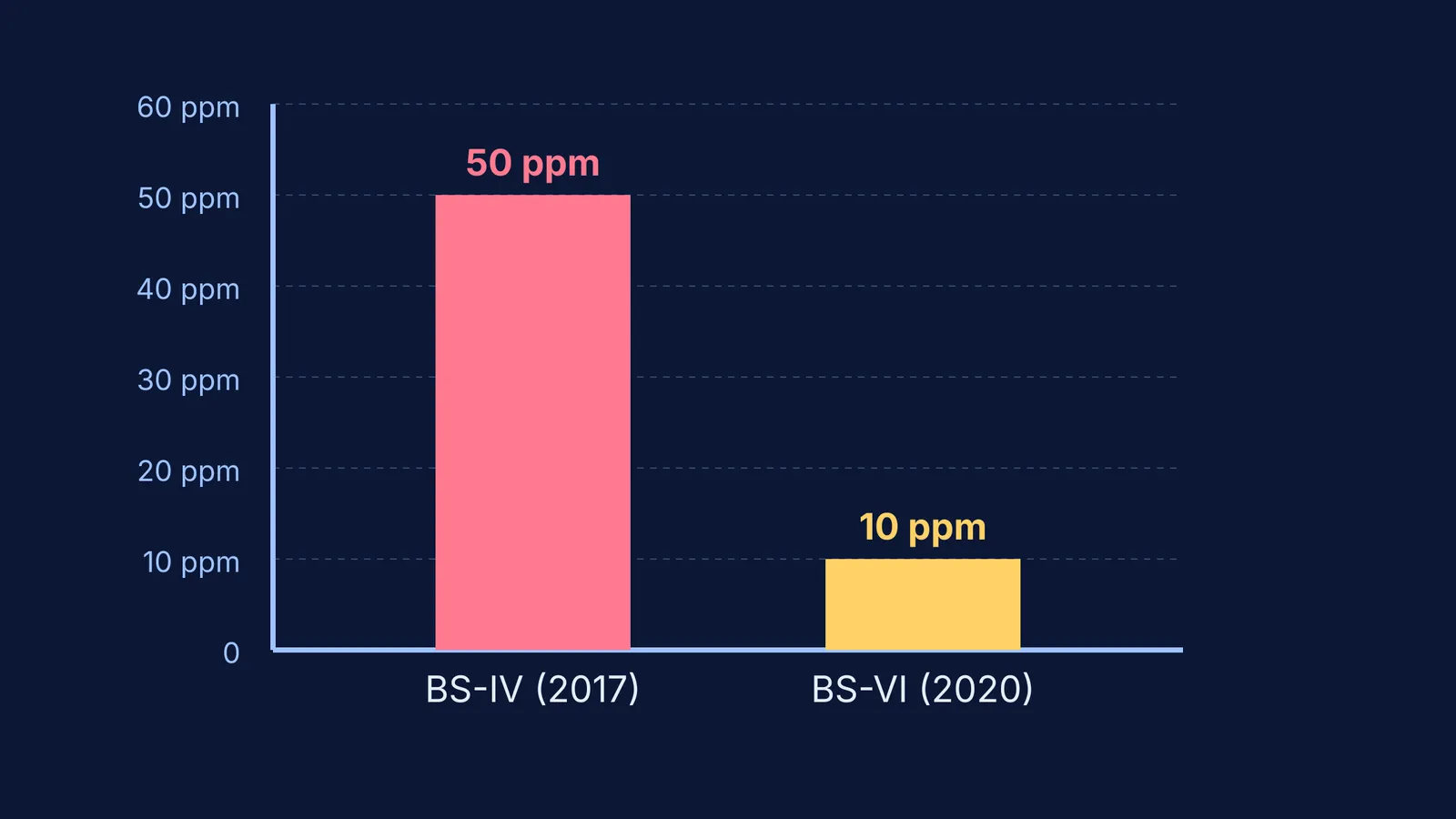
The defining feature of BS-VI fuel is its ultra-low sulphur limit. Under the BS-VI standard, fuel contains a maximum of 10 parts per million (ppm) of sulphur, as mandated by the government. This represents a staggering 80% drop from the older BS-IV fuels, which permitted up to 50 ppm of sulphur prior to the transition.
Why does this single element matter so much? Sulphur naturally occurs in crude oil, and when it burns inside an internal combustion engine, it oxidises to form sulphur dioxide (SO₂). In an engine, SO₂ acts as a poison to the delicate exhaust after-treatment systems. Reducing the sulphur to 10 ppm ensures that the advanced filters and catalysts inside modern vehicles continue to work effectively for years, rather than failing prematurely from chemical blockages. Because of this cleaner fuel, BS-VI diesel engines emit 80% less particulate matter (PM) and 70% less nitrogen oxides (NOx) than their predecessors based on official estimates.
Understanding how sulphur behaves is a core part of industrial chemistry. For instance, the oxidation of SO₂ is also the crucial and carefully controlled step in the Contact process for sulphuric acid.
Why is sulphur bad for car engine catalysts?
Modern vehicles rely on highly engineered components like the Diesel Particulate Filter (DPF) and the Selective Catalytic Reduction (SCR) system to scrub exhaust gases before they leave the tailpipe. These devices are coated with precious metals like platinum, palladium, and rhodium, which act as catalysts to speed up the breakdown of toxic gases.
Sulphur dioxide physically blocks the active sites on these precious metals. When the active sites are covered by sulphur, the catalyst cannot bind to and convert harmful carbon monoxide (CO) and unburnt hydrocarbons into harmless carbon dioxide and water. This phenomenon is known as catalyst poisoning. Short-term exposure to high-sulphur fuel can temporarily blind the system, but continuous exposure to fuel with more than 10 ppm of sulphur leads to permanent thermal degradation of the entire exhaust structure.
For students studying chemistry, visualising how molecules compete for active sites on a catalyst is often challenging. If you want to see exactly how gases flow and bind, the Fermi Simulation Lab provides interactive simulations for the ideas that are easier to see than to read, letting you observe these microscopic interactions in real time.
How does low sulphur fuel prevent acid rain?
Sulphur dioxide is not just an engine killer; it is a primary driver of widespread environmental damage. When SO₂ escapes from the tailpipe and enters the atmosphere, it reacts with water vapour, oxygen, and other atmospheric chemicals to form sulphuric acid (H₂SO₄).
This highly acidic mixture eventually falls back to the ground as acid rain. Acid rain lowers the pH of soils and lakes, which strips away essential plant nutrients and destroys fragile aquatic ecosystems. Historically, the damage to rivers from industrial pollution has been profound, a problem tracked closely by early ecologists like Ruth Patrick and her work on diatoms as indicators of river health. By firmly capping the fuel sulphur limit at 10 ppm, the BS-VI standard drastically cuts the volume of SO₂ entering the sky, directly reducing the frequency and severity of acid rain over major cities.
How to make sure you master emission chemistry?
When preparing for competitive exams, pollution and environmental chemistry are high-yield topics that require precision. Here is a practical checklist to structure your revision around the chemistry of emissions:
Map the primary pollutants: Write down the major tailpipe emissions (CO, NOx, SO₂, and unburnt hydrocarbons) and classify their specific sources.
Memorise the exact limits: The BS-VI fuel sulphur limit is strictly capped at 10 ppm by national regulations. Hard facts and numbers like this frequently appear as direct multiple-choice questions.
Track the atmospheric reactions: Practice writing out the balanced chemical equations for how SO₂ turns into H₂SO₄ in the atmosphere, tracking the oxidation states of sulphur along the way.
Learn the catalyst metals: Know the specific roles of platinum, palladium, and rhodium in a three-way catalytic converter, and understand the definition of catalyst poisoning.
Connect chemistry to biology: Review how acid rain affects plant nutrients and aquatic life, paying attention to the specific pH thresholds that cause biological stress.
Connecting these dots turns a list of disconnected facts into a clear, logical system that is much easier to recall on test day. If you find yourself struggling to link these environmental chemistry concepts, Fermi's AI tutor can work out what you already know and build a plan for the session, guiding you through the equations step by step.


